Michigan driving lesson · Railroad Crossings and Parking
Disability parking
A 2-minute lesson from the Michigan course. Read the rules and examples, follow the handbook page references, and check your understanding before you move on.
Disability parking spaces are reserved for people who need them, and not every disability is visible. The rules cover who may park there, when free parking applies, and why the striped area must stay clear.
Know the rule
Disability spaces are reserved for people with disabilities. Disabilities aren't always apparent — someone without a cane or wheelchair isn't necessarily abusing the privilege.
Free parking is only for vehicles displaying a disability placard with a yellow free-parking sticker. Requirements for the sticker are narrower than for a disability plate or placard.
Blindness, or any condition that significantly limits walking or requires a wheelchair, walker, crutch or other assistive device. It may be temporary or permanent.
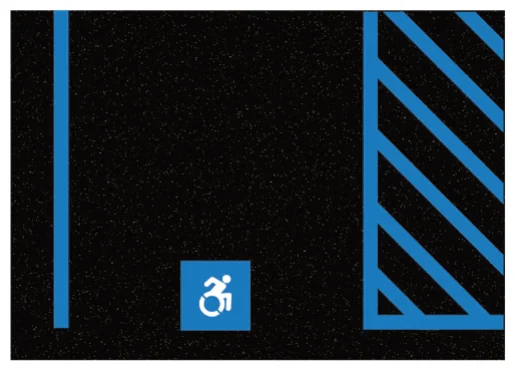
Van-accessible space: never park on the blue-striped area
Put it into practice
You're using your mother's placard while running errands alone. You may not park in a disability space — the person with the disability must be with you and going inside.
Check your understanding
Read the question, decide on an answer, then open it to check the explanation. These are Roadwise study questions based on the source handbook.
What must a vehicle display to park for free in a disability parking space?
A doctor's note on the dashboard
A disability placard with a yellow free-parking sticker
Only a disability placard
A disability license plate only
Answer: A disability placard with a yellow free-parking sticker
Free parking in a disability space is provided only to vehicles displaying a placard with a yellow free-parking sticker.