roadwise.Open study app

Michigan driving lesson · Signs, Signals, and Pavement Markings

Traffic lights and the doghouse signal

A 3-minute lesson from the Michigan course. Read the rules and examples, follow the handbook page references, and check your understanding before you move on.

Read time
3 minutes
Course unit
Signs, Signals, and Pavement Markings
Checkpoint questions
6
Source pages
63, 64

Signal colors seem simple, but the test checks the details: what to do on yellow when you can't stop, how a green arrow differs from a green ball, and what flashing lights mean.

Know the rule

It is illegal to cut across public or private property, such as a store parking lot, to avoid a traffic-control device.

Handbook p. 63 ↗

Steady signal lights

Steady signal lights
LightMeaning
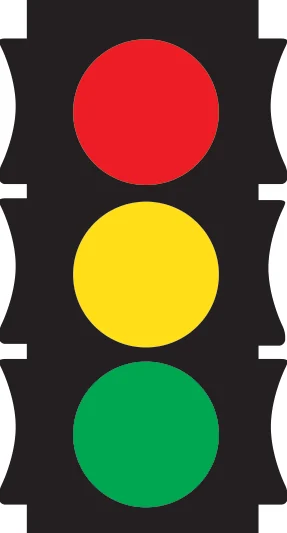
Red (top of the signal)Stop behind the crosswalk or stop line
YellowAbout to turn red: stop; if you can't safely, go carefully
GreenProceed with caution after checking for pedestrians
Handbook p. 63 ↗
Traffic signal (red, yellow, green)
Standard signal: red on top, then yellow, then green

Know the rule

On yellow, if you can't stop safely, don't speed up — drive cautiously through the intersection.

Handbook p. 63 ↗

Know the rule

If a signal isn't working and no officer or other device controls traffic, come to a complete stop and yield to vehicles already there. If you arrive together, yield to the vehicle on your right.

Handbook p. 63 ↗

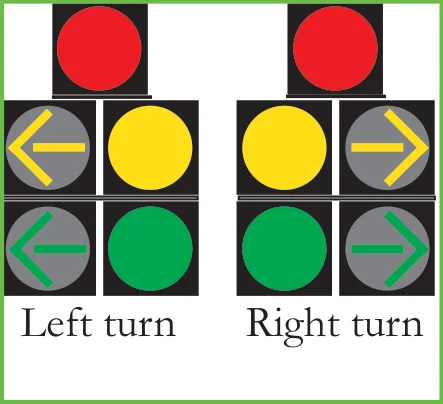
5-section-head ("doghouse") signal

Controls left or right turns with red, yellow and green lights plus a yellow and a green turn arrow.

Handbook p. 63 ↗
Protected turn arrow signals (left and right)
5-section-head signals for left and right turns

Know the rule

Green arrow = a protected turn: all oncoming or conflicting traffic is stopped. Green light = you may turn once oncoming traffic clears.

Handbook p. 63 ↗

Know the rule

When the yellow light or yellow arrow shows, stop if you haven't entered the intersection. If you're already in it, complete your turn with caution once traffic is clear.

Handbook p. 64 ↗

Know the rule

On red, come to a complete stop. Check for cross traffic and pedestrians before going on green or turning right on red.

Handbook p. 64 ↗

Flashing lights and arrows

Flashing lights and arrows
SignalMeaning
Flashing redFull stop; go when the road is clear
Flashing yellowProceed carefully; scan both directions
Steady green arrowOncoming stopped; go in the arrow's direction
Handbook p. 64 ↗

Know the rule

With a steady green arrow, still yield the right of way to pedestrians in the intersection.

Handbook p. 64 ↗
Steady red light
Flashing red: stop, then go when clear
Steady yellow light
Flashing yellow: proceed with caution

Put it into practice

Your light turns yellow just as you reach the stop line, and a truck is right behind you. Stopping is required on yellow, but if you truly can't stop safely, don't speed up — continue through cautiously.

Check your understanding

Read the question, decide on an answer, then open it to check the explanation. These are Roadwise study questions based on the source handbook.

What does a red traffic light mean, and where is it positioned in Michigan?
  1. Stop; it's at the top of the signal
  2. Caution; middle of the signal
  3. Stop; it's at the bottom of the signal
  4. Proceed; top of the signal

Answer: Stop; it's at the top of the signal

Red means stop and is positioned at the top of a traffic signal in Michigan.
Handbook p. 63 ↗
You approach a yellow light and cannot stop safely. What should you do?
  1. Stop abruptly regardless of following traffic
  2. Accelerate hard to clear the intersection before it turns red
  3. Swerve into the turn lane to avoid stopping
  4. Drive cautiously through without speeding up

Answer: Drive cautiously through without speeding up

If you can't stop safely on yellow, don't speed up — drive cautiously through the intersection.

Handbook p. 63 ↗
At a completely dead traffic signal with no officer present, what must you do?
  1. Only slow down, no full stop needed
  2. Proceed as if it were green
  3. Wait for a police officer to arrive first
  4. Come to a complete stop and yield to vehicles already there

Answer: Come to a complete stop and yield to vehicles already there

At a malfunctioning signal, come to a complete stop and yield to vehicles already at the intersection.

Handbook p. 63 ↗
On a 5-section "doghouse" signal, what does a green arrow mean for a turning driver?
  1. The signal is malfunctioning
  2. A protected turn — all conflicting traffic is stopped
  3. Proceed only if no pedestrians are near
  4. Yield to all oncoming traffic first

Answer: A protected turn — all conflicting traffic is stopped

A green arrow on a 5-section signal gives a protected turn, meaning all oncoming or conflicting traffic is stopped.

Handbook p. 63 ↗
On the same 5-section signal, what does a plain green light (not an arrow) mean for a turning driver?
  1. You must turn immediately
  2. You may turn once oncoming traffic has cleared
  3. You have a fully protected turn
  4. You must wait for the arrow

Answer: You may turn once oncoming traffic has cleared

A green light (not an arrow) means you may complete your turn once oncoming traffic has cleared.

Handbook p. 63 ↗
What does a flashing red light mean?
  1. The signal is broken, treat it as green
  2. Proceed with caution, no stop needed
  3. Stop fully, then go when clear
  4. Yield only, don't stop

Answer: Stop fully, then go when clear

A flashing red light means come to a full stop and proceed once the road is clear.

Handbook p. 64 ↗
Take the lesson checkpoint in the app

More in Signs, Signals, and Pavement Markings