roadwise.Open study app

Michigan driving lesson · Signs, Signals, and Pavement Markings

White pavement markings

A 3-minute lesson from the Michigan course. Read the rules and examples, follow the handbook page references, and check your understanding before you move on.

Read time
3 minutes
Course unit
Signs, Signals, and Pavement Markings
Checkpoint questions
6
Source pages
59, 60, 61

Pavement markings are white or yellow and warn, regulate and inform. White lines separate lanes moving in the same direction; yellow lines separate opposite directions.

Know the rule

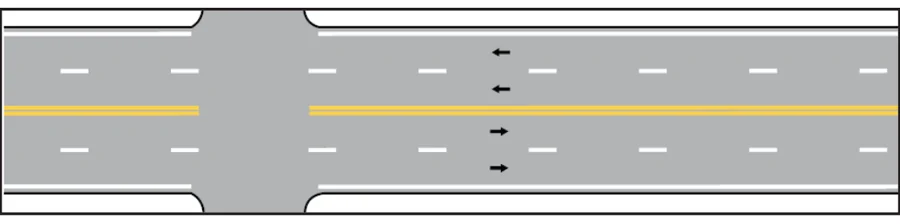
On roads with more than one lane in one direction, broken white lines separate the lanes. Don't straddle them.

Handbook p. 59 ↗
Passing lane pavement markings
Figure 5.1: Broken white lines separate same-direction lanes

Know the rule

Solid white lines (fog lines) mark the right edge of the road. They also separate same-direction lanes where lane changes are dangerous — sharp curves, freeway acceleration and deceleration lanes. Don't cross them; crossing to pass is illegal.

Handbook p. 60 ↗

Know the rule

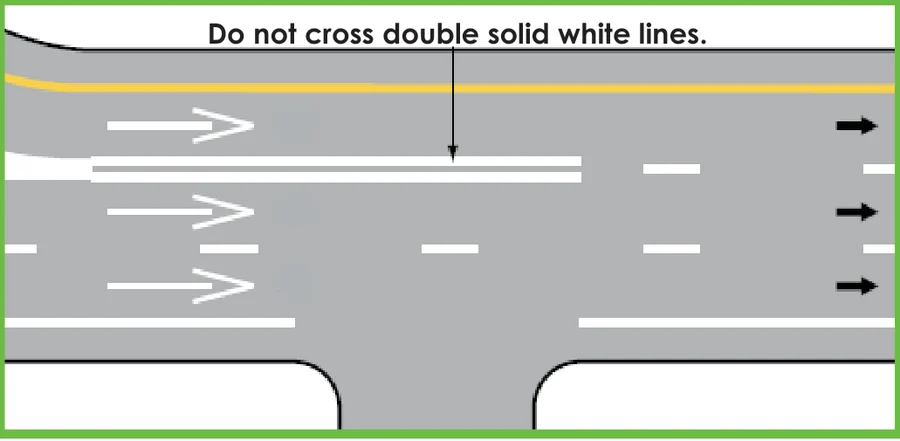
A double solid white line marks a travel path with same-direction traffic on both sides where crossing is prohibited.

Handbook p. 60 ↗
Double solid white lines (lane restriction)
Figure 5.3: Do not cross double solid white lines

Know the rule

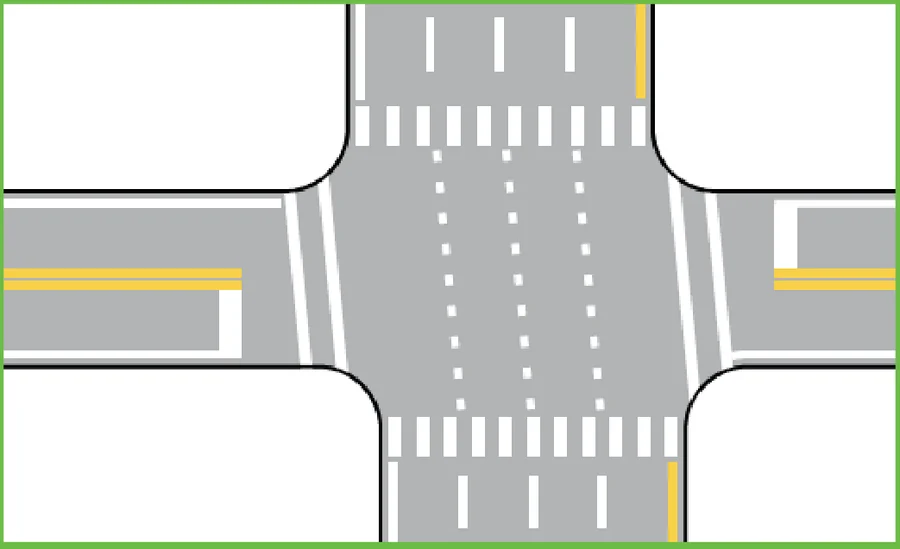
Crosswalks are marked by solid white lines across the pavement or white stripes in the direction of traffic, at intersections and sometimes between them. Stop behind the crosswalk line.

Handbook p. 60 ↗

Know the rule

Stop lines are wide white lines across a lane showing where to stop. With no stop line or crosswalk, stop before entering the intersection. Either way, make sure you can see traffic from all directions.

Handbook p. 60 ↗
Intersection pavement markings (turn lanes)
Figure 5.4: Crosswalks and stop lines

Know the rule

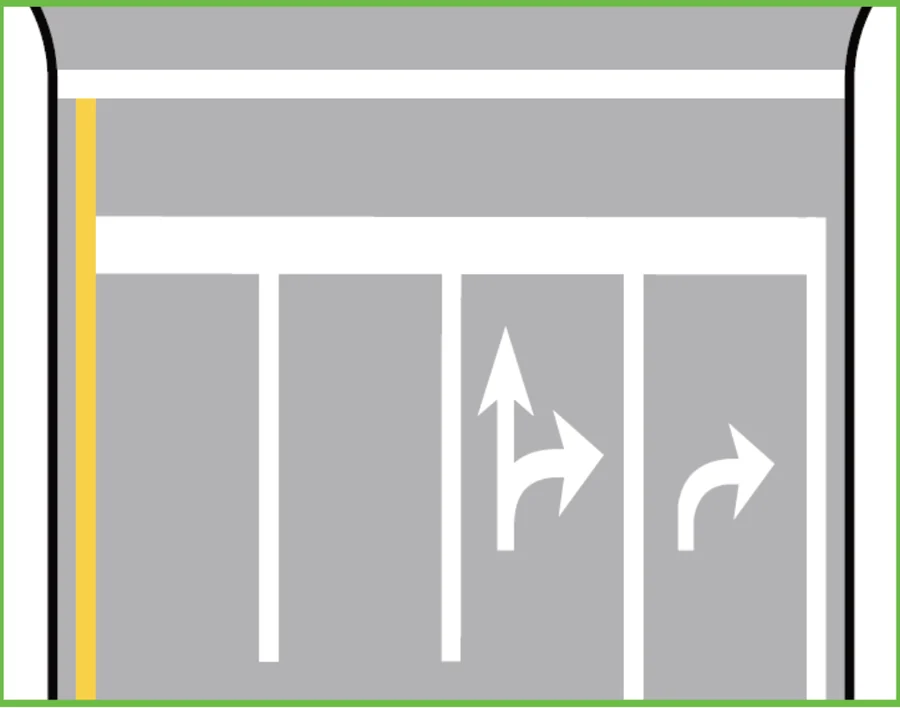
Wide white arrows show lane use. In Figure 5.5, the far-right lane is right turn only and the next lane is right or straight; right turns from the other two lanes are illegal.

Handbook p. 61 ↗
Lane use arrows (multi-lane)
Figure 5.5: Directional arrows

Know the rule

Bicycle lanes are reserved exclusively for bicyclists. Green paint marks conflict points like intersections and driveways. It's illegal to use a bike lane to drive, pass, turn right, park, wait for someone or make a delivery.

Handbook p. 61 ↗

Know the rule

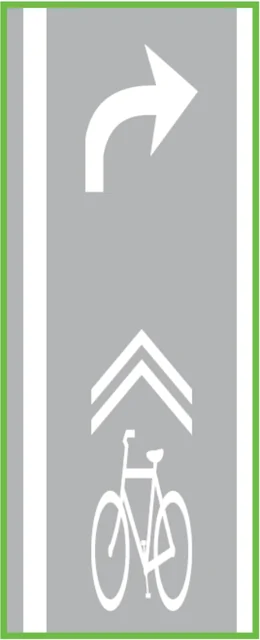
Shared lane markings show proper lane position and flow. When you see one, watch for bicyclists and give them space.

Handbook p. 61 ↗
Shared lane marking (sharrow)
Shared lane marking: bicycle symbol with chevrons

Put it into practice

A solid white line separates your lane from the freeway acceleration lane beside you. Stay in your lane — solid white means lane changes there are considered dangerous.

Check your understanding

Read the question, decide on an answer, then open it to check the explanation. These are Roadwise study questions based on the source handbook.

What do broken white lines on a multi-lane road indicate?
  1. They separate opposing traffic
  2. They separate lanes moving the same direction
  3. They mark the road's right edge
  4. They mark a lane you may never leave

Answer: They separate lanes moving the same direction

On roads with more than one lane moving in one direction, broken white lines separate the traffic lanes.
Handbook p. 59 ↗
What is another common name for the solid white line marking the right edge of the road?
  1. Gore line
  2. Fog line
  3. Center line
  4. Stop line

Answer: Fog line

Solid white edge lines are often called fog lines and help you stay on the road at night or in bad weather.

Handbook p. 60 ↗
Is it legal to cross a solid white line to pass another vehicle?
  1. No, it's illegal when passing
  2. Yes, only on a two-lane road
  3. Yes, if no other cars are close
  4. Yes, if signaled first

Answer: No, it's illegal when passing

It is illegal to cross solid white lines when passing.

Handbook p. 60 ↗
What does a double solid white line indicate?
  1. Same direction; crossing prohibited
  2. Opposite-direction traffic separation
  3. A passing zone
  4. A bike lane boundary

Answer: Same direction; crossing prohibited

Double solid white lines show a travel path where driving is permitted on both sides, but crossing the line is prohibited.

Handbook p. 60 ↗
Where should you stop your vehicle relative to a painted stop line?
  1. Directly on top of it
  2. Past the stop line, into the crosswalk
  3. Even with the stop sign post
  4. Behind the stop line

Answer: Behind the stop line

Stop lines mark where you must stop your vehicle, so you stop behind them.

Handbook p. 60 ↗
Is it legal to drive in a bicycle lane to make a right turn from it?
  1. No, it's illegal
  2. Yes, if you signal first
  3. Yes, within 100 feet of the turn
  4. Yes, if a bicyclist isn't present

Answer: No, it's illegal

It's illegal to use a bicycle lane for driving, passing, making right turns, parking, or waiting.

Handbook p. 61 ↗
Take the lesson checkpoint in the app

More in Signs, Signals, and Pavement Markings