roadwise.Open study app

Michigan driving lesson · Signs, Signals, and Pavement Markings

Flashing yellow arrows, pedestrian signals and HAWK beacons

A 3-minute lesson from the Michigan course. Read the rules and examples, follow the handbook page references, and check your understanding before you move on.

Read time
3 minutes
Course unit
Signs, Signals, and Pavement Markings
Checkpoint questions
6
Source pages
64, 65

Newer signals help traffic move while protecting pedestrians. The flashing yellow arrow lets you turn left with care, and pedestrian signals and hybrid beacons tell you when people are crossing.

Know the rule

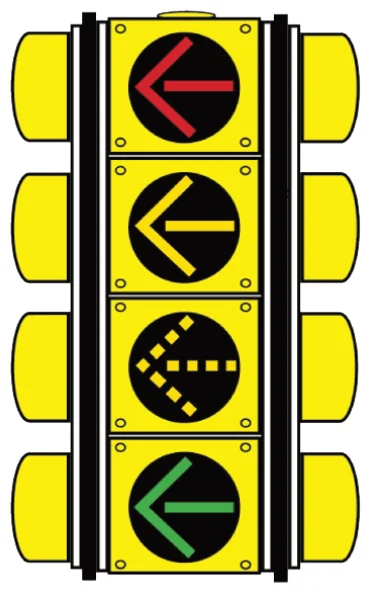
Federal Highway Administration research shows the flashing yellow arrow setup moves traffic more efficiently and reduces crashes. The signal head uses four separate lenses.

Handbook p. 64 ↗
Flashing yellow arrow signal head
Flashing yellow arrow left-turn signal head

Flashing yellow arrow signal head

Flashing yellow arrow signal head
ArrowWhat you do
Solid red arrowStop; don't turn until the signal changes
Solid yellow arrowAbout to turn red: stop if approaching
Flashing yellow arrowTurn left when oncoming traffic (on green) clears
Solid green arrowOncoming traffic stopped; turn left with care
Handbook p. 64 ↗

Know the rule

On a solid yellow arrow, if you're already in the intersection and there's no conflicting traffic, you may complete your left turn.

Handbook p. 64 ↗

Know the rule

On a flashing yellow arrow, wait for an adequate gap and make sure no pedestrians or bicyclists are crossing. On a solid green arrow, still yield to people in the crosswalk.

Handbook p. 64 ↗

Know the rule

Where cameras or in-pavement sensors detect vehicles, the green-arrow phase may be skipped when no left-turning vehicles are present.

Handbook p. 64 ↗

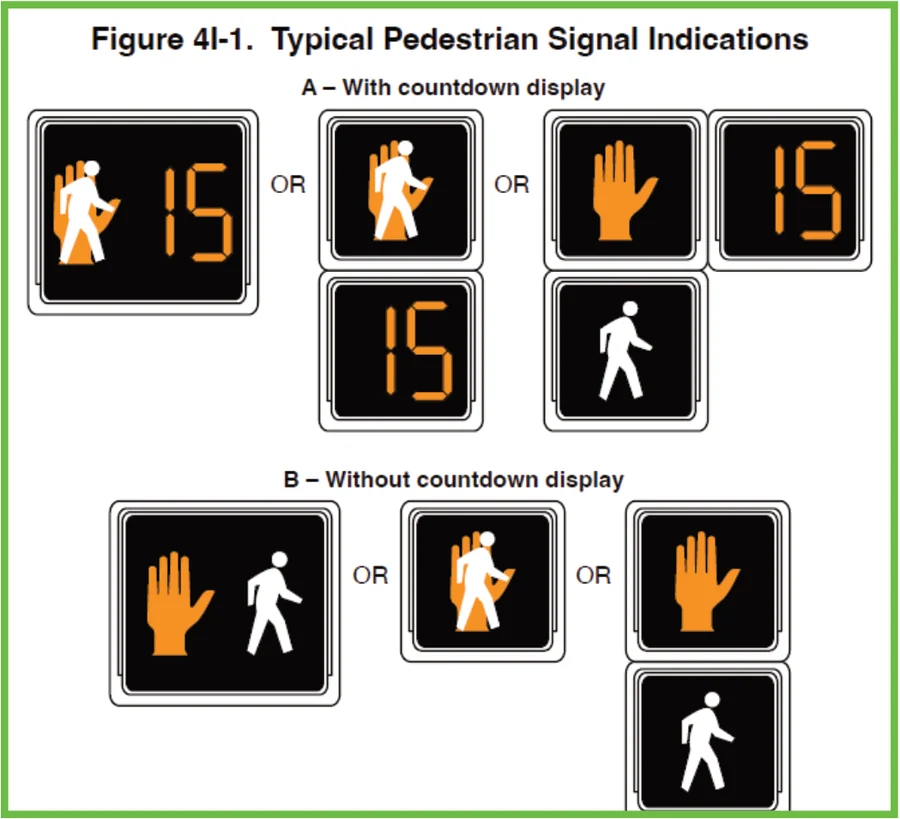
Pedestrian signals:

  • WALK or white walking person: traffic must yield; pedestrians may cross
  • Flashing: crossing time is ending; people already crossing should finish
  • DONT WALK or red upraised hand: do not cross
  • Some signals show audible or visual countdowns
  • Drivers must always yield to pedestrians
Handbook p. 64 ↗
Pedestrian signal indications reference chart
Figure 5.11: Pedestrian signal indications

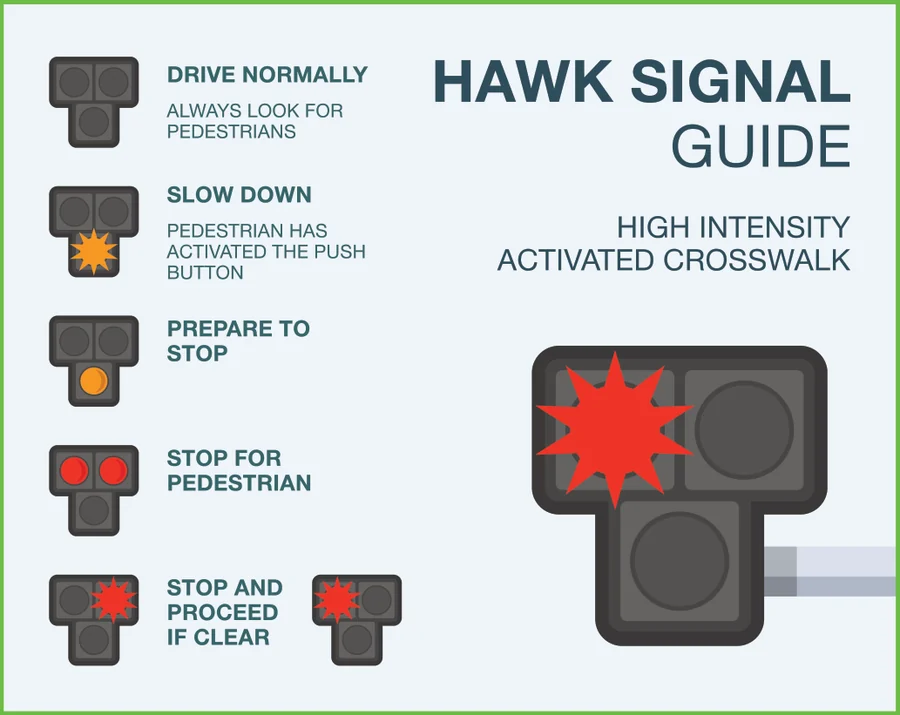
Pedestrian Hybrid Beacon (HAWK)

A crossing device that alerts drivers to pedestrians. Its signal sequence has six steps.

Handbook p. 65 ↗

The handbook's HAWK signal guide:

  • Dark: drive normally, always look for pedestrians
  • Flashing yellow: slow down — a pedestrian has pushed the button
  • Steady yellow: prepare to stop
  • Two steady reds: stop for the pedestrian
  • Alternating flashing reds: stop, then proceed if clear
Handbook p. 65 ↗
Pedestrian Hybrid Beacon (HAWK) signal guide
Figure 5.12: The Pedestrian Hybrid Beacon

Put it into practice

You're waiting to turn left on a flashing yellow arrow. Oncoming cars have a green light. Turn only when there's a safe gap in their traffic and no one is in the crosswalk you're turning across.

Check your understanding

Read the question, decide on an answer, then open it to check the explanation. These are Roadwise study questions based on the source handbook.

On a flashing-yellow-arrow left-turn signal head, what does the solid red arrow mean?
  1. You may turn if clear
  2. Proceed with caution
  3. It's the same as a flashing yellow arrow
  4. Stop; don't turn until it changes

Answer: Stop; don't turn until it changes

A solid red arrow means you must stop and cannot turn until the signal changes.
Handbook p. 64 ↗
On the same signal head, what does the flashing yellow arrow allow?
  1. Stop and wait for the green arrow
  2. A protected turn; oncoming traffic is stopped
  3. Turn left when oncoming traffic clears
  4. Turn left only after a full stop

Answer: Turn left when oncoming traffic clears

A flashing yellow arrow allows you to turn left once there's an adequate gap in the oncoming traffic, which has a green light.

Handbook p. 64 ↗
On the same signal head, what does a solid green arrow indicate?
  1. You must yield to all oncoming traffic
  2. Oncoming traffic is stopped and you may turn left with caution
  3. The signal is transitioning to red
  4. Oncoming traffic still has a green light

Answer: Oncoming traffic is stopped and you may turn left with caution

A solid green arrow means oncoming traffic is stopped, so you may turn left, but still watch for pedestrians.

Handbook p. 64 ↗
What does a steady "WALK" signal or white walking-person symbol indicate to drivers?
  1. Drivers may proceed if turning right on red
  2. Drivers may proceed regardless of pedestrians
  3. Traffic must yield and pedestrians may cross
  4. The signal is malfunctioning

Answer: Traffic must yield and pedestrians may cross

A steady WALK signal or walking-person symbol means traffic must yield and pedestrians may cross.

Handbook p. 64 ↗
A pedestrian signal begins flashing after showing WALK. What should a pedestrian already in the crosswalk do?
  1. Stop and wait in the middle
  2. Turn back immediately
  3. Complete their crossing
  4. Run back to the curb they started from

Answer: Complete their crossing

When the signal begins flashing, pedestrians already in the crosswalk should complete their crossing.

Handbook p. 64 ↗
What is the purpose of a Pedestrian Hybrid Beacon?
  1. To alert drivers to pedestrians crossing
  2. To time traffic lights for rush hour
  3. To warn of a railroad crossing ahead
  4. To direct commercial truck traffic

Answer: To alert drivers to pedestrians crossing

A Pedestrian Hybrid Beacon is a crossing device that alerts drivers to the presence of pedestrians.

Handbook p. 65 ↗
Take the lesson checkpoint in the app

More in Signs, Signals, and Pavement Markings