A breakdown on a busy road puts you and others at risk. The right steps make you visible, keep you out of traffic, and bring help. Fires, water and tunnels call for their own special steps.
Know the rule
Move your vehicle to the side of the road and stop. Never park on a hill or curve where others can't see you. If you can't get off the pavement, get all passengers out of the vehicle and off the road.
Handbook p. 133 ↗Know the rule
On a highway with a breakdown lane or shoulder, move as far from the travel lane as you can and stay in your vehicle. Don't stand near the travel lane or in the breakdown lane.
Handbook p. 133 ↗Once parked, while still inside:
- Turn on your emergency (hazard) lights; at night, turn on interior lights too
- Locate your safety vest and warning triangles or LED flares
- Put your safety vest on while still inside the vehicle
Setting up safety equipment:
- Decide if it's safe to get out; consider exiting on the side away from traffic
- Tie a white cloth to your antenna or door handle (a red cloth when it's snowing)
- Raise your vehicle's hood
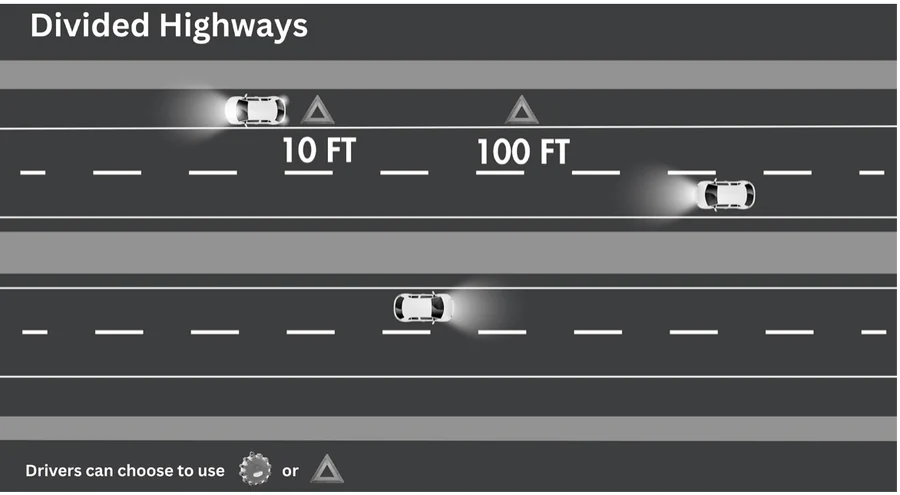
Where to place warning triangles or LED flares
| Road | Placement |
|---|---|
| Divided highway | 10 feet and 100 feet behind |
| Two-lane two-way road or undivided highway | 10 and 100 feet behind, plus 100 feet in front |
Smoke coming from under the hood:
- Pull off the road, turn off the ignition, and move away from the vehicle
- Call the fire department or emergency services
- Don't try to fight the fire unless you have an extinguisher
If your car drives into water:
- Unfasten your safety belt and escape through a window
- With power windows, open them quickly before the water stops them working
- Don't open a door: water rushes in and the vehicle could flip over
- Sinking first? Climb into the rear seat (an air pocket may form); once it settles, breathe deep, exit a window
Crash or disabled vehicle in a tunnel:
- Pull to the side of the road if you can, and activate your hazard lights
- Call 911 and follow instructions
- Stay in your vehicle if it's safe to do so, and wait for emergency personnel
Tunnel rules:
- Turn on your headlights and obey all signs and signals
- Don't enter if you see smoke near the entrance or your car is smoking or burning
- Keep a safe distance, even in slow traffic, and note the emergency exits
- Hazardous materials, including propane, are prohibited
If there's a fire in a tunnel:
- Stop, turn off the engine, and exit your vehicle
- Leave your keys and your belongings in the vehicle
- Call 911 and follow the Fire Department, State Police, MassDOT officials and message signs
- Exit at the nearest tunnel entrance unless directed otherwise
Put it into practice
You break down at night on a two-lane country road. Pull off as far as you can, turn on hazards and interior lights, put on your vest inside, then place triangles 10 and 100 feet behind the car and 100 feet in front.