A 3-minute lesson from the Maryland course. Read the rules and examples, follow the handbook page references, and check your understanding before you move on.
Emergency vehicles with sirens and lights get the road. Large trucks need far more room to turn and stop than you do, so give them space and never squeeze in beside or in front of them.
Know the rule
Police cars, ambulances, fire engines and other emergency vehicles have the right-of-way when using sirens and flashing lights.
Approaching a stopped emergency vehicle, tow truck or other service vehicle, move to a lane not immediately next to it. If you can't, slow to a safe speed and be ready to stop.
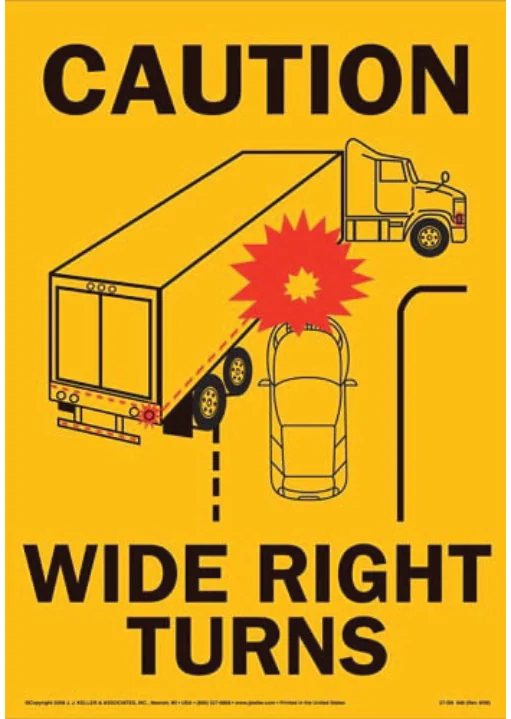
Trucks make wide turns and need more space. For a right turn they often move left first, so don't assume they're changing lanes and try to pass on the right.
If a truck is stopped at or approaching an intersection, never cut in along its right side as it begins to turn. You could be caught between the truck and the curb.
A tractor-trailer ahead drifts left with its right signal on at an intersection. It's setting up a wide right turn. Stay behind it; don't slip into the gap on its right.
Check your understanding
Read the question, decide on an answer, then open it to check the explanation. These are Roadwise study questions based on the source handbook.
When an emergency vehicle approaches with sirens and lights on, what must you do?
Speed up to clear the intersection first
Pull into the nearest intersection and wait
Continue at normal speed but move slightly right
Pull to the road's edge and stop
Answer: Pull to the road's edge and stop
You must move as close as possible to the edge of the road, stay out of intersections, and remain stopped until the emergency vehicle passes.
Fully loaded trucks can weigh more than 80,000 pounds but can stop in about the same distance as a car.
True
False
Answer: False
False. The handbook says fully loaded trucks can weigh more than 80,000 pounds and take the length of a football field to stop, so never cut in front of one.