roadwise.Open study app

Maine driving lesson · Seat Belts, Air Bags and Child Safety

Adjusting your seat and mirrors

A 3-minute lesson from the Maine course. Read the rules and examples, follow the handbook page references, and check your understanding before you move on.

Read time
3 minutes
Course unit
Seat Belts, Air Bags and Child Safety
Checkpoint questions
4
Source pages
39, 40

Before you pull away, set up the car to fit you. The right seat position lets you reach everything and keeps you a safe distance from the air bag; well-set mirrors shrink your blind spots.

Know the rule

Sit straight up with your back against the seat and feet on the floor, close enough to reach the pedals and steering wheel comfortably while leaving room for the air bag to deploy.

Handbook p. 39 ↗

Seat adjustment rules:

  • Sit high enough to see the road; use a seat cushion if the seat is too low
  • Don't move the seat so far forward that you can't steer properly
  • You should move your foot easily from brake to gas while keeping your heel on the floor
  • The top of the steering wheel should be no higher than your shoulders and below your chin
  • Your head rest should contact the back of your head above the level of your ears
Handbook p. 39 ↗
10 inches

Space to leave between your chest and the steering wheel because of the air bag; don't lean the seat back

Handbook p. 39 ↗

Know the rule

Adjust the inside mirror to frame the rear window. Set a day/night mirror for the time of day, and use it to cut glare from headlights behind you.

Handbook p. 39 ↗

Know the rule

Adjust all mirrors before you start driving. In heavy traffic, when you really need them, you won't have time.

Handbook p. 39 ↗

Know the rule

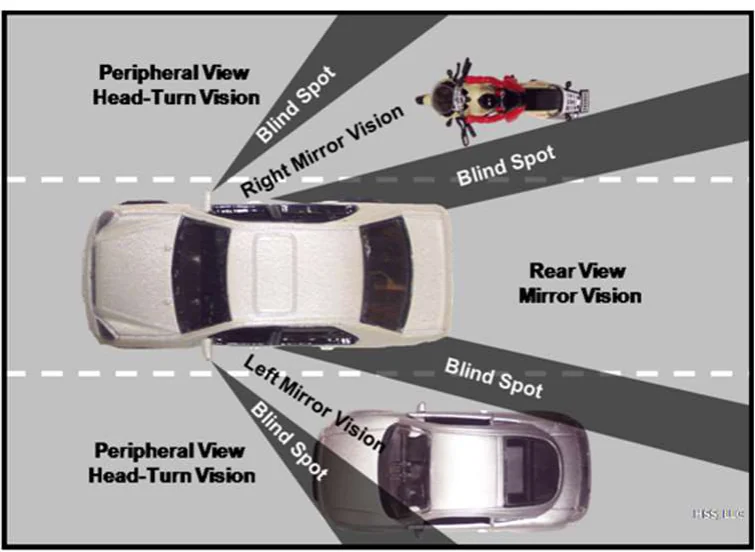
Left mirror: rest your head against the closed left window, then set the mirror so you can barely see the rear left edge of your vehicle.

Handbook p. 40 ↗

Know the rule

Right mirror: lean right until your head is directly below the rearview mirror, then set it so you can barely see the right side of your vehicle.

Handbook p. 40 ↗
Blind spot and mirror vision zones
What each mirror covers, and the blind spots that need a head turn

Put it into practice

You borrow a taller friend's car. Before shifting out of park, raise the seat until you can see the road, slide forward until your heel stays on the floor between pedals but your chest is still 10 inches from the wheel, then reset all three mirrors.

Check your understanding

Read the question, decide on an answer, then open it to check the explanation. These are Roadwise study questions based on the source handbook.

How much space should you leave between your chest and the steering wheel for airbag safety?
  1. 10 inches
  2. 16 inches
  3. 4 inches
  4. 20 inches

Answer: 10 inches

You should leave 10 inches between your chest and the steering wheel because of the airbag.
Handbook p. 39 ↗
Where should your head rest contact your head when your seat is properly adjusted?
  1. At the base of your neck
  2. Below the level of your ears
  3. At the very top of your head
  4. Above the level of your ears

Answer: Above the level of your ears

Your head rest should contact the back of your head above the level of your ears.

Handbook p. 39 ↗
To set your left side mirror, you rest your head against the closed left window. How much of your car should you see?
  1. None of your car at all
  2. Barely the rear left edge of your car
  3. About half of the mirror filled by your car
  4. The whole left side of your car

Answer: Barely the rear left edge of your car

Rest your head against the left window and set the mirror so you can barely see the rear left edge of your vehicle.

Handbook p. 40 ↗
The top of the steering wheel should be no higher than your shoulders and below your chin.
  1. True
  2. False

Answer: True

The handbook says the top of the steering wheel should be no higher than your shoulders but below your chin level.

Handbook p. 39 ↗
Take the lesson checkpoint in the app

More in Seat Belts, Air Bags and Child Safety