A 4-minute lesson from the Kentucky course. Read the rules and examples, follow the handbook page references, and check your understanding before you move on.
More than 250,000 crashes a year happen between cars and commercial vehicles. Big trucks and buses are larger and less maneuverable, have much larger blind spots, take longer to stop and accelerate, and need more room to turn.
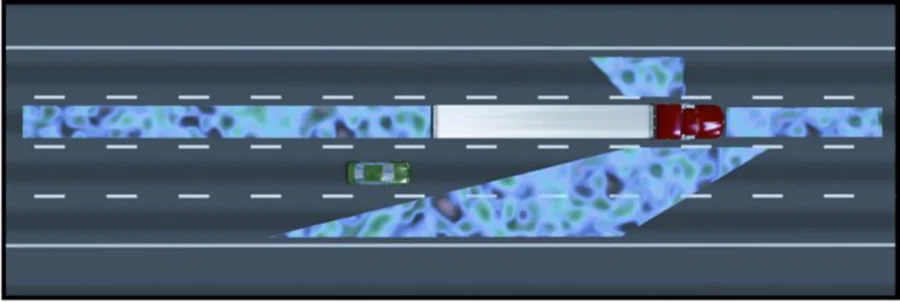
No Zone
The areas around a large truck or bus—on the sides, rear and front—where vehicles disappear from the driver's view into blind spots.
Don't change lanes or enter the road in front of a large vehicle. After passing one, wait until you can see its whole front in your rear-view mirror before pulling in, and maintain your speed.
Following too closely puts you in the rear No Zone, where the driver can't see you and you can't see ahead. Stay back, positioned so the driver can see you in the side mirrors.
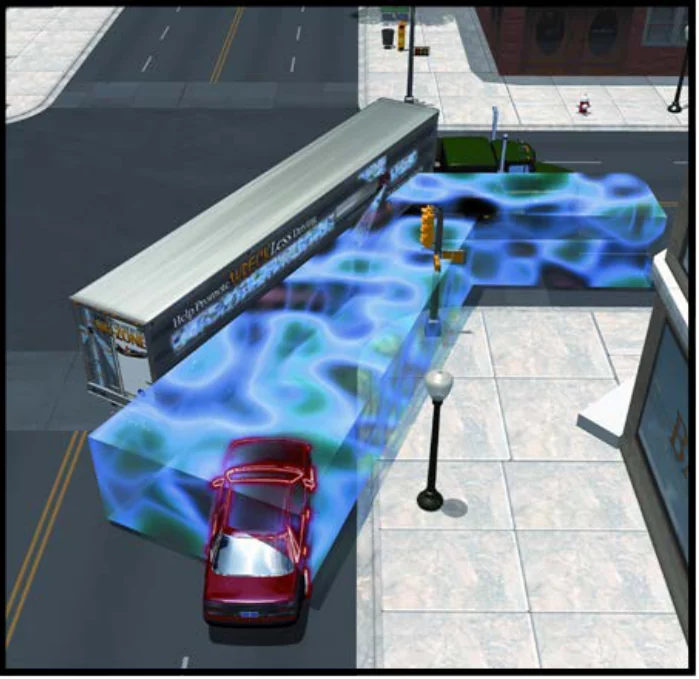
Don't get between a right-turning bus and the curb
Put it into practice
A tractor-trailer ahead signals right and swings wide into the left lane. Don't slip into the gap on its right—stay back and wait until it has completed its turn.
Check your understanding
Read the question, decide on an answer, then open it to check the explanation. These are Roadwise study questions based on the source handbook.
A loaded truck traveling at 55 mph with good brakes may need how much distance to stop, compared to a car?
Exactly the same distance as a car
About half the distance of a car
At least 335 feet, over 1.5 times a car's stopping distance
About 100 feet, less than a car
Answer: At least 335 feet, over 1.5 times a car's stopping distance
A loaded truck at 55 mph may need at least 335 feet to stop, more than 1.5 times a car's stopping distance.