roadwise.Open study app

Indiana driving lesson · Sharing the Road

School buses

A 3-minute lesson from the Indiana course. Read the rules and examples, follow the handbook page references, and check your understanding before you move on.

Read time
3 minutes
Course unit
Sharing the Road
Checkpoint questions
6
Source pages
56, 57, 46

The biggest danger to children who ride a school bus isn't the ride. It's approaching and leaving the bus. The bus's lights tell you what is about to happen.

Know the rule

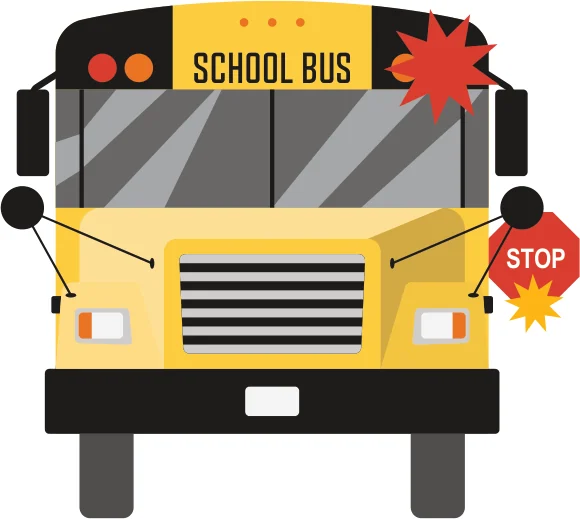
Amber flashing lights warn that the bus is slowing to load or unload children. Once the bus stops, its red lights and stop arm are activated.

Handbook p. 56 ↗

Know the rule

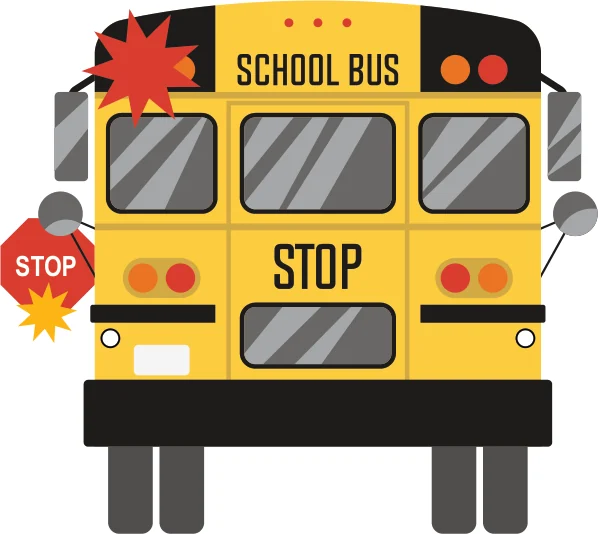
You must stop when you approach a school bus with flashing red lights and its stop arm extended.

Handbook p. 57 ↗

Know the rule

On a roadway divided by a barrier or an unimproved median, you must stop only if you're traveling in the same direction as the bus.

Handbook p. 57 ↗
School bus with flashing lights (with explanatory text)
School bus with red lights and stop arm (front)
School bus stop arm extended (rear view)
School bus with stop arm extended (rear)

When approaching a bus stop:

  • Watch for children playing or gathering near bus stops
  • Children late for the bus may dart into the street without looking
  • Be ready to stop when yellow flashing lights appear on the bus
Handbook p. 57 ↗

Penalties for disregarding a school bus stop arm

Penalties for disregarding a school bus stop arm
ResultOffense
Disregarding the stop armClass A misdemeanor
Offense results in bodily injuryLevel 6 felony
Offense results in deathLevel 5 felony
Handbook p. 57 ↗

Know the rule

School buses stop at railroad crossings. Rear-end collisions with school buses stopped at crossings have increased in recent years.

Handbook p. 57 ↗

School bus maximum speeds

School bus maximum speeds
WhereLimit
Not on an interstate or state highway40 mph, unless posted lower
Interstate or highway60 mph or the posted limit
Handbook p. 46 ↗

Put it into practice

On a two-lane road, a school bus coming toward you stops with red lights flashing and its stop arm out. You must stop, even though you're traveling the opposite direction, because there's no barrier or median between you.

Check your understanding

Read the question, decide on an answer, then open it to check the explanation. These are Roadwise study questions based on the source handbook.

What do amber flashing lights on a school bus mean?
  1. The bus has broken down
  2. The bus is about to turn right
  3. The bus is making a U-turn ahead
  4. The bus is slowing to load or unload children

Answer: The bus is slowing to load or unload children

Amber lights warn other drivers that the bus is slowing and preparing to load or unload children.
Handbook p. 56 ↗
Must you stop for a school bus with flashing red lights and extended stop arm on a two-lane road?
  1. Yes, even from the opposite direction
  2. No, only if you're traveling behind the bus
  3. No, only on divided highways with a median
  4. Only if children are visible outside

Answer: Yes, even from the opposite direction

You must stop when approaching a school bus with flashing red lights and stop arm extended, even on a two-lane road.

Handbook p. 57 ↗
On a road divided by a barrier or unimproved median, when must you stop for a stopped school bus?
  1. Always, even coming from the opposite direction
  2. Only if traveling the same direction as the bus
  3. Never, once a median separates the roadway
  4. Only when children are crossing the road

Answer: Only if traveling the same direction as the bus

On a roadway divided by a barrier or unimproved median, you are required to stop only if traveling the same direction as the bus.

Handbook p. 57 ↗
What is the potential penalty for disregarding a school bus stop arm if it results in bodily injury?
  1. A traffic infraction only
  2. A Class C misdemeanor
  3. A Level 6 felony
  4. A Level 1 felony

Answer: A Level 6 felony

Disregarding a school bus stop arm can result in a Level 6 felony if the offense results in bodily injury.

Handbook p. 57 ↗
What is the biggest threat to children riding a school bus, according to the handbook?
  1. The bus ride itself
  2. Approaching or leaving the bus
  3. Riding without seat belts
  4. Crowded bus aisles

Answer: Approaching or leaving the bus

The biggest threat to children who ride a bus is not the bus ride but approaching or leaving the bus.

Handbook p. 57 ↗
Besides road stops, where else do school buses commonly stop that drivers should watch for?
  1. Railroad crossings
  2. Gas station lots
  3. Highway rest areas
  4. Highway on-ramps

Answer: Railroad crossings

School buses stop at railroad crossings, and rear-end collisions there have increased in recent years.

Handbook p. 57 ↗
Take the lesson checkpoint in the app

More in Sharing the Road