A 3-minute lesson from the Illinois course. Read the rules and examples, follow the handbook page references, and check your understanding before you move on.
Railroad crossings use a set of signs, markings, lights and gates. Each device tells you what to expect and when you must stop. The rules are strict because a train cannot stop quickly.
Know the rule
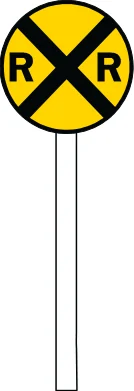
Round advance warning sign: a yellow sign with a black "X" and "RR" means a highway-railway crossing is ahead. It may be up to 750 feet before the crossing.
Pavement markings: a solid yellow line before the crossing means no passing. White stop lines on each side of the track show where to stop when a train approaches.
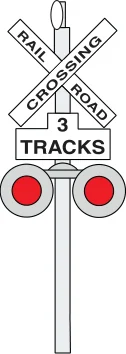
The railroad crossbuck is treated as a YIELD sign. Yield to any oncoming trains and railroad equipment. If there is more than one track, a sign below the crossbuck shows the number of tracks.
Automated railroad crossing enforcement systems may record your plate number and the time, date and location of a violation. Violators face fines and possible license suspension.
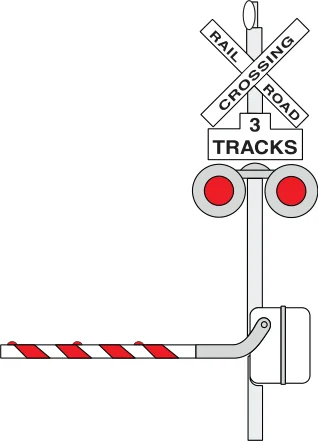
The gates start coming down just as you reach the crossing. Stop. Don't try to beat them, and never go around them. Wait until they are fully up and the lights stop flashing.
Check your understanding
Read the question, decide on an answer, then open it to check the explanation. These are Roadwise study questions based on the source handbook.
What does a railroad crossbuck sign function as, legally?
A stop sign, always requiring a full stop
A yield sign
A guide sign
An advisory sign with no legal force
Answer: A yield sign
A crossbuck functions as a yield sign, requiring you to yield to trains.