Roadwise States Illinois Driving lessons Pedestrian signals and lane-use signals Illinois driving lesson · Signals & Pavement Markings
Pedestrian signals and lane-use signals A 3-minute lesson from the Illinois course. Read the rules and examples, follow the handbook page references, and check your understanding before you move on.
Read time 3 minutes
Course unit Signals & Pavement Markings
Checkpoint questions 4
Source pages 81, 30 Pedestrian signals tell walkers when to cross. Drivers need to know them too, because a pedestrian who started legally still has the right of way. Overhead lane-use signals on some highways switch lanes on and off during the day.
Know the rule
Pedestrians must yield to drivers by obeying traffic signals, observing walk lights and using crosswalks.
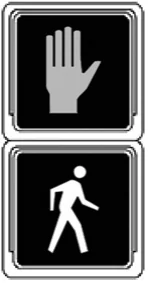
Handbook p. 81 ↗ Don't Walk (upraised hand) and Walk (walking person) Know the rule
A pedestrian who began crossing during the steady walk signal may continue to the sidewalk or a safety island after the hand starts flashing.
Handbook p. 81 ↗ Know the rule
Drivers must yield to a pedestrian walking with a green light, walking-person symbol or WALK signal, and to one who entered the crosswalk before the light changed.
Handbook p. 30 ↗ Special lights over each lane on some highways and expressways change the direction of traffic flow during certain hours of the day.
Red X, yellow X and green arrow lane signals Put it into practice
Your light turns green, but a pedestrian who stepped off the curb on WALK is still halfway across. Wait. They may finish crossing, and you must yield.
Check your understanding Read the question, decide on an answer, then open it to check the explanation. These are Roadwise study questions based on the source handbook.
A pedestrian starts crossing legally on a walk signal, but it changes to 'don't walk' before they finish. What should the driver do? Keep yielding until they finish crossing Pass behind them if there is room Only yield if the pedestrian is a child Proceed immediately since the signal changed Answer: Keep yielding until they finish crossing
Drivers must keep yielding until the pedestrian reaches safety.
Handbook p. 81 ↗ What does a Red 'X' lane signal mean? The lane is for U-turns only Never drive in that lane while it shows Leave the lane before the signal changes The lane is for emergency vehicles only Answer: Never drive in that lane while it shows
A red X means that lane is closed to all traffic.
Handbook p. 81 ↗ What does a flashing yellow lane 'arrow' over a lane indicate? Leave the lane before it closes It may be used to approach and turn left The lane is closed to all traffic Use it for any movement; obey signs Answer: It may be used to approach and turn left
A flashing yellow arrow lane signal marks a left-turn approach lane.
Handbook p. 81 ↗ For a pedestrian, what does a constantly lit orange upraised hand mean? Cross only if no vehicles are visible Proceed if you're already halfway across Do not enter the roadway Cross quickly before it changes Answer: Do not enter the roadway
A steady upraised hand means pedestrians should not enter the roadway.
Handbook p. 81 ↗ Previous lesson Traffic lights and arrows Next lesson Pavement markings More in Signals & Pavement Markings About the source Roadwise’s Illinois course uses the driver handbook edition supplied with this study pack. This lesson cites source pages 81, 30. The linked PDF is a third-party mirror of the handbook, rather than a government-hosted page.
Open the handbook source PDF · View the source edition
For current application requirements, fees, appointments, and the format that applies to your age or license type, check Illinois’s SOS. Roadwise provides study material and does not issue permits or licenses.