Roadwise States Georgia Driving lessons Hydroplaning and skidding Georgia driving lesson · Safety Guidelines
Hydroplaning and skidding A 3-minute lesson from the Georgia course. Read the rules and examples, follow the handbook page references, and check your understanding before you move on.
Read time 3 minutes
Course unit Safety Guidelines
Checkpoint questions 6
Source pages 39 Wet roads cut your traction. At higher speeds, tires can ride up on standing water and lose contact with the road; that's hydroplaning. A skid happens when tires lose their grip. Knowing how to respond keeps a slide from becoming a crash.
Hydroplaning When standing water keeps your tires from channeling it away, so they lose contact with the road and ride on the water like water skis.
Handbook p. 39 ↗ Know the rule
At speeds up to 35 mph, most tires channel water away from the tire, the way a windshield wiper clears the windshield.
Handbook p. 39 ↗ 35 mph Partial hydroplaning can begin in a standard passenger car
Handbook p. 39 ↗ Know the rule
With no road contact there's no friction to brake, accelerate or steer, and the car may go into an unpredictable skid. Take your foot off the accelerator and let the car slow down.
Handbook p. 39 ↗ Know the rule
Prevent hydroplaning with good tires that have enough tread to channel water, and most importantly, slow down when there's water on the road.
Handbook p. 39 ↗ Skid When the tires lose their grip on the road surface, so both the engine's power to the wheels and the wheels' braking ability are lost.
Handbook p. 39 ↗ Know the rule
On slick surfaces, braking too hard or turning the wheel too sharply can cause a skid.
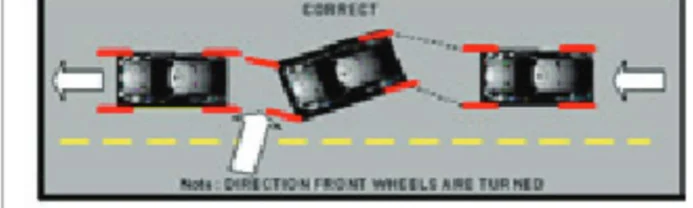
Handbook p. 39 ↗ If you start to skid: Ease your foot off the accelerator Begin turning the steering wheel in the direction of the skid Once you regain control, brake lightly and steer in a safe direction Handbook p. 39 ↗ Correcting a skid: note the direction the front wheels are turned Know the rule
The first half-hour of rainfall is the most dangerous, because water mixes with oil and other chemicals and makes roads extremely slippery.
Handbook p. 39 ↗ Put it into practice
You're driving 60 mph in heavy rain and the steering suddenly feels light. You're hydroplaning. Ease off the gas and let the car slow down; don't slam the brakes.
Check your understanding Read the question, decide on an answer, then open it to check the explanation. These are Roadwise study questions based on the source handbook.
At approximately what speed can partial hydroplaning begin in a standard passenger car? 70 mph 35 mph 15 mph 55 mph Answer: 35 mph
Partial hydroplaning in a standard passenger car can begin at speeds as low as 35 mph.
Handbook p. 39 ↗ At approximately what speed may tires lose all contact with a wet road during hydroplaning? 35 mph 65 mph 55 mph 45 mph Answer: 55 mph
At 55 mph, tires may lose all contact with the road during hydroplaning.
Handbook p. 39 ↗ What should you do first if your vehicle begins to hydroplane and skid unpredictably? Shift into neutral immediately Turn the steering wheel sharply away from the skid Take your foot off the accelerator Apply the brakes as hard as possible Answer: Take your foot off the accelerator
If hydroplaning causes an uncontrollable skid, take your foot off the accelerator to let the car slow down.
Handbook p. 39 ↗ If your car begins to skid, which direction should you initially steer? Toward the shoulder of the road Straight ahead only, never turning the wheel Directly opposite the direction of the skid In the direction of the skid Answer: In the direction of the skid
When a skid begins, ease off the accelerator and begin turning the steering wheel in the direction of the skid.
Handbook p. 39 ↗ Why is the first half-hour of rainfall considered the most dangerous time to drive? Visibility is always at its worst during this period Tires are coldest when rain begins Standing water is deepest at first Water mixes with oil, making roads slick Answer: Water mixes with oil, making roads slick
The first half-hour of rain is most dangerous because water mixes with oil and chemicals on the roadway, creating a slick surface.
Handbook p. 39 ↗ What should you do after regaining control of your vehicle following a skid? Come to a complete stop in your lane Brake lightly and steer safely Immediately accelerate back to your original speed Turn the wheel sharply in the opposite direction Answer: Brake lightly and steer safely
Once you've regained control after a skid, you can lightly apply brakes and steer in a safe direction.
Handbook p. 39 ↗ Previous lesson Before you drive: tires, getting in and steering Next lesson Curves, fog and winter driving More in Safety Guidelines About the source Roadwise’s Georgia course uses the driver handbook edition supplied with this study pack. This lesson cites source pages 39. The linked PDF is a third-party mirror of the handbook, rather than a government-hosted page.
Open the handbook source PDF · View the source edition
For current application requirements, fees, appointments, and the format that applies to your age or license type, check Georgia’s DDS. Roadwise provides study material and does not issue permits or licenses.