roadwise.Open study app

Georgia driving lesson · Safety Guidelines

Following distance and stopping

A 2-minute lesson from the Georgia course. Read the rules and examples, follow the handbook page references, and check your understanding before you move on.

Read time
2 minutes
Course unit
Safety Guidelines
Checkpoint questions
4
Source pages
41

Rear-end crashes come from following too closely. Leave enough space to stop safely if the car ahead suddenly slows or stops. Georgia's handbook uses a simple counting method, and more speed makes every crash worse.

Know the rule

When following another vehicle, you must leave enough distance to stop safely if it suddenly slows down or stops.

Handbook p. 41 ↗

Check your following distance:

  • Watch the car ahead pass a fixed point, such as a telephone pole or street sign
  • Count "one-thousand-one, one-thousand-two"
  • If you pass the same spot before you finish counting, you're following too closely
Handbook p. 41 ↗

Know the rule

Leave even more distance in bad weather, in construction, in heavy traffic, and always at night.

Handbook p. 41 ↗

Besides speed, stopping distance depends on:

  • The driver's mental and physical reaction
  • The type and condition of the pavement
  • The kind of tires and tread
  • Chassis (frame) design
  • The type, condition and balance of the brakes
  • Wind direction and velocity
Handbook p. 41 ↗

Know the rule

Speed is a leading factor in serious injury and death in crashes: the greater the speed, the greater the force of impact.

Handbook p. 41 ↗
Speed limit by district density chart
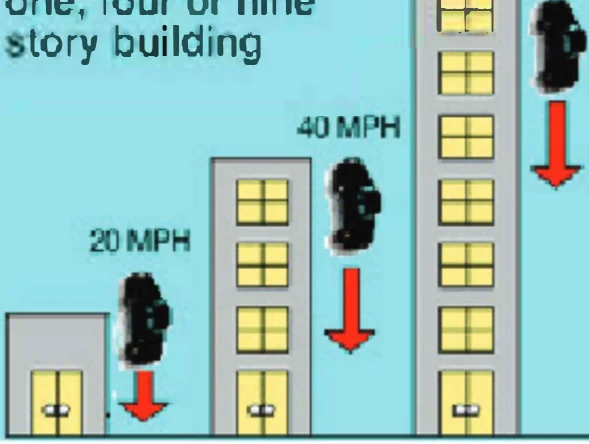
Force of impact rises sharply with speed

Know the rule

The handbook compares hitting a fixed object at increasing speeds to driving off a one-, four- or nine-story building.

Handbook p. 41 ↗

Put it into practice

The car ahead passes a speed limit sign. You say "one-thousand-one" and you're already at the sign. You're too close; ease off, and leave even more room if it's night or raining.

Check your understanding

Read the question, decide on an answer, then open it to check the explanation. These are Roadwise study questions based on the source handbook.

What counting method can help you check your following distance behind another vehicle?
  1. Measuring the distance with your speedometer reading
  2. Estimating car lengths by eye only
  3. Counting to ten after the vehicle ahead brakes
  4. Count seconds past a fixed point

Answer: Count seconds past a fixed point

Watch a reference point and count seconds between when the vehicle ahead passes it and when you do, to check your following distance.
Handbook p. 41 ↗
Besides vehicle speed, which factor affects your vehicle's stopping distance?
  1. The type and condition of the pavement
  2. The size of the vehicle's engine
  3. The amount of fuel in the tank
  4. Whether cruise control is on

Answer: The type and condition of the pavement

Stopping distance depends on factors including pavement type/condition, tire tread, brakes, and driver reaction time, in addition to speed.

Handbook p. 41 ↗
During inclement weather, heavy traffic, construction, or at night, how should your following distance change?
  1. It should stay exactly the same
  2. It should be even greater than normal
  3. It can stay at two seconds
  4. It only needs to increase at night, not in other conditions

Answer: It should be even greater than normal

The handbook advises increasing following distance during bad weather, construction, heavy traffic, and at night.

Handbook p. 41 ↗
The handbook compares hitting a fixed object at 60 mph to driving off a building how many stories tall?
  1. One story
  2. Four stories
  3. Nine stories
  4. Twelve stories

Answer: Nine stories

Striking something at 20, 40 or 60 mph is like driving off a one-, four- or nine-story building.

Handbook p. 41 ↗
Take the lesson checkpoint in the app

More in Safety Guidelines