Roadwise States Georgia Driving lessons Curves, fog and winter driving Georgia driving lesson · Safety Guidelines
Curves, fog and winter driving A 3-minute lesson from the Georgia course. Read the rules and examples, follow the handbook page references, and check your understanding before you move on.
Read time 3 minutes
Course unit Safety Guidelines
Checkpoint questions 4
Source pages 39, 40 Curves, fog and winter weather all demand lower speeds. Because of Georgia's usually mild climate, most Georgians have little experience driving in winter weather, so it's worth knowing how to prepare your car and handle ice and snow.
Know the rule
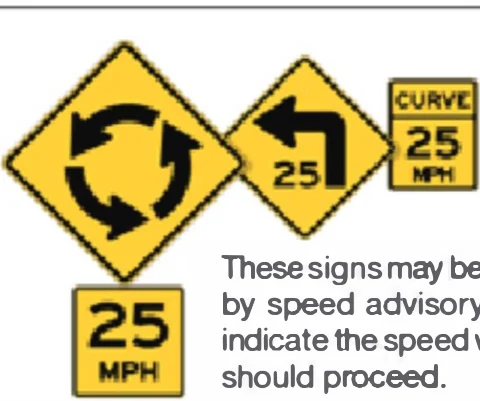
Curves are hazards, especially when roads are slick. Sharper curves are usually marked with an advisory speed sign, usually lower than the posted limit.
Handbook p. 39 ↗ Curve warning signs with advisory speed plaques Know the rule
Slow down before entering a curve. If you're going too fast in it, don't brake forcefully (you may skid): lift off the accelerator, brake carefully and keep steering in your lane.
Handbook p. 40 ↗ If you must drive in heavy fog: Reduce your speed Slow down more when you see headlights or taillights; distances are hard to judge Dim your headlights; bright lights glare in fog and make it harder to see Don't drive with parking lights or hazard lights on Handbook p. 39 ↗ Driving in winter weather: Use chains or snow tires if you need extra traction; check the manuals first Remove snow and ice from all windows before driving Test your brakes gently to get a feel for the road; never brake suddenly Slow down gradually before intersections, turns and stops Keep a safe distance and reduce speed for conditions Watch for hazards and changing road conditions ahead Handbook p. 40 ↗ Tips for safe winter driving: Get your car serviced routinely; check the battery and cooling system Fill the windshield washer reservoir; check wipers and defrosters Verify floor mat installation to prevent pedal interference Inspect your tires and check their age Know your car, and plan your travel and route Stock tools and supplies, and learn what to do in a winter emergency Handbook p. 40 ↗ Put it into practice
Fog rolls in on a rural road. Slow down, switch to low beams, and leave your hazard lights off. When taillights appear ahead, slow down even more.
A useful reminder In fog: low beams, not high beams or hazard lights.
Check your understanding Read the question, decide on an answer, then open it to check the explanation. These are Roadwise study questions based on the source handbook.
In heavy fog, why should you dim your headlights rather than use high beams? High beams create glare in fog Low beams reach farther in fog Dimmed lights are required by federal law in fog It is illegal to use high beams at any time Answer: High beams create glare in fog
In heavy fog, bright lights create glare that makes visibility worse, so you should use dimmed headlights.
Handbook p. 39 ↗ What is one recommended step when preparing for winter driving conditions? Let some air out of the tires for traction Check the battery, coolant, and wipers Pump the brakes hard to test them Remove your floor mats to stop sliding Answer: Check the battery, coolant, and wipers
Winter driving tips include checking your battery, cooling system, and windshield wipers/defrosters before winter weather arrives.
Handbook p. 40 ↗ On a curve, if you realize you are going too fast, what should you do? Forcefully apply the brakes immediately Ease off the gas, brake gently, stay in lane Accelerate through the curve to maintain control Turn the wheel sharply toward the outside of the curve Answer: Ease off the gas, brake gently, stay in lane
Forcefully braking in a curve can cause a skid; instead ease off the accelerator and brake carefully while steering.
Handbook p. 40 ↗ Sharper curves are usually marked with an advisory speed sign showing a safe speed, often lower than the posted limit. True False Answer: True
Advisory speed signs on sharp curves typically show a reduced safe speed, usually lower than the posted limit.
Handbook p. 39 ↗ Previous lesson Hydroplaning and skidding Next lesson Vehicle emergencies More in Safety Guidelines About the source Roadwise’s Georgia course uses the driver handbook edition supplied with this study pack. This lesson cites source pages 39, 40. The linked PDF is a third-party mirror of the handbook, rather than a government-hosted page.
Open the handbook source PDF · View the source edition
For current application requirements, fees, appointments, and the format that applies to your age or license type, check Georgia’s DDS. Roadwise provides study material and does not issue permits or licenses.