A 4-minute lesson from the Georgia course. Read the rules and examples, follow the handbook page references, and check your understanding before you move on.
Expressways have controlled access: you get on and off only at interchanges. Traffic moves faster, exits are fewer, and stopping or backing up is prohibited. Good merging, lane use and alertness keep you safe.
Know the rule
Expressways are like divided highways: a median separates opposite traffic, lanes are marked with dashed lines and the edge with a solid line, and slower traffic keeps right.
To exit, move to the right lane (left lane for a left exit) and use the deceleration lane. If you slow in a travel lane, warn drivers behind with brake lights or a turn signal.
Driving in reverse on an expressway is prohibited under any circumstances. Stopping is prohibited; the shoulder is for emergencies only, and switching drivers, stretching or getting items isn't an emergency.
Drive defensively: don't stare at the center line, check mirrors often, never assume others will do what you expect (a signal doesn't mean they'll turn), and always plan an escape route.
A Diverging Diamond Interchange (DDI) shifts traffic to the opposite side of the road so drivers can turn left onto an on-ramp without stopping. It can cut evening rush-hour delays up to 20 percent.
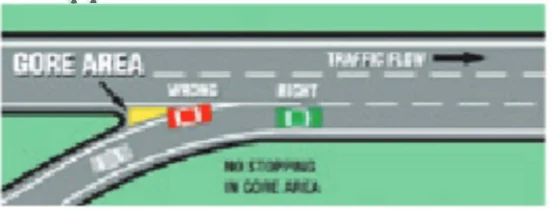
You're merging from an on-ramp and the solid white gore line is still beside you. Stay in the acceleration lane until the line ends, match speed, then merge into a gap.
Check your understanding
Read the question, decide on an answer, then open it to check the explanation. These are Roadwise study questions based on the source handbook.
What is the purpose of the acceleration lane when entering an expressway?
To serve as an emergency stopping lane
To wait at a stop for a gap
To pass slow traffic on the ramp
To reach traffic speed before merging
Answer: To reach traffic speed before merging
The acceleration lane lets you adjust your speed to the speed of expressway traffic before merging in.