Florida practice test
Florida permit practice test.
Get to know the format, try six study questions, and check the explanations before opening a full Roadwise practice test. This course’s simulation is based on the format described below.
- Questions
- 50
- Correct to pass
- 40
- Practice timer
- No timer
- Study question bank
- 757
The format in this course
Florida Class E Knowledge Exam
To pass this Roadwise simulation, answer at least 40 of 50 questions correctly. Answers and explanations appear after you finish. Unanswered questions count as incorrect.
This practice format uses one overall passing threshold, without a separately scored sign section.
This Roadwise practice format has no countdown, so you can take the time you need.
The handbook states the exam format (50 questions, p.28) but does not itself state the passing score. The 40/50 (80%) passing score is confirmed on the official FLHSMV website. No separate scored sections; the exam is a single combined test.
Try a few practice questions
Read the question, decide on an answer, then open it to check the explanation. These are Roadwise study questions based on the source handbook.
A non-resident accepts a job in Florida and enrolls their child in a Florida public school. Within how many days must they get a Florida license?
- 90 days
- 30 days
- 60 days
- 10 days
Answer: 30 days
A non-resident who accepts employment or enrolls a child in a Florida public school must get a Florida license within 30 days.
Handbook p. 11 ↗An older driver has difficulty turning their head to check blind spots. What adjustment does the handbook suggest?
- Consider getting a larger side mirror
- Consider getting a steering knob
- Rely only on the rear-view mirror
- Consider an assistive belt device
Answer: Consider getting a larger side mirror
If it's difficult to turn your head to check blind spots, consider getting a larger side mirror.
Handbook p. 41 ↗A single solid white lane line (not an edge line) means you should:
- Travel on either side, but not cross unless avoiding a hazard
- Always change lanes across it freely
- Never travel on either side of it
- Pass on the left only when safe
Answer: Travel on either side, but not cross unless avoiding a hazard
You may travel in the same direction on both sides of a single solid white lane line, but should not cross it unless avoiding a hazard.
Handbook p. 51 ↗When backing up, why shouldn't you rely only on your rear-view or side mirrors?
- Mirrors are only for highway driving
- Mirrors can't show directly behind you
- Using mirrors while backing is illegal
- Mirrors only show the left side
Answer: Mirrors can't show directly behind you
You cannot see directly behind your vehicle using only your rear-view or side mirrors; you must turn and look through the rear window.
Handbook p. 67 ↗What is the minimum clearance a motorist must give a bicyclist when passing?
- 1 foot
- 5 feet
- 3 feet
- 2 feet
Answer: 3 feet
Florida law requires drivers to give bicyclists a minimum of three feet of clearance when passing.
Handbook p. 89 ↗What does this sign mean?
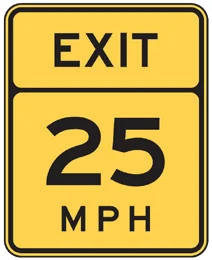
- This area is reserved for emergency parking only.
- Recommended safe speed for the exit ramp ahead.
- Slower vehicles must stay in the right lane.
- Traffic in this lane may only go straight.
Answer: Recommended safe speed for the exit ramp ahead.
Advisory speed: Recommended safe speed for the exit ramp ahead. Slow to the posted advisory speed before taking the exit.
Handbook p. 55 ↗What to study next
The practice question pool spans the course. Use the topics below to read the rules behind an answer, then return to practice.
8 lessons
Getting Your License
Who needs one, documents, teen rules, exams
Explore8 lessons
Your Driving Privilege
Insurance, DUI, points, courses, suspensions
Explore5 lessons
You the Driver
Fitness, distraction, alcohol, drugs, emotions
Explore6 lessons
Your Vehicle
Registration, equipment, brakes, towing, belts
Explore8 lessons
Signs and Pavement Markings
Lines, lanes, sign colors, regulatory and warning signs
Explore5 lessons
Traffic Signals
Lights, arrows, work zones, railroads, pedestrians
Explore4 lessons
Driving Safety Fundamentals
Pre-drive checks, stopping, following, intersections
Explore8 lessons
Highways, Parking, and Turning
Expressways, Move Over, parking, passing, speed, turns
Explore7 lessons
Special Situations and Emergencies
Weather, night, traffic stops, crashes, vehicle emergencies
Explore8 lessons
Sharing the Road
Bicycles, trucks, motorcycles, golf carts, pedestrians, buses
Explore