roadwise.Open study app

Florida driving lesson · Driving Safety Fundamentals

Pre-drive checks, backing up and blind spots

A 3-minute lesson from the Florida course. Read the rules and examples, follow the handbook page references, and check your understanding before you move on.

Read time
3 minutes
Course unit
Driving Safety Fundamentals
Checkpoint questions
6
Source pages
67, 68

Safe trips start before you move. A quick check of the car, a set routine before starting the engine, and careful backing prevent many crashes. Once moving, the biggest hidden danger is your blind spots.

Inspect your vehicle

Inspect your vehicle
ItemWhat to check
BrakesPedal stays above floor; no pulling, scraping, squealing
LightsReplace burned-out bulbs; keep lenses clean
TiresProper inflation, even tread wear, no damage
Windows and windshieldsClean inside and out
Handbook p. 67 ↗

Before you start your engine:

  • Make sure the vehicle is in park or neutral
  • Adjust the seat so you can reach all controls
  • Adjust the mirrors so you don't have to lean forward or back to use them
  • Move anything that blocks your view of the mirrors or road
  • Lock all doors
  • Fasten your safety belt and make sure all passengers do the same
Handbook p. 67 ↗

Backing up:

  • 1. Check behind the vehicle before you get in; children and small objects can't be seen from the seat
  • 2. Put your right arm on the passenger seat back and turn to look directly through the rear window
  • 3. Back up slowly; the vehicle is harder to steer in reverse
  • 4. When possible, have someone outside help guide you
Handbook p. 67 ↗

Know the rule

Don't depend on your mirrors when backing, because they can't show what's directly behind you. Don't fully rely on cameras or alarms either; they don't always detect small children and animals.

Handbook p. 67 ↗

Blind spots

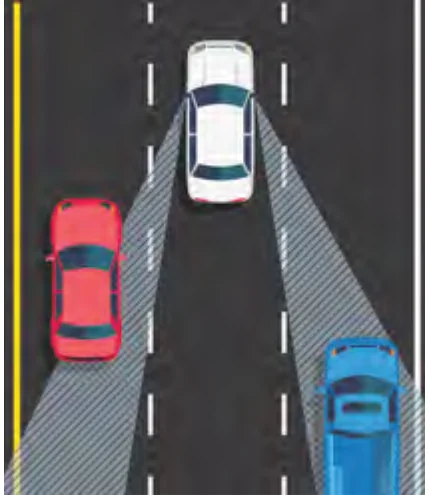
Areas near the left and right rear corners of your vehicle that you can't see in your mirrors or with peripheral vision.

Handbook p. 68 ↗
Blind spot diagram
Blind spots (shaded) beside and behind a car

Know the rule

Before changing lanes on a highway, passing on any road or making certain turns, turn your head to check that your blind spots are clear.

Handbook p. 68 ↗

Know the rule

Don't drive in another driver's blind spot. Speed up or drop back so the other driver can see you.

Handbook p. 68 ↗

Know the rule

The larger the vehicle, the larger its blind spots. Large trucks and SUVs have blind spots close to the rear that mirrors can't show.

Handbook p. 68 ↗

Put it into practice

You're about to back out of your driveway. Walk around the car first, because a child or a bike could be hidden. Then turn and look out the rear window as you back slowly, using the camera only as an extra aid.

Check your understanding

Read the question, decide on an answer, then open it to check the explanation. These are Roadwise study questions based on the source handbook.

Before starting your engine, what should you do with your rear-view mirrors?
  1. Set them so you needn't lean to use them
  2. Leave them as the last owner set them
  3. Adjust only the driver's side mirror
  4. Adjust them once you start moving

Answer: Set them so you needn't lean to use them

Adjust all rear-view mirrors so that you can use them without having to lean forward or backward.
Handbook p. 67 ↗
When backing up, why shouldn't you rely only on your rear-view or side mirrors?
  1. Mirrors are only for highway driving
  2. Mirrors can't show directly behind you
  3. Using mirrors while backing is illegal
  4. Mirrors only show the left side

Answer: Mirrors can't show directly behind you

You cannot see directly behind your vehicle using only your rear-view or side mirrors; you must turn and look through the rear window.

Handbook p. 67 ↗
Why does the handbook caution against relying completely on backup cameras or alarms?
  1. They show the view reversed
  2. They only work in daylight
  3. They don't always detect small children and animals
  4. They can't see past 10 feet

Answer: They don't always detect small children and animals

Don't completely rely on cameras or alarms; they don't always detect small children and animals.

Handbook p. 67 ↗
Before backing up, you should check behind your vehicle:
  1. Only if backing out of a driveway
  2. Only if backing more than 50 feet
  3. Only if you hear something
  4. Before you get in

Answer: Before you get in

Check behind your vehicle before you get in, since children and small objects cannot be seen from the driver's seat.

Handbook p. 67 ↗
Blind spots are best described as areas:
  1. Near the rear corners, not seen in mirrors
  2. Areas you can see in the rear-view mirror
  3. Directly in front of the hood
  4. Directly behind, seen in the rear window

Answer: Near the rear corners, not seen in mirrors

Blind spots are areas near the left and right rear corners of your vehicle that you can't see in mirrors or with peripheral vision.

Handbook p. 68 ↗
If you notice you are driving in another vehicle's blind spot, you should:
  1. Stay beside them so they notice you
  2. Match their speed exactly
  3. Speed up or drop back so you're seen
  4. Stay there; it's their responsibility

Answer: Speed up or drop back so you're seen

Do not drive in someone else's blind spot; move forward or drop back so the other driver can see you.

Handbook p. 68 ↗
Take the lesson checkpoint in the app

More in Driving Safety Fundamentals