roadwise.Open study app

Florida driving lesson · Driving Safety Fundamentals

Intersections, right-of-way and roundabouts

A 3-minute lesson from the Florida course. Read the rules and examples, follow the handbook page references, and check your understanding before you move on.

Read time
3 minutes
Course unit
Driving Safety Fundamentals
Checkpoint questions
6
Source pages
70, 71, 76

Intersections are where most crashes happen, so right-of-way rules decide who goes and who waits. The law says who must yield, and you must still do everything possible to avoid a crash.

Know the rule

Right-of-way rules tell you who goes first and who must wait. The law says who must yield (give up) the right-of-way.

Handbook p. 76 ↗

Know the rule

After a complete stop at a stop line, yield to traffic already in the intersection and to pedestrians and bicyclists. Look both ways, and look right before a right turn.

Handbook p. 70 ↗

Who goes first:

  • Vehicles go in the order they arrived; the first to arrive goes first
  • Arrive at about the same time: yield to the driver on your right
  • At a two-way stop, the turning vehicle yields to the vehicle going straight
Handbook p. 70 ↗

Know the rule

Entering a road from a driveway, alley or roadside, yield to vehicles on the main road and to pedestrians and bicyclists on the sidewalk or in bike lanes.

Handbook p. 70 ↗

Open intersection

An intersection with no traffic control signs or signals.

Handbook p. 70 ↗

At an open intersection, you must yield if:

  • A vehicle is already in the intersection
  • You're entering or crossing a state highway from a secondary road
  • You're entering a paved road from an unpaved road
  • You're turning left and a vehicle is coming from the opposite direction
Handbook p. 70 ↗

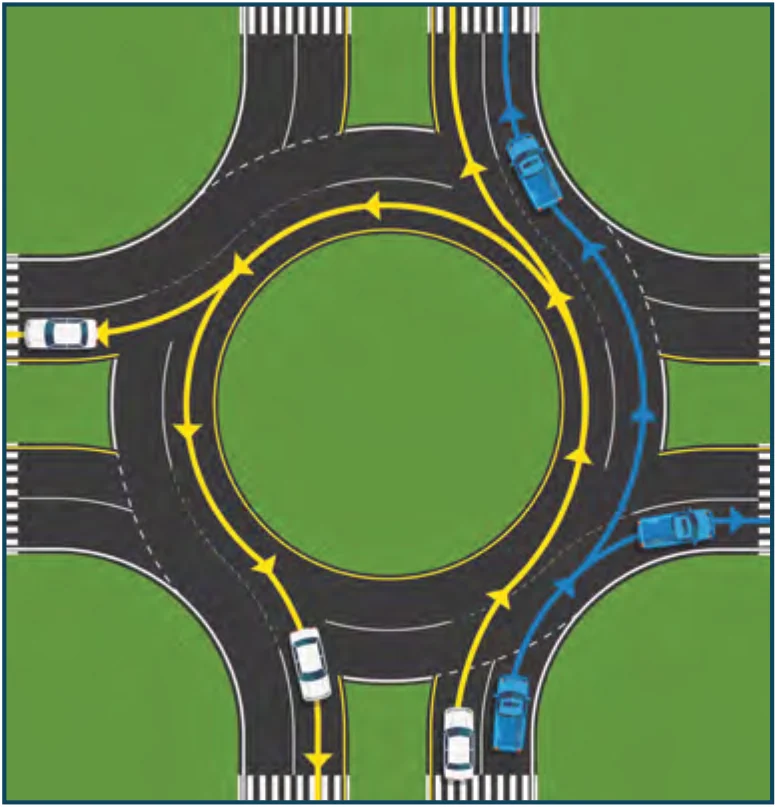
Roundabout

A circular intersection with no traffic signal. Traffic moves one way, counter-clockwise.

Handbook p. 71 ↗

Roundabout rules:

  • Yield to traffic already in the roundabout; with no traffic, enter without yielding
  • Do not change lanes in the roundabout
  • Do not stop in the roundabout
  • Signal before exiting
  • Yield to pedestrians in crosswalks before entering or exiting
Handbook p. 71 ↗

Multi-lane roundabout lanes

Multi-lane roundabout lanes
To…Use
Go straight or rightRight lane
Go straight or left, or make a U-turnLeft lane
Handbook p. 71 ↗
Multi-lane roundabout
Multi-lane roundabout: choose your lane before entering

Know the rule

In a roundabout, bicyclists may take the lane or use the sidewalk.

Handbook p. 71 ↗

Put it into practice

You're at a two-way stop and want to turn left, while a car across from you on the same street is going straight. The turning vehicle yields to the vehicle going straight, so let it clear before you turn.

Check your understanding

Read the question, decide on an answer, then open it to check the explanation. These are Roadwise study questions based on the source handbook.

At an intersection after coming to a complete stop, you must yield to:
  1. Only vehicles turning left
  2. Traffic already in the intersection and pedestrians/bicyclists
  3. No one, since you already stopped
  4. Only oncoming traffic

Answer: Traffic already in the intersection and pedestrians/bicyclists

After a complete stop, you must yield the right-of-way to traffic already in the intersection and to pedestrians and bicyclists.
Handbook p. 70 ↗
A driver entering a road from a driveway must yield to:
  1. Only oncoming vehicles from the left
  2. No one if there's no stop sign
  3. Vehicles on the main road, and pedestrians/bicyclists on the sidewalk or bike lane
  4. Only pedestrians, not vehicles

Answer: Vehicles on the main road, and pedestrians/bicyclists on the sidewalk or bike lane

Drivers entering from a driveway must yield to vehicles already on the main road, as well as pedestrians and bicyclists.

Handbook p. 70 ↗
At an open intersection with no signs or signals, you must yield if you plan to:
  1. Continue straight with no other traffic present
  2. Turn right when the road is clear
  3. Enter from a paved road onto another paved road of equal size
  4. Turn left with a vehicle approaching head-on

Answer: Turn left with a vehicle approaching head-on

At an open intersection, you must yield if you plan to make a left turn and a vehicle is approaching from the opposite direction.

Handbook p. 70 ↗
At an open intersection, when must you yield if entering from a secondary road?
  1. When entering or crossing a state highway
  2. Only when turning left
  3. Never, secondary roads always have the right-of-way
  4. Only if a sign is posted

Answer: When entering or crossing a state highway

You must yield the right-of-way when you enter or cross a state highway from a secondary road at an open intersection.

Handbook p. 70 ↗
Roundabouts in Florida move traffic in which direction?
  1. Clockwise
  2. Counter-clockwise
  3. Either direction depending on lane
  4. Clockwise in multi-lane roundabouts

Answer: Counter-clockwise

Roundabouts travel in a one-way, counter-clockwise direction.

Handbook p. 71 ↗
In a multi-lane roundabout, which lane should you use to go straight or turn right?
  1. The left lane
  2. Either lane, it doesn't matter
  3. The center lane only
  4. The right lane

Answer: The right lane

To go straight or right in a multi-lane roundabout, use the right lane.

Handbook p. 71 ↗
Take the lesson checkpoint in the app

More in Driving Safety Fundamentals