Roadwise States Florida Driving lessons Limited access highways Florida driving lesson · Highways, Parking, and Turning
Limited access highways A 4-minute lesson from the Florida course. Read the rules and examples, follow the handbook page references, and check your understanding before you move on.
Read time 4 minutes
Course unit Highways, Parking, and Turning
Checkpoint questions 6
Source pages 71, 72, 73 Limited access highways, also called expressways, interstates, turnpikes, toll roads and freeways, have multiple lanes and no stop signs, traffic lights or railroad crossings. They're built for speed, so getting on, getting off and handling trouble each follow set steps.
NOT allowed on limited access highways: Pedestrians and hitchhikers Bicycles Animal-drawn vehicles Motor-driven cycles and motor scooters of 150 cc or less Handbook p. 71 ↗ Know the rule
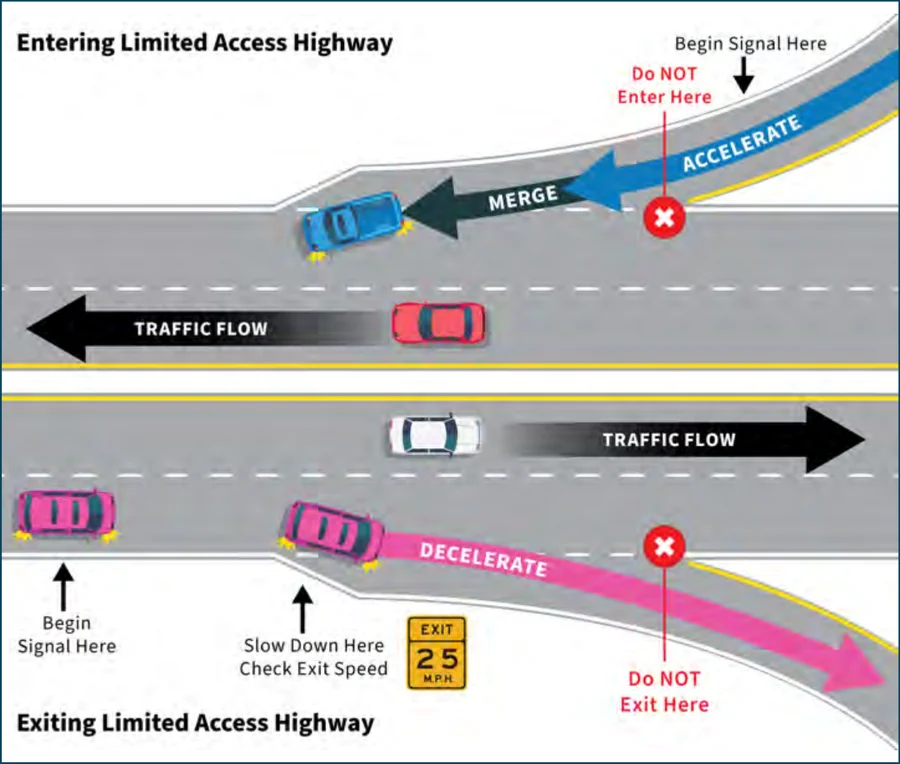
Every entrance has three parts: an entrance ramp, an acceleration lane and a merging area.
Handbook p. 71 ↗ Entering: 1. On the ramp, start looking for an opening in traffic and signal your intent to merge 2. Speed up as the ramp straightens into the acceleration lane 3. Adjust your speed to merge safely by the end of the acceleration lane 4. Merge when safe; you must yield to traffic already on the highway Handbook p. 71 ↗ Know the rule
Don't stop in the acceleration lane unless traffic is too heavy and there's no space to enter safely.
Handbook p. 71 ↗ Entering and exiting a limited access highway Leaving: 1. Get into the exit lane; most exits are from the right lane 2. Turn on your signal to show you're exiting 3. Slow down in the deceleration lane and check the posted exit ramp speed 4. No last-minute turns into an exit; if you miss it, go to the next one Handbook p. 72 ↗ Know the rule
In Florida, exits match the mile markers on the highway. Plan ahead and know your exit.
Handbook p. 72 ↗ Know the rule
Drive in the right lane and pass on the left. While in the right lane, watch for cars entering and adjust your speed or move over so they can merge.
Handbook p. 72 ↗ Know the rule
Never drive across or park on the median. Never stop on the pavement, shoulder or a ramp except in an emergency.
Handbook p. 72 ↗ Know the rule
If your vehicle breaks down, move it completely off the pavement. It may stay there no more than six hours.
Handbook p. 72 ↗ 6 hours Longest a broken-down vehicle may be left off the pavement of a limited access highway
Handbook p. 72 ↗ Know the rule
Never back up on an entrance or exit ramp. The only exception: if you see a WRONG WAY or DO NOT ENTER sign or red reflectors on the lane lines, you must back up or turn around.
Handbook p. 73 ↗ Know the rule
Rear-end collisions are the greatest danger on limited access highways, so don't follow too closely. If you feel tired, stop driving.
Handbook p. 73 ↗ Put it into practice
You're in the exit lane but realize at the last second that your exit was the one you just passed. Don't swerve in at the last moment or back up. Continue to the next exit and turn around there.
A useful reminder The only time you may back up on a ramp is when you've entered the wrong way (WRONG WAY / DO NOT ENTER sign or red reflectors).
Check your understanding Read the question, decide on an answer, then open it to check the explanation. These are Roadwise study questions based on the source handbook.
Which of these is NOT allowed on a Florida limited access highway? Bicycles Commercial trucks Passenger cars Buses Answer: Bicycles
Pedestrians, hitchhikers, bicycles, animal-drawn vehicles, and small motor-driven cycles are not allowed on limited-access highways.
Handbook p. 71 ↗ What are the three basic parts of a limited access highway entrance? Stop sign, yield sign, and merge sign Entrance ramp, acceleration lane, merge area Shoulder, median, and guardrail Exit ramp, deceleration lane, and toll booth Answer: Entrance ramp, acceleration lane, merge area
All limited access highway entrances have an entrance ramp, an acceleration lane, and a merging area.
Handbook p. 71 ↗ Under what condition may you stop in the acceleration lane of a limited access highway? Never, stopping there is always illegal Only if you missed your exit Anytime you feel unsafe merging If traffic is too heavy to merge safely Answer: If traffic is too heavy to merge safely
Do not stop in the acceleration lane unless traffic is too heavy and there is no space for you to enter safely.
Handbook p. 71 ↗ If you miss your intended exit on a limited access highway, what should you do? Go to the next exit Back up on the shoulder to reach it Make a U-turn across the median Stop and wait for a gap in traffic to reverse Answer: Go to the next exit
If you pass your exit, you must go to the next one; don't make last-minute turns into an exit.
Handbook p. 72 ↗ If your vehicle breaks down on a limited access highway, how long can it remain in place before it must be moved? No more than 24 hours No more than six hours No more than one hour No more than three hours Answer: No more than six hours
You must move a broken-down vehicle completely off the pavement; it cannot remain for more than six hours.
Handbook p. 72 ↗ Under what circumstance is it legal to back up on a highway entrance or exit ramp? Never under any circumstance Only if traffic is light If you see a WRONG WAY or DO NOT ENTER sign, or red reflectors on lane lines If you are less than a mile from your exit Answer: If you see a WRONG WAY or DO NOT ENTER sign, or red reflectors on lane lines
The only exception to never backing up on a ramp is if you see a WRONG WAY/DO NOT ENTER sign or red reflectors, meaning you must turn around.
Handbook p. 73 ↗ Previous lesson Intersections, right-of-way and roundabouts Next lesson The Move Over law More in Highways, Parking, and Turning About the source Roadwise’s Florida course uses the driver handbook edition supplied with this study pack. This lesson cites source pages 71, 72, 73. The linked PDF is a third-party mirror of the handbook, rather than a government-hosted page.
Open the handbook source PDF · View the source edition
For current application requirements, fees, appointments, and the format that applies to your age or license type, check Florida’s FLHSMV. Roadwise provides study material and does not issue permits or licenses.