roadwise.Open study app

Florida driving lesson · Driving Safety Fundamentals

Perception, reaction and stopping distance

A 3-minute lesson from the Florida course. Read the rules and examples, follow the handbook page references, and check your understanding before you move on.

Read time
3 minutes
Course unit
Driving Safety Fundamentals
Checkpoint questions
6
Source pages
68, 69

Stopping takes much longer than it feels. Your car keeps moving while your eyes spot a hazard, while your brain decides to brake, and while the brakes slow you. Speed makes every part longer, and braking distance grows fastest.

Perception distance

How far you travel, in good conditions, from when your eyes see a hazard until your brain recognizes it. Affected by your condition, medication, visibility and the hazard itself.

Handbook p. 68 ↗

Reaction distance

How far you keep traveling after recognizing the hazard until you physically hit the brakes.

Handbook p. 68 ↗

Braking distance

How far your vehicle travels, in good conditions, while you are braking.

Handbook p. 68 ↗

Total stopping distance

Perception distance + reaction distance + braking distance: the total until your vehicle comes to a complete stop.

Handbook p. 68 ↗
¾ to 1 second

Average perception time for an alert driver, and average reaction time

Handbook p. 68 ↗

Stopping at 50 mph (dry pavement, good brakes)

Stopping at 50 mph (dry pavement, good brakes)
PartDistance
Reaction distance55 feet
Braking distanceAbout 158 feet
Total stopping distanceMinimum 268 feet, nearly a football field
Handbook p. 68 ↗
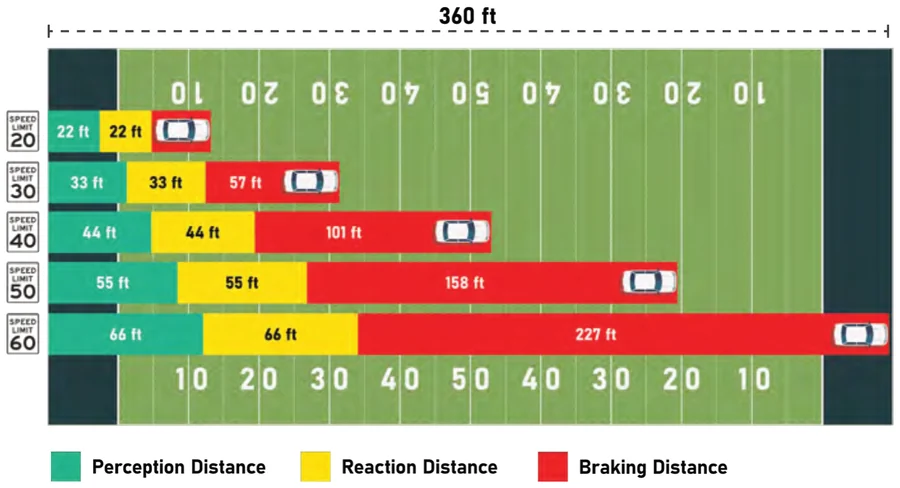
Total stopping distance chart
Perception, reaction and braking distance at 20–60 mph

Distances by speed (from the chart)

Distances by speed (from the chart)
SpeedPerceptionReactionBraking
30 mph33 ft33 ft57 ft
40 mph44 ft44 ft101 ft
50 mph55 ft55 ft158 ft
60 mph66 ft66 ft227 ft
Handbook p. 69 ↗

Speed vs. braking distance and impact

Speed vs. braking distance and impact
If you…Braking distance and impact
Double your speed4 times greater
Triple your speed9 times greater
Quadruple your speed16 times greater
Handbook p. 68 ↗

Know the rule

High speeds greatly increase stopping distance and crash severity. The faster you drive, the greater your vehicle's impact or striking power.

Handbook p. 68 ↗

Put it into practice

At 50 mph a child runs into the road 200 feet ahead. Even an alert driver needs a minimum of 268 feet to stop, so you would still be moving when you reach the child. That is why speed near schools and neighborhoods matters so much.

Check your understanding

Read the question, decide on an answer, then open it to check the explanation. These are Roadwise study questions based on the source handbook.

What is the average perception time for an alert driver to recognize a hazard?
  1. Under 1/4 second
  2. 2 to 3 seconds
  3. 5 seconds
  4. 3/4 to 1 second

Answer: 3/4 to 1 second

The average perception time for an alert driver is 3/4 second to 1 second.
Handbook p. 68 ↗
At 50 mph, how far does a vehicle travel during the average driver's reaction time?
  1. 55 feet
  2. 15 feet
  3. 90 feet
  4. 35 feet

Answer: 55 feet

At 50 mph, the average reaction time of 3/4 to 1 second accounts for about 55 feet traveled.

Handbook p. 68 ↗
At 50 mph on dry pavement with good brakes, approximately how far does braking distance take?
  1. 258 feet
  2. 158 feet
  3. 58 feet
  4. 108 feet

Answer: 158 feet

At 50 mph, on dry pavement with good brakes, braking distance takes about 158 feet.

Handbook p. 68 ↗
If you double your driving speed, what happens to your braking distance and impact?
  1. They become 9 times greater
  2. They stay the same
  3. They become 4 times greater
  4. They double

Answer: They become 4 times greater

Doubling the speed means the braking distance and impact are 4 times greater.

Handbook p. 68 ↗
At 50 mph, what is the approximate total minimum stopping distance?
  1. 158 feet
  2. 268 feet
  3. 400 feet
  4. 100 feet

Answer: 268 feet

At 50 mph, total stopping distance is a minimum of about 268 feet—nearly the length of a football field.

Handbook p. 68 ↗
Perception distance and reaction distance are the same thing.
  1. True
  2. False

Answer: False

Perception distance is the time to recognize a hazard; reaction distance is the additional distance traveled until you physically hit the brakes.

Handbook p. 68 ↗
Take the lesson checkpoint in the app

More in Driving Safety Fundamentals