roadwise.Open study app

Florida driving lesson · Traffic Signals

Railroad crossings

A 4-minute lesson from the Florida course. Read the rules and examples, follow the handbook page references, and check your understanding before you move on.

Read time
4 minutes
Course unit
Traffic Signals
Checkpoint questions
6
Source pages
64, 65, 87, 88

Trains can't stop quickly and are often going faster than they look. Crossings are marked with signs, pavement markings, lights and gates. Know exactly when you must stop, and where you must never stop.

Know the rule

Slow down near a railroad crossing and be ready to stop. Never stop on the tracks or within 15 feet of the crossing.

Handbook p. 64 ↗
15 feet

Never stop on the tracks or this close to a railroad crossing

Handbook p. 64 ↗

Drivers, bicyclists and pedestrians must stop if:

  • The warning devices are flashing
  • The crossing gate is lowered
  • A human flagger warns of an approaching train
  • An approaching train is clearly visible
Handbook p. 64 ↗

Know the rule

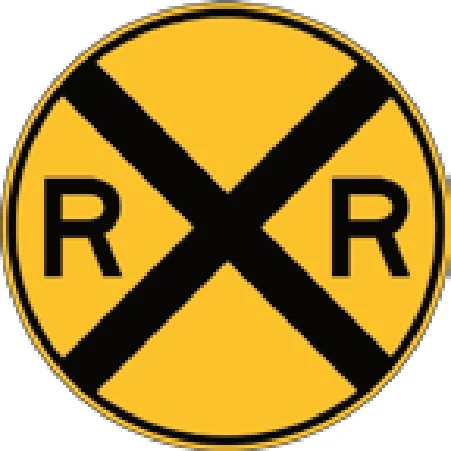
Advance Warning Sign: usually the first sign you see when approaching a highway-railroad crossing.

Handbook p. 64 ↗
Railroad crossing ahead
Railroad advance warning sign

Know the rule

Crossbuck signs are yield signs: yield the right-of-way to trains. A sign below the crossbuck shows the number of tracks if there is more than one.

Handbook p. 64 ↗

Know the rule

When the flashing red lights start, stop immediately. A train is coming. Stop before gates lower, and never drive around or under a gate, whether down or moving.

Handbook p. 64 ↗

Dynamic envelope

White pavement markings shaped like connected X's that show the danger zone next to the tracks, where anything could be struck by a passing train. Don't stop there.

Handbook p. 64 ↗

Remember:

  • Be ready to stop behind buses and trucks; many must stop at crossings even when gates are up
  • With more than one track, make sure all tracks are clear before crossing
  • In heavy traffic, make sure there's room on the other side before crossing
  • Don't try to beat the train; the train always wins
Handbook p. 65 ↗

Know the rule

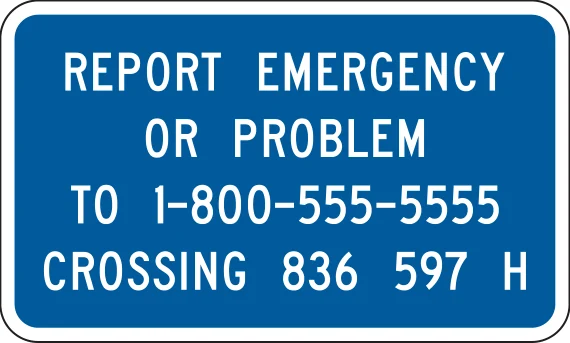
A blue Emergency Notification System (ENS) sign is posted at every highway-rail crossing. It gives the railroad's emergency contact if there's a problem or something is blocking the tracks.

Handbook p. 88 ↗
Emergency notification sign
Blue ENS sign with emergency phone number and crossing ID

Know the rule

If your car stalls on the tracks, get everyone out immediately and away from the car. After the warning lights start flashing, 20 seconds is the minimum time before a train reaches the crossing.

Handbook p. 87 ↗

Know the rule

If a train is coming, run away from the tracks at a 45-degree angle, toward the train, so you're less likely to be hit by your vehicle or debris. Then call 911 or *FHP (*347).

Handbook p. 88 ↗

Put it into practice

Traffic is backed up just past a crossing and the car ahead of you clears the tracks. Stay behind the stop line until there's room for your whole car on the far side, so you never end up stopped on the tracks.

Check your understanding

Read the question, decide on an answer, then open it to check the explanation. These are Roadwise study questions based on the source handbook.

When approaching a railroad crossing, how close to the tracks are you prohibited from stopping?
  1. Within 15 feet
  2. Within 5 feet
  3. Within 25 feet
  4. Within 50 feet

Answer: Within 15 feet

Do not stop on the railroad tracks or within 15 feet of the crossing.
Handbook p. 64 ↗
A crossbuck sign at a railroad crossing functions as what type of sign?
  1. A regulatory speed limit sign
  2. A yield sign; you must yield to trains
  3. A stop sign requiring a full stop every time
  4. A warning sign only, with no legal requirement

Answer: A yield sign; you must yield to trains

Crossbuck signs are yield signs; you must yield the right-of-way to trains.

Handbook p. 64 ↗
Which vehicles are required to stop at railroad crossings even when gates are up and lights are not flashing?
  1. Motorcycles and mopeds
  2. Low-speed vehicles and golf carts
  3. School and city buses and hazmat vehicles
  4. Only vehicles towing trailers

Answer: School and city buses and hazmat vehicles

City and school buses and vehicles carrying hazardous materials are required to stop at railroad crossings, so be ready to stop behind them.

Handbook p. 70 ↗
What are dynamic envelope pavement markings at a railroad crossing designed to show?
  1. A pedestrian crosswalk
  2. The speed limit through the crossing
  3. A bicycle lane
  4. Where road users must not stop

Answer: Where road users must not stop

Dynamic envelope markings are white connecting X's that highlight the danger zone where road users should not stop.

Handbook p. 64 ↗
You must stop at a railroad crossing if an approaching train is clearly visible, even without flashing lights or a lowered gate.
  1. True
  2. False

Answer: True

You must stop if an approaching train is clearly visible, in addition to flashing devices, lowered gates, or a flagger.

Handbook p. 64 ↗
If there is more than one railroad track at a crossing, you only need to make sure the nearest track is clear before proceeding.
  1. True
  2. False

Answer: False

If there is more than one track, make sure all tracks are clear before crossing.

Handbook p. 65 ↗
Take the lesson checkpoint in the app

More in Traffic Signals