Warning signs alert you to what's ahead — a signal, a stop, a merge, a curve, a crossing. Most are yellow diamonds. When you see one, slow down and get ready to stop if needed.
Know the rule
Warning signs are usually yellow with black lettering or symbols, and most are diamond-shaped. They warn you to slow down and be ready to stop because a special situation or hazard is ahead.
Handbook p. 51 ↗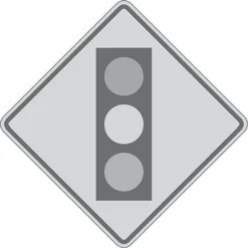
Common warning signs
| Sign | Meaning / what to do |
|---|---|
| Signal Ahead | Traffic signals ahead; slow and prepare to stop |
| Stop Ahead | Stop sign ahead; slow and prepare to stop |
| Reduction in Lanes | Fewer lanes ahead; change lanes or let others merge |
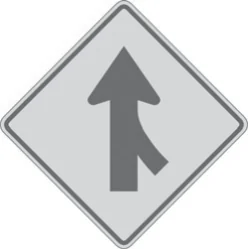
| Merge | Two lanes become one; both lanes merge smoothly |
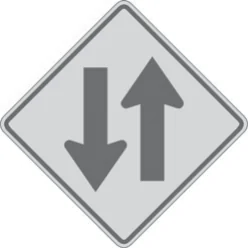
| Two-Way Roadway | Leaving a divided road for two-way traffic |
| No Passing (pennant) | Start of a no-passing zone |
| Advisory Speed Plaque | Advisory speed for a condition, below a sign |
| Divided Highway Begins | Road splits into two one-way roads; keep right |
Pedestrian, school and wet-road warnings:
- Pedestrian Crossing — watch for people crossing; an arrow plaque may show the crosswalk
- School Zone — school grounds nearby; watch for children, be ready to stop, obey crossing guards
- RRFB (Rectangular Rapid Flashing Beacon) — helps pedestrians cross busy streets at unsignalized crossings
- Slippery When Wet — slow down, don't brake hard or turn suddenly, increase following distance
Know the rule
Change in Direction signs (chevrons) warn of a change in direction or narrowing of the road; you may see several on the outside of a sharp curve or approaching a narrow bridge.
Handbook p. 52 ↗Know the rule
Four intersection signs — crossroad, side road, 'T' and 'Y' — warn of intersections where traffic may exist or a turn may be required. A sign naming the crossing road may also be posted.
Handbook p. 52 ↗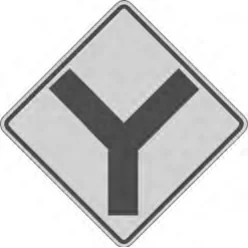
Know the rule
Turn and curve signs are posted before turns and curves; the arrow's shape shows what to expect, and a small maximum safe speed sign may be posted below it.
Handbook p. 52 ↗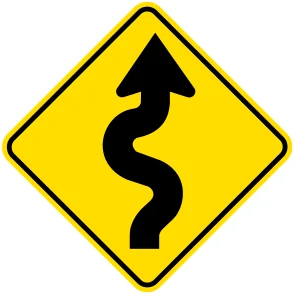
Put it into practice
You see a yellow diamond showing a curved arrow with a '35 MPH' plaque under it. The plaque is the advisory speed for that curve — slow to it before you enter the curve.