roadwise.Open study app

Connecticut driving lesson · Signs, Signals & Pavement Markings

Regulatory signs

A 3-minute lesson from the Connecticut course. Read the rules and examples, follow the handbook page references, and check your understanding before you move on.

Read time
3 minutes
Course unit
Signs, Signals & Pavement Markings
Checkpoint questions
5
Source pages
49, 50

Regulatory signs tell you the law: when to stop, which way to go, where you can't turn or pass, and how fast you may drive. Breaking them is breaking the law, so learn what each one requires.

Know the rule

Regulatory signs are square, rectangular or a special shape, usually white, red or black with black, red, white or green letters or symbols. A red circle with a red slash over a symbol prohibits that action, such as no left turn, no right turn or no U-turn.

Handbook p. 49 ↗
Stop
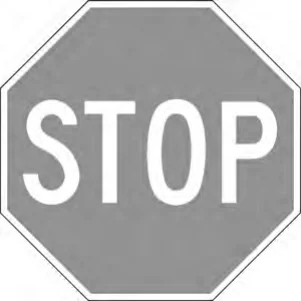
Stop sign

Know the rule

A stop sign has eight sides and is red with white letters. Come to a full stop at the sign or at the stop line if there is one, wait until crossing vehicles and pedestrians clear, and pull forward only when safe.

Handbook p. 49 ↗
Yield
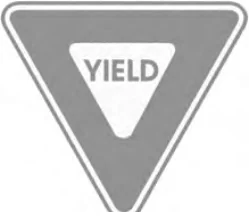
Yield sign

Know the rule

A yield sign is a downward-pointing red-and-white triangle with red letters. Slow down and yield to traffic in the intersection you're crossing or the road you're entering.

Handbook p. 49 ↗
Do not enter
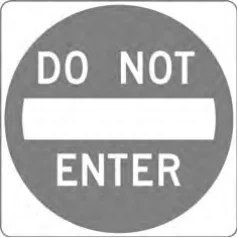
Do Not Enter sign

Know the rule

A Do Not Enter sign — a white horizontal line inside a red ball — means you cannot enter. It appears at exit ramps where you'd go the wrong way, crossovers on divided roadways, and on one-way streets.

Handbook p. 49 ↗

Know the rule

A Wrong Way sign marks a one-way street, expressway ramp, or the wrong side of a divided highway. Do not drive past it — turn around.

Handbook p. 49 ↗

Know the rule

No U-Turn signs are often posted on divided highways or expressways at openings that lead to the other side.

Handbook p. 50 ↗

Other regulatory signs:

  • Movement prohibition — movements not allowed from a lane or approach; may hang over the lane
  • One Way — go only in the direction of the arrow
  • Lane use control — the movements permitted from a lane
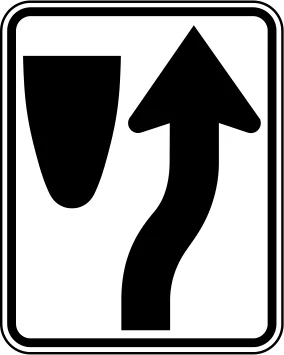
  • Keep Right — pass traffic islands, medians or obstructions on the side the arrow shows
  • No Passing — where passing is not permitted, based on how far you can see ahead
  • Disabled parking — spaces reserved for people with disabled parking privileges
  • Speed limit — the maximum speed for the road
Handbook p. 50 ↗
Keep right
Keep Right sign

Know the rule

Where passing is permitted, you may pass only if it's safe; be aware of road conditions and other vehicles.

Handbook p. 50 ↗

Put it into practice

Exiting a parking garage onto a ramp, you see a red Wrong Way sign ahead. You're about to go against traffic — stop and turn around instead of driving past it.

Check your understanding

Read the question, decide on an answer, then open it to check the explanation. These are Roadwise study questions based on the source handbook.

A regulatory sign shows a red circle with a red slash over a symbol. What does this generally mean?
  1. A certain action is prohibited
  2. A certain action is required
  3. You are entering a school zone
  4. The road ahead curves

Answer: A certain action is prohibited

Regulatory signs with a red circle and red slash over a symbol prohibit certain actions, such as 'no left turn.'
Handbook p. 49 ↗
What color and shape is a 'Do Not Enter' sign?
  1. A yellow triangle
  2. A green rectangle
  3. A red circle with a white bar
  4. An orange diamond

Answer: A red circle with a white bar

A square sign with a white horizontal line inside a red ball means you cannot enter.

Handbook p. 49 ↗
What should you do when you see a 'Wrong Way' sign while driving?
  1. Do not drive past it; turn around
  2. Proceed with caution at reduced speed
  3. Pull onto the shoulder and wait
  4. Turn on your hazard lights and continue

Answer: Do not drive past it; turn around

Do not drive past a Wrong Way sign; turn around, since it marks a one-way street or wrong-direction ramp.

Handbook p. 49 ↗
What must you do at a stop sign before proceeding?
  1. Stop only if other traffic is approaching
  2. Stop fully; wait for cross traffic to clear
  3. Roll through slowly if the way is clear
  4. Slow down; a full stop is optional

Answer: Stop fully; wait for cross traffic to clear

You must come to a full and complete stop at a stop sign and wait until crossing vehicles and pedestrians have cleared.

Handbook p. 49 ↗
What does a 'Keep Right' sign tell you to do?
  1. Pass the obstruction on the side the arrow shows
  2. Yield to traffic on your right
  3. Turn right at the next intersection
  4. Merge into the rightmost lane

Answer: Pass the obstruction on the side the arrow shows

A Keep Right sign tells you where to drive when approaching traffic islands, medians, or other obstructions.

Handbook p. 50 ↗
Take the lesson checkpoint in the app

More in Signs, Signals & Pavement Markings