A 3-minute lesson from the Connecticut course. Read the rules and examples, follow the handbook page references, and check your understanding before you move on.
Some lanes are set aside for buses, bikes, carpools or turning, and some even change direction during the day. Learn the markings and signal lights so you never end up in a lane you're not allowed to use.
Know the rule
Reserved lanes are marked by signs saying the lane is reserved for special use, and often by a white diamond at the roadside or painted on the road. For HOV lanes, posted signs say how many people must be in the vehicle.
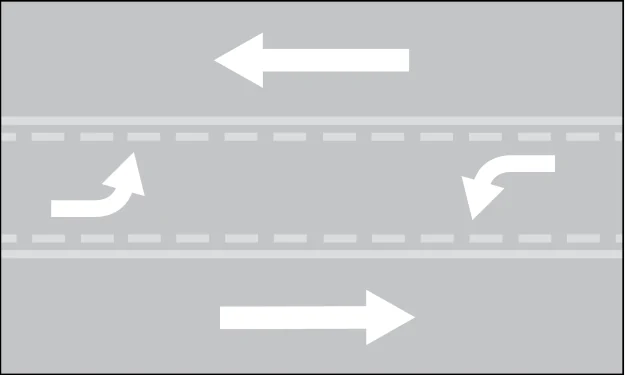
A center lane for left turns (or U-turns where permitted) used by both directions. Left-turn arrows alternate by direction; it's edged by solid and dashed yellow lines.
A lane that carries traffic one way at certain times and the opposite way at other times, usually marked by double-dashed yellow lines, with signs or overhead lights.
Driving at rush hour, you see a steady yellow X above your lane. The lane's direction is about to change — signal and move out of it as soon as it's safe.
Check your understanding
Read the question, decide on an answer, then open it to check the explanation. These are Roadwise study questions based on the source handbook.
What does a white diamond marking or sign typically indicate about a lane?
It marks a no-parking zone
It's a passing lane for trucks only
An HOV or special-use lane
It marks a school zone
Answer: An HOV or special-use lane
A white diamond marker indicates lanes reserved for special use, such as high-occupancy vehicles.