roadwise.Open study app

California driving lesson · Turns, Merging & Parking

Which lane to turn from & into; braking

A 3-minute lesson from the California course. Read the rules and examples, follow the handbook page references, and check your understanding before you move on.

Read time
3 minutes
Course unit
Turns, Merging & Parking
Checkpoint questions
5
Source pages
27, 28

On the drive test and in daily driving, you're judged on starting and ending turns in the correct lane. The rule of thumb: start in the lane closest to where you're turning, and end in the matching lane.

Know the rule

Watch for pedestrians, motorcycles, and bicycles between your vehicle and the curb. Signs or arrows may allow you to turn from, or end in, more than one lane.

Handbook p. 27 ↗

Turn examples 1–4

Turn examples 1–4
TurnStart inEnd in
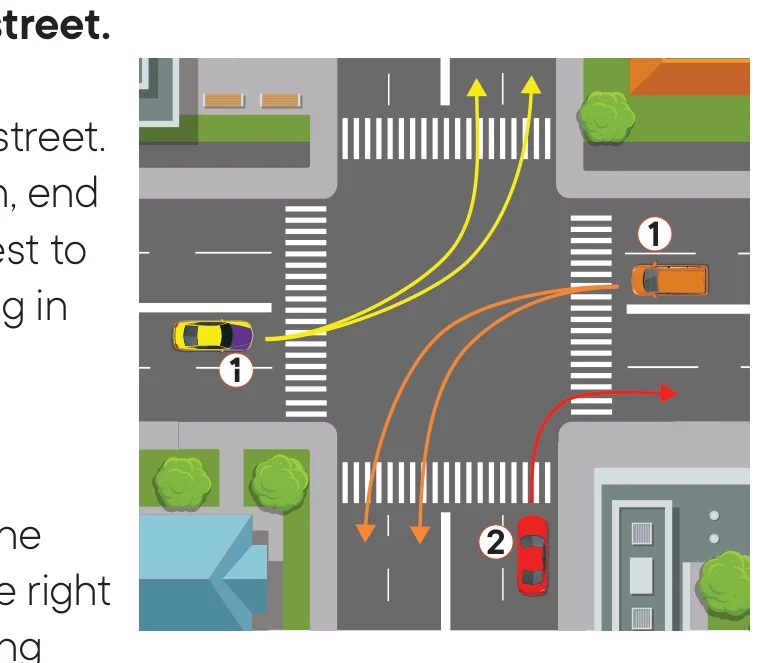
1. Left, two-way onto two-wayLeft lane closest to the middleLeft lane closest to the middle
2. Right turnLane closest to the right edgeLane closest to right edge; no wide swing
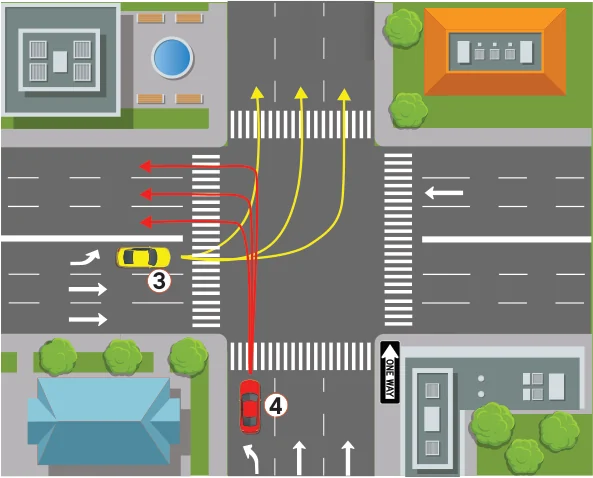
3. Left, two-way onto one-wayLane closest to the middleAny open lane if 3+ lanes your way
4. Left, one-way onto two-wayFar-left laneLeft lane closest to the middle
Handbook p. 27 ↗
Turning from a one-way street diagram
Turns 1 and 2: left and right turns between two-way streets
Multi-lane turn diagram with signal
Turn 3 (two-way onto one-way) and turn 4 (one-way onto two-way)

Turn examples 5–7

Turn examples 5–7
TurnStart inEnd in
5. Left, one-way onto one-wayFar-left laneAny open lane if 3+ lanes your way
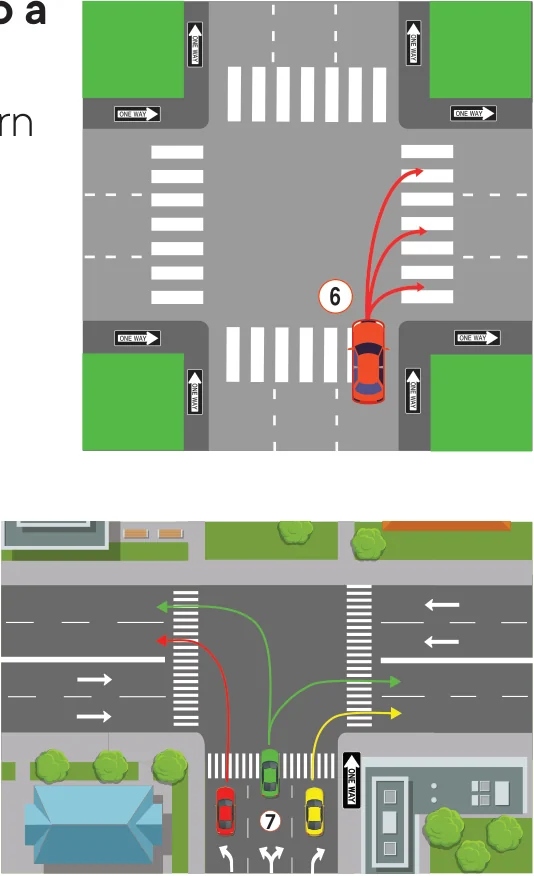
6. Right, one-way onto one-wayFar-right laneAny lane, if safe
7. T intersection, one-way onto two-wayCenter lane: may turn right or leftYield to traffic going straight
Handbook p. 28 ↗

Know the rule

Bicyclists can legally use the left turn lane for their left turns.

Handbook p. 28 ↗

Know the rule

At a T intersection from a one-way street onto a two-way street, traffic going straight through the intersection has the right-of-way.

Handbook p. 28 ↗
Turn path diagram (composite)
Turn 6 (one-way onto one-way) and turn 7 (T intersection)

Braking:

  • Take your foot off the accelerator and let the vehicle slow down
  • Lightly press the brake until you come to a full stop
  • Give yourself enough space and time to do this
  • At a limit line, do not cross over the line
  • Behind another vehicle, stop where you can see its rear wheels
Handbook p. 28 ↗

Put it into practice

You're on a one-way street with three lanes and will turn left onto another one-way street with three lanes. Start from the far-left lane. Because the new street has three or more lanes going your way, you may end in any lane that is open.

Check your understanding

Read the question, decide on an answer, then open it to check the explanation. These are Roadwise study questions based on the source handbook.

What should you do when stopping behind another vehicle?
  1. Stop as close as possible
  2. Leave about 3 feet of space
  3. Stop across the limit line if needed
  4. Leave room to see their rear tires

Answer: Leave room to see their rear tires

When stopping behind a vehicle, leave enough space to see their rear wheels.
Handbook p. 28 ↗
When braking to a stop, you should remove your foot from the accelerator and lightly press the brake.
  1. True
  2. False

Answer: True

Braking technique includes releasing the accelerator and lightly pressing the brake until stopped.

Handbook p. 28 ↗
You turn left from a two-way street onto a one-way street with three lanes going your way. Which lane may you end the turn in?
  1. The far-left lane
  2. The far-right lane
  3. Any lane that is open
  4. The center lane

Answer: Any lane that is open

Turning left onto a one-way street with three or more lanes in your direction, you may end the turn in any lane that is open.

Handbook p. 27 ↗
At a T intersection, you are in the center lane of a one-way street ending at a two-way street. Which way may you turn?
  1. Right only
  2. Either right or left
  3. Left only
  4. Neither; move to an outer lane first

Answer: Either right or left

At a T intersection from a one-way street onto a two-way street, you may turn either right or left from the center lane.

Handbook p. 28 ↗
Turning left from a one-way street onto a two-way street, which lane should you start the turn from?
  1. The far-right lane
  2. The center lane
  3. Any open lane
  4. The far-left lane

Answer: The far-left lane

Start the turn from the far-left lane and end it in the left lane closest to the middle of the street.

Handbook p. 27 ↗
Take the lesson checkpoint in the app

More in Turns, Merging & Parking