roadwise.Open study app

California driving lesson · Turns, Merging & Parking

Left turns

A 3-minute lesson from the California course. Read the rules and examples, follow the handbook page references, and check your understanding before you move on.

Read time
3 minutes
Course unit
Turns, Merging & Parking
Checkpoint questions
4
Source pages
25, 26

Left turns cross oncoming traffic, so position, timing and wheel direction matter. Keep your wheels straight while you wait so a rear-end crash can't push you into oncoming cars.

To turn left:

  • Drive close to the center divider or into the left turn lane
  • Enter a designated left turn lane at the opening; do not cross any solid line
  • Enter a two-way center left turn lane within 200 feet of the turn
  • Start signaling 100 feet before the turn
  • Look over your left shoulder and reduce your speed
  • Stop behind the limit line (or before the crosswalk or intersection if none)
  • Look left-right-left and begin your turn when it is safe
Handbook p. 25 ↗

Know the rule

When entering a two-way center left turn lane, respect the right-of-way of any vehicle, bicyclist, or motorcyclist already in it. Always yield to pedestrians.

Handbook p. 25 ↗

Know the rule

Proceed into the intersection while turning so you complete the turn in the left lane.

Handbook p. 25 ↗

Know the rule

Do not turn the steering wheel too soon and enter the lane of oncoming vehicles.

Handbook p. 25 ↗

Know the rule

Keep your wheels pointed straight ahead until it is safe to start your turn. If they point left and you are hit from behind, you could be pushed into oncoming traffic.

Handbook p. 25 ↗

Know the rule

Accelerate smoothly during and after the turn, and let the steering wheel straighten in the new lane.

Handbook p. 25 ↗
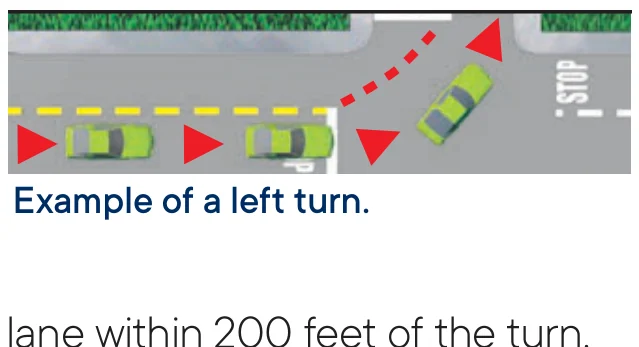
Left turn technique diagram
Example of a left turn

Know the rule

You may turn left against a red light only when turning from a one-way street onto a one-way street, and no sign prohibits it.

Handbook p. 26 ↗

Know the rule

When turning left on red, yield to vehicles, pedestrians, and bicyclists with a green light. Look both ways and turn when safe.

Handbook p. 26 ↗

Put it into practice

You're waiting in the intersection to turn left with oncoming traffic streaming past. Keep your wheels straight, not cranked left. If someone rear-ends you, you'll be pushed forward instead of into the oncoming lane.

Check your understanding

Read the question, decide on an answer, then open it to check the explanation. These are Roadwise study questions based on the source handbook.

How far before a left turn should you start signaling?
  1. 50 feet
  2. 300 feet
  3. 100 feet
  4. 200 feet

Answer: 100 feet

Start signaling 100 feet before a left turn, the same as a right turn.
Handbook p. 25 ↗
Within how many feet of a turn may you enter a two-way center left turn lane?
  1. 50 feet
  2. 500 feet
  3. 20 feet
  4. 200 feet

Answer: 200 feet

You may enter a two-way center left turn lane within 200 feet of the turn.

Handbook p. 25 ↗
When is it legal to turn left against a red light?
  1. From a two-way street onto a one-way street
  2. From a one-way street onto a one-way street
  3. From a one-way street onto a two-way street
  4. Whenever no traffic is coming

Answer: From a one-way street onto a one-way street

You may turn left against a red light only from a one-way street onto a one-way street, if no sign prohibits it, after yielding.

Handbook p. 26 ↗
Why should you keep your wheels pointed straight ahead while waiting to turn left, rather than turning them early?
  1. It signals your intention more clearly
  2. It keeps you out of the crosswalk
  3. If hit from behind, you could be pushed into oncoming traffic
  4. It lets you accelerate faster into the turn

Answer: If hit from behind, you could be pushed into oncoming traffic

Keeping wheels straight until it's safe prevents being pushed into oncoming traffic if hit from behind.

Handbook p. 25 ↗
Take the lesson checkpoint in the app

More in Turns, Merging & Parking