roadwise.Open study app

California driving lesson · Lane Markings & Lane Types

Bicycle lanes & bike markings

A 3-minute lesson from the California course. Read the rules and examples, follow the handbook page references, and check your understanding before you move on.

Read time
3 minutes
Course unit
Lane Markings & Lane Types
Checkpoint questions
6
Source pages
23

Bicycle lanes run alongside vehicle traffic and are for bicyclists only. You may enter one only in a few situations, and you must check for cyclists first.

Know the rule

Bicycle lanes are typically marked by a single solid white line and signs, and are sometimes painted bright green to make them easier to see.

Handbook p. 23 ↗

It is illegal to drive in a bicycle lane unless you are:

  • Parking (where permitted)
  • Entering or leaving the road
  • Turning (within 200 feet of an intersection)
Handbook p. 23 ↗
200 ft

You may enter a bike lane within this distance of an intersection to turn

Handbook p. 23 ↗

Types of bike lanes and markings

Types of bike lanes and markings
TypeWhat it is
Bike laneSolid white line that turns dashed near intersections
Buffered bike laneChevrons/diagonal markings add separation
Bike routeSigns and shared markings mark a preferred route
Bicycle boulevardShared street that prioritizes bicycle travel
Separated bikewayPhysically separated; cycle track/protected lane
Shared roadway markingsBicyclists can occupy the lane
Handbook p. 23 ↗

Know the rule

A separated bikeway's separation may include flexible posts, grade separation, inflexible barriers, or on-street parking.

Handbook p. 23 ↗

Know the rule

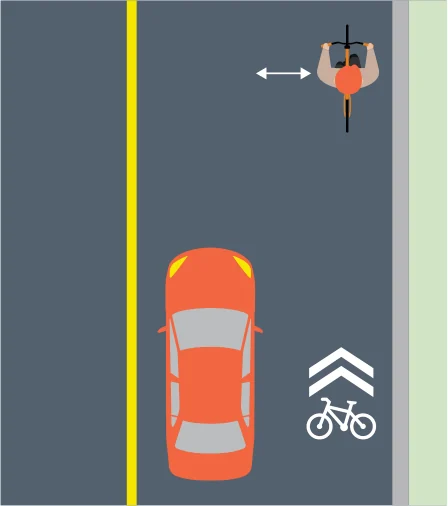
Shared roadway bicycle markings alert drivers that bicyclists can occupy the lane and help bicyclists keep a safe lane position.

Handbook p. 23 ↗
Shared lane marking (sharrow)
Shared roadway marking: keep 3 feet between your car and a cyclist
3 ft

Distance you must keep between your car and a cyclist

Handbook p. 23 ↗

Know the rule

Check your blind spots before entering a bike lane.

Handbook p. 23 ↗

Know the rule

If you drive a motorized bicycle, travel at a reasonable speed and do not endanger other bicyclists.

Handbook p. 23 ↗

Put it into practice

You'll turn right at an intersection 150 feet ahead, and a bike lane runs along the curb. Because you are within 200 feet, check your blind spot for cyclists, signal, then merge into the bike lane and make your turn from there.

Check your understanding

Read the question, decide on an answer, then open it to check the explanation. These are Roadwise study questions based on the source handbook.

Bicycle lanes are typically marked by what?
  1. A single solid white line and signs
  2. A single solid yellow line
  3. Double solid white lines
  4. A broken yellow line

Answer: A single solid white line and signs

Bicycle lanes are typically marked by a single solid white line and signs.
Handbook p. 23 ↗
When may you legally drive in a bicycle lane?
  1. Whenever traffic in your lane is heavy
  2. To turn within 200 feet of an intersection
  3. To pass a slow vehicle on the right
  4. To turn within 500 feet of an intersection

Answer: To turn within 200 feet of an intersection

You may drive in a bike lane to park where permitted, enter or leave the road, or turn within 200 feet of an intersection.

Handbook p. 23 ↗
What is a buffered bike lane designed to provide?
  1. A lane shared with buses
  2. More space between bikes and traffic
  3. A turn lane for vehicles
  4. A lane cars may use to park

Answer: More space between bikes and traffic

A buffered bike lane uses chevrons or diagonal markings to give greater separation from traffic and on-street parking.

Handbook p. 23 ↗
How much distance must a driver maintain between their car and a cyclist while passing?
  1. One foot
  2. Five feet
  3. Ten feet
  4. Three feet

Answer: Three feet

Three feet of distance must be maintained between a car and a cyclist.

Handbook p. 23 ↗
A separated bikeway, also called a cycle track, is characterized by what?
  1. Physical separation from traffic
  2. Green paint with no barrier
  3. Shared road markings in the lane
  4. Chevrons painted beside the lane

Answer: Physical separation from traffic

A separated bikeway is physically separated from motor vehicle traffic for exclusive bicyclist use.

Handbook p. 23 ↗
Before entering a bike lane to prepare for a turn, what should you do?
  1. Sound your horn
  2. Check your blind spots
  3. Turn on your emergency flashers
  4. Come to a complete stop

Answer: Check your blind spots

Check your blind spots before entering a bike lane.

Handbook p. 23 ↗
Take the lesson checkpoint in the app

More in Lane Markings & Lane Types