roadwise.Open study app

California driving lesson · Lane Markings & Lane Types

White lines, lane-end markings & yield lines

A 3-minute lesson from the California course. Read the rules and examples, follow the handbook page references, and check your understanding before you move on.

Read time
3 minutes
Course unit
Lane Markings & Lane Types
Checkpoint questions
5
Source pages
19, 20

White lines separate lanes moving in the same direction. Solid white discourages or forbids lane changes; broken white means you may change lanes when safe.

Know the rule

A single solid white line marks traffic lanes going in the same direction, including on one-way streets.

Handbook p. 19 ↗

Know the rule

Double solid white lines are a lane barrier between a regular-use lane and a preferential-use lane, such as a carpool (HOV) lane.

Handbook p. 20 ↗

Know the rule

You may also see double solid white lines in or near freeway on-ramps and off-ramps.

Handbook p. 20 ↗

Know the rule

Never change lanes over double solid white lines. Wait until you see a single broken white line.

Handbook p. 20 ↗

Know the rule

Broken white lines separate traffic lanes on roads with two or more lanes going the same direction.

Handbook p. 20 ↗

Know the rule

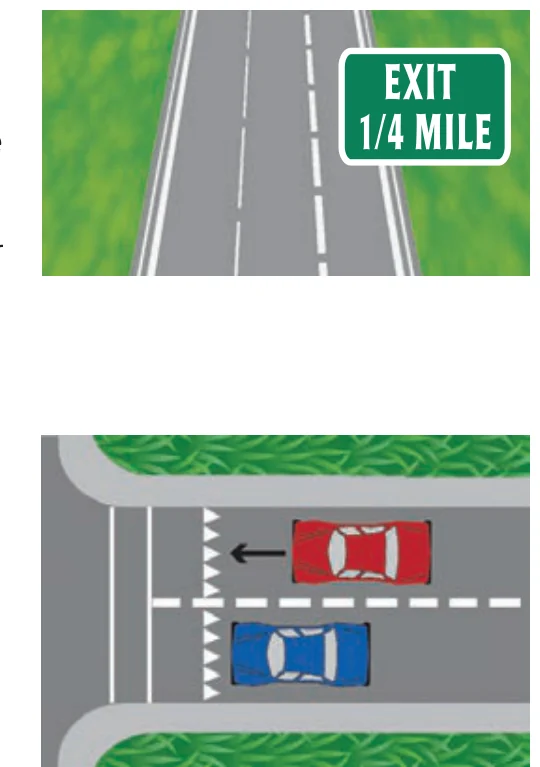
Ending freeway and street lanes are usually marked with large broken lines. In such a lane, be prepared to exit or for the lane to end, and look for an exit or merge sign.

Handbook p. 20 ↗

Yield line

A line of solid white triangles showing approaching vehicles where to yield or stop. The triangles point toward approaching vehicles.

Handbook p. 20 ↗
Exit sign and lane change diagram (composite)
Top: large broken lines mark an exiting lane. Bottom: a yield line of white triangles

Line color and pattern at a glance

Line color and pattern at a glance
LineMeaning
Single solid yellowCenter of a two-way road
Broken yellow (your side)You may pass when safe
Double solid yellowDo not pass over (limited exceptions)
Single solid whiteLanes going the same direction
Double solid whiteBarrier; never change lanes over it
Broken whiteLanes going same direction; may change
Handbook p. 20 ↗

Put it into practice

You're in the left lane beside a carpool lane separated by double solid white lines. You want to enter the carpool lane. Keep driving until the lines become a single broken white line, then signal and move over.

Check your understanding

Read the question, decide on an answer, then open it to check the explanation. These are Roadwise study questions based on the source handbook.

What do double solid white lines typically separate?
  1. Opposing directions of traffic
  2. A bike lane from a parking lane
  3. A regular lane from a carpool lane
  4. A freeway from a frontage road

Answer: A regular lane from a carpool lane

Double solid white lines indicate a barrier between a regular lane and a preferential lane like an HOV lane.
Handbook p. 20 ↗
You see large broken lane markings and a freeway lane appears to be ending. What should you do?
  1. Be ready to exit or merge; watch for signs
  2. Speed up to pass before it ends
  3. Stop and wait for a gap
  4. Move left across the solid line

Answer: Be ready to exit or merge; watch for signs

Large broken lines mark an ending freeway or street lane; be prepared to exit or merge and watch for a sign.

Handbook p. 20 ↗
What shape are the markings in a yield line?
  1. Yellow triangles
  2. White triangles
  3. White diagonal stripes
  4. A solid white bar

Answer: White triangles

A yield line is a line of solid white triangles showing approaching vehicles where to yield or stop.

Handbook p. 20 ↗
May you change lanes across a double solid white line?
  1. Yes, at any time it's safe
  2. Yes, but only on a one-way street
  3. No, never
  4. Yes, if signaled first

Answer: No, never

You should never change lanes over double solid white lines; wait for a single broken white line.

Handbook p. 20 ↗
A single solid white line marks traffic lanes going in the same direction, including one-way streets.
  1. True
  2. False

Answer: True

A single solid white line marks lanes traveling the same direction, including one-way streets.

Handbook p. 19 ↗
Take the lesson checkpoint in the app

More in Lane Markings & Lane Types