A 3-minute lesson from the Alabama course. Read the rules and examples, follow the handbook page references, and check your understanding before you move on.
Where your car ends up after a turn depends on whether you're turning from and onto two-way or one-way streets. Turning around and taking curves have their own rules.
Proper turning rules:
Plan ahead
Be in the proper lane well before the turn, following the steps to change lanes
Signal the direction you plan to turn
Reduce your speed and check for persons and vehicles in your turning path
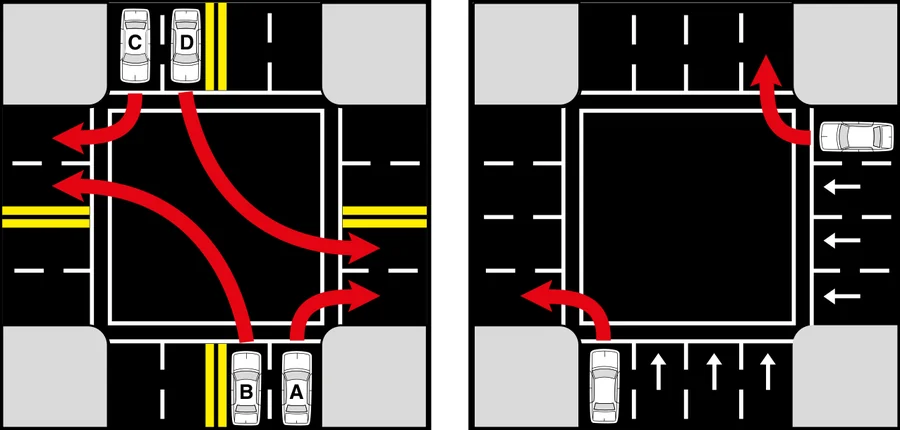
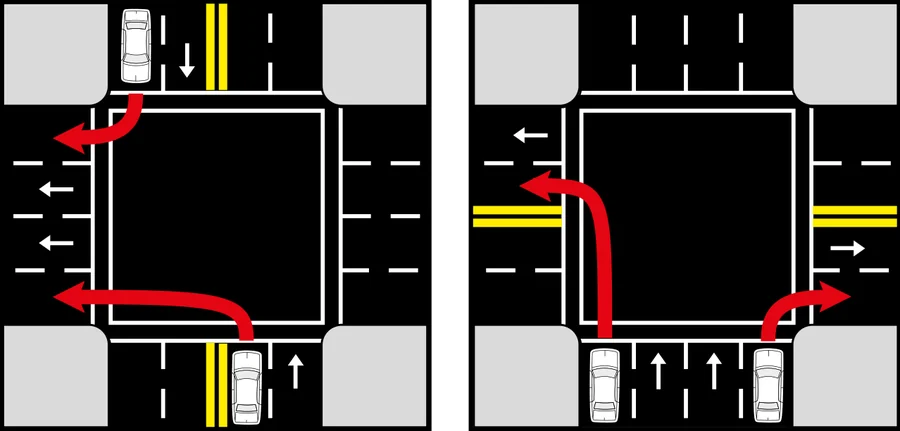
Right turns (cars A and C) and left turns (cars B and D) from two-way streets, and turns from one-way onto one-wayTurns from two-way onto one-way, and from one-way onto two-way
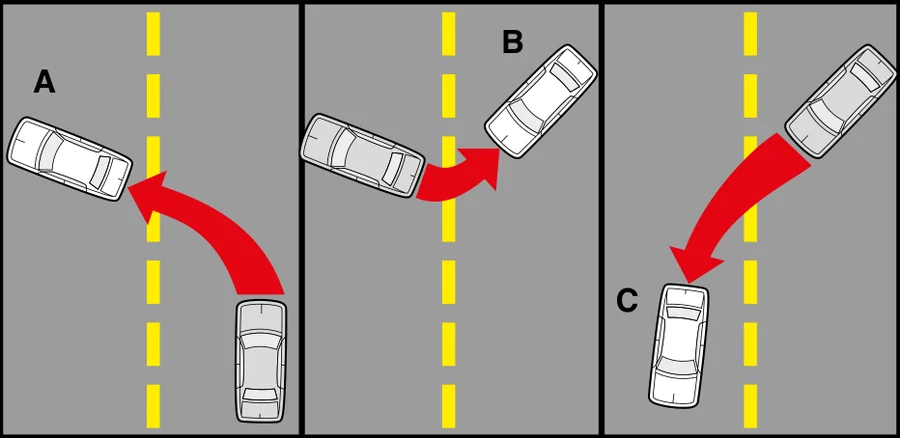
Three-point turn
Turning your vehicle around to drive in the opposite direction. It must be made without endangering other traffic.
Three-point turns are governed by local ordinances, and there may be no signs to warn you. Prohibitory signs are usually posted at hazardous locations.
Slow down before entering a curve, or you risk crossing the center line or leaving the roadway. Enter slowly enough that you can accelerate slightly while rounding the curve.
You passed the house you were looking for on a two-lane road just below the crest of a hill. Don't turn around there, because drivers coming over the hill couldn't see you within 500 feet. Drive on to a spot with a long, clear view in both directions.
Check your understanding
Read the question, decide on an answer, then open it to check the explanation. These are Roadwise study questions based on the source handbook.
Three-point turns are prohibited near the top of a hill unless you can be seen by approaching drivers from how far away?
500 feet
100 feet
1,000 feet
250 feet
Answer: 500 feet
Three-point turns aren't permitted near hilltops where you can't be seen by approaching drivers within 500 feet.