Roadwise States Alabama Driving lessons Parking rules Alabama driving lesson · The Driving Task
Parking rules A 3-minute lesson from the Alabama course. Read the rules and examples, follow the handbook page references, and check your understanding before you move on.
Read time 3 minutes
Course unit The Driving Task
Checkpoint questions 6
Source pages 30, 31 Parking rules keep your car from rolling into traffic and keep it out of places where it blocks views, emergency access or other drivers. The distances are favorite test questions.
Know the rule
Any vehicle left standing along a rural highway must be moved off the paved or main traveled part of the road. If it can't be moved, use lights and markings to warn other traffic.
Handbook p. 30 ↗ Know the rule
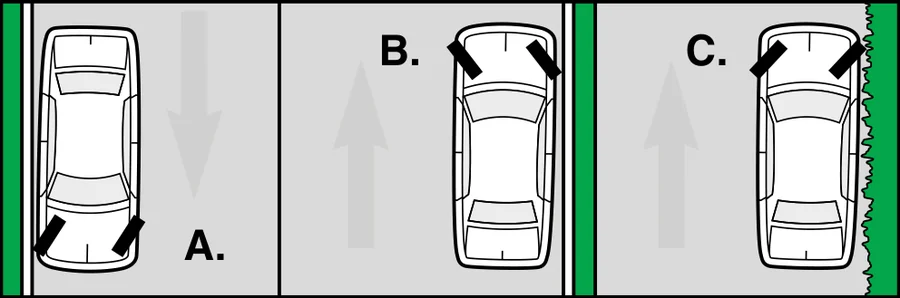
On a hill, always set the hand brake and shift to PARK. If you have no PARK position, shift to reverse or low gear.
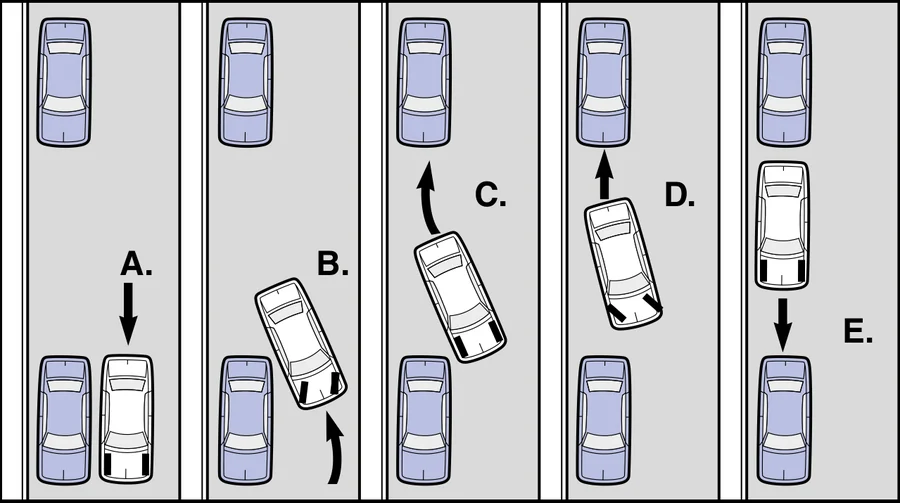
Handbook p. 30 ↗ Hill parking: A downhill, B uphill with curb, C uphill without curb Parking is NOT allowed: Within intersections On a crosswalk or a sidewalk Within 20 feet of a crosswalk at an uncontrolled intersection Within 30 feet of a flashing beacon, stop sign or traffic signal at the side of the road Within 50 feet of the nearest rail of a railroad crossing Within 15 feet of a fire hydrant In front of a driveway Upon any bridge or in a tunnel On the roadway side of a vehicle parked at the curb or edge Beside a curb painted yellow, or where official signs prohibit parking Handbook p. 31 ↗ Steps in parallel parking: A. Pull even with the parked car ahead of the space (car 1) B. Maneuver gently toward the space C. Turn your wheels sharply D. Begin straightening your wheels E. Finish with your wheels parallel to the curb Handbook p. 31 ↗ Parallel parking steps A to E Put it into practice
You park facing uphill on a street with a curb. Turn your front wheels away from the curb, shift into PARK (or low gear), and set the hand brake. If the brakes fail, the tires roll back against the curb instead of into traffic.
A useful reminder Parking distances climb 15-20-30-50: hydrant 15 ft, crosswalk 20 ft, stop sign/signal 30 ft, railroad rail 50 ft.
Check your understanding Read the question, decide on an answer, then open it to check the explanation. These are Roadwise study questions based on the source handbook.
Parking is prohibited within how many feet of a fire hydrant? Within 10 feet Within 15 feet Within 30 feet Within 20 feet Answer: Within 15 feet
Parking is prohibited within 15 feet of a fire hydrant.
Handbook p. 31 ↗ How close to an uncontrolled intersection crosswalk are you prohibited from parking? Within 15 feet Within 30 feet Within 20 feet Within 50 feet Answer: Within 20 feet
Parking is not allowed within 20 feet of a crosswalk at an uncontrolled intersection.
Handbook p. 31 ↗ How close to the nearest rail of a railroad crossing is parking prohibited? Within 15 feet Within 20 feet Within 100 feet Within 50 feet Answer: Within 50 feet
Parking is prohibited within 50 feet of the nearest rail of a railroad crossing.
Handbook p. 31 ↗ How close to a stop sign or traffic signal located at the roadside are you prohibited from parking? Within 30 feet Within 15 feet Within 20 feet Within 50 feet Answer: Within 30 feet
Parking is prohibited within 30 feet of any flashing beacon, stop sign, or traffic control signal at the roadside.
Handbook p. 31 ↗ When parking downhill facing a curb, which way should you turn your wheels? Away from the curb Toward the curb Either way, if in PARK Straight ahead Answer: Toward the curb
Facing downhill with a curb, turn your wheels toward the curb so the car will roll into the curb if the brakes fail.
Handbook p. 30 ↗ When parking uphill with no curb present, which way should you turn your wheels? Straight ahead only Either way, if in low gear Toward the center of the road Toward the edge of the road Answer: Toward the edge of the road
With no curb, turn your wheels toward the edge of the road whether facing uphill or downhill.
Handbook p. 30 ↗ Previous lesson Sharing the road with trucks and buses Next lesson Seat belts and child restraints About the source Roadwise’s Alabama course uses the driver handbook edition supplied with this study pack. This lesson cites source pages 30, 31. The linked PDF is a third-party mirror of the handbook, rather than a government-hosted page.
Open the handbook source PDF · View the source edition
For current application requirements, fees, appointments, and the format that applies to your age or license type, check Alabama’s ALEA. Roadwise provides study material and does not issue permits or licenses.