roadwise.Open study app

Alabama driving lesson · The Driving Task

Sharing the road with bicycles

A 4-minute lesson from the Alabama course. Read the rules and examples, follow the handbook page references, and check your understanding before you move on.

Read time
4 minutes
Course unit
The Driving Task
Checkpoint questions
6
Source pages
25, 26, 27, 52

People on bicycles have the same rights and responsibilities as drivers. They're small, slower and unprotected, so a crash can seriously injure or kill them. As the driver of the more dangerous vehicle, it's on you to take extra care.

Know the rule

A bicyclist must ride as close as practicable to the right curb or edge, except when passing, preparing for a left turn, or avoiding hazards like debris, opening car doors or pedestrians.

Handbook p. 25 ↗

Know the rule

People on bicycles may ride two abreast at all times.

Handbook p. 25 ↗

Bicyclists must:

  • Ride with the flow of traffic
  • Signal turns, lane changes and stops with the same hand and arm signals drivers use
  • Use a bicycle lane where one is available
  • Stay off sidewalks: riding a bicycle on the sidewalk is illegal in Alabama
  • Wear a securely fastened helmet if under 16, on public roads, rights-of-way, bike paths and parks
Handbook p. 26 ↗

Bicycle lane

Part of a roadway designated by striping, signing and pavement markings for preferential or exclusive use by bicycles. Sidewalks and multipurpose paths don't qualify.

Handbook p. 26 ↗
3 feet

Minimum distance required by Alabama law when passing a person on a bicycle

Handbook p. 26 ↗
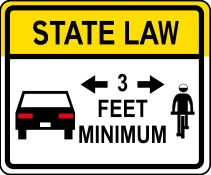
State law: 3 feet minimum passing distance
STATE LAW: 3 feet minimum clearance when passing

Know the rule

Don't drive in a bicycle lane except to park where parking is permitted, to enter or leave the highway, or to prepare for a turn. When turning across one, merge into it before the turn, if that doesn't endanger a cyclist in it.

Handbook p. 26 ↗

Passing a person on a bicycle:

  • Pass with the same caution and respect as you would another motor vehicle
  • Avoid passing uphill or in a curve, where visibility is limited
  • Don't pass when other vehicles are in the lane you'd have to use
  • On a narrow road, stay back at a safe interval; don't tailgate or blast your horn
  • At higher speeds your vehicle's wind currents can batter a cyclist
Handbook p. 26 ↗

Watch especially for cyclists:

  • At intersections, crossing sidewalks, and entering or leaving alleys and driveways
  • In wet weather, when a bicycle's braking ability is greatly reduced
  • At night: bicycles should have lights or reflectors, but darkness is still dangerous
Handbook p. 27 ↗
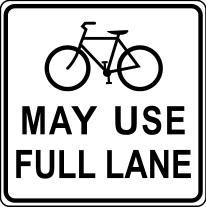
Bicycle may use full lane
MAY USE FULL LANE: a cyclist may use the full lane if the travel lane is narrow

Know the rule

Shared lane markings (sharrows) tell road users that people on bicycles might occupy the travel lane.

Handbook p. 52 ↗

Put it into practice

You come up behind a cyclist on a narrow two-lane road with a car coming the other way. Stay back at a safe distance without honking. Once the oncoming lane is clear and you can see ahead, pass with at least 3 feet between your car and the cyclist.

Check your understanding

Read the question, decide on an answer, then open it to check the explanation. These are Roadwise study questions based on the source handbook.

What is the minimum distance Alabama law requires when passing a person on a bicycle?
  1. 5 feet
  2. 3 feet
  3. 1 foot
  4. 2 feet

Answer: 3 feet

Alabama law requires passing a bicyclist with a distance of not less than 3 feet between the vehicle and the bicycle.
Handbook p. 26 ↗
Under what age must a bicyclist wear a securely fastened helmet on Alabama public roadways?
  1. Under 18 years old
  2. Under 12 years old
  3. Under 16 years old
  4. Under 21 years old

Answer: Under 16 years old

Bicyclists under age 16 are required to wear a securely fastened protective helmet.

Handbook p. 26 ↗
When a bicycle lane is available on a roadway, bicyclists are generally required to do what?
  1. Ride on the sidewalk instead
  2. Ride only in the center of the travel lane
  3. Ride against traffic in the bike lane
  4. Use the bicycle lane

Answer: Use the bicycle lane

Where a bicycle lane is available, bicyclists must use it.

Handbook p. 26 ↗
A motorist turning across a bicycle lane should do what before making the turn?
  1. Turn from the travel lane across the bike lane
  2. Straddle the bike lane line
  3. Move into the bike lane before turning, if safe
  4. Sound the horn before turning

Answer: Move into the bike lane before turning, if safe

Drivers must move into the bicycle lane before turning, as long as doing so doesn't encroach on the cyclist's safety.

Handbook p. 26 ↗
A motor vehicle may legally drive in a designated bicycle lane in which situation?
  1. To enter/leave the road or to turn
  2. At any time if no cyclist is present
  3. Whenever traffic is heavy
  4. To pass a slow bicyclist

Answer: To enter/leave the road or to turn

Vehicles may not drive in a bike lane except to park where permitted, enter or leave the highway, or prepare for a turn.

Handbook p. 26 ↗
A multipurpose path counts as a designated bicycle lane under Alabama law.
  1. True
  2. False

Answer: False

The handbook specifies that neither sidewalks nor multipurpose paths qualify as designated bicycle lanes.

Handbook p. 26 ↗
Take the lesson checkpoint in the app

More in The Driving Task