roadwise.Open study app

Alabama driving lesson · The Driving Task

Sharing the road with trucks and buses

A 3-minute lesson from the Alabama course. Read the rules and examples, follow the handbook page references, and check your understanding before you move on.

Read time
3 minutes
Course unit
The Driving Task
Checkpoint questions
6
Source pages
29, 30

Trucks and buses have No-Zones: danger areas around them where crashes are more likely and where your car can "disappear" from the driver's view. Know where they are and how to stay out of them.

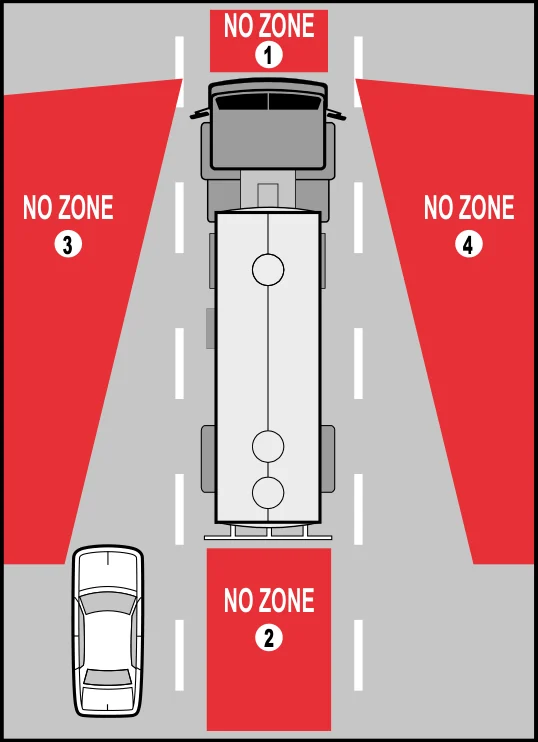
Truck no-zones (blind spots)
The No-Zones beside, behind and in front of a large vehicle

No-Zone

A danger area around a truck or bus where crashes are more likely. Some No-Zones are blind spots where your car disappears from the driver's view.

Handbook p. 29 ↗

Know the rule

Side No-Zones: don't ride alongside a truck or bus. If you can't see the driver's face in the side mirror, the driver can't see you. Pass on the left, as quickly as possible, and get ahead.

Handbook p. 29 ↗
200 feet

How far a truck's or bus's rear No-Zone may extend

Handbook p. 29 ↗

Know the rule

Rear No-Zones: avoid tailgating. You can't see ahead, and if the truck brakes suddenly you have nowhere to go. At night, always dim your headlights when following a large vehicle.

Handbook p. 29 ↗

Know the rule

Front No-Zones: don't cut in too soon after passing. Wait until you see the truck's entire front in your rear-view mirror, and don't slow down.

Handbook p. 30 ↗

Stopping distance at 55 mph (National Safety Council)

Stopping distance at 55 mph (National Safety Council)
VehicleDistance to stop
Passenger car193 feet
Loaded truck430 feet
Handbook p. 30 ↗

Know the rule

Backing No-Zones: never cross behind a truck or bus that's backing up. Their drivers can't see directly behind them.

Handbook p. 30 ↗

Know the rule

Turning No-Zones: trucks and buses swing wide to the left to make a right turn. If the right signal is blinking, don't try to pass on the right.

Handbook p. 30 ↗

Put it into practice

A bus ahead signals right, then drifts left toward the center. Don't slip into the gap on its right. That's the "squeeze play", and you'd be trapped. Wait until the bus finishes the turn.

Check your understanding

Read the question, decide on an answer, then open it to check the explanation. These are Roadwise study questions based on the source handbook.

How far can the rear “No-Zone” blind spot behind a large truck or bus extend?
  1. 200 feet
  2. 50 feet
  3. 20 feet
  4. 500 feet

Answer: 200 feet

The rear No-Zone behind trucks and buses may extend as far as 200 feet, so tailgating them is dangerous.

Handbook p. 30 ↗
At 55 mph, how much stopping distance does a loaded truck need compared with a passenger car?
  1. About 600 feet versus 100 feet for a car
  2. About 430 feet versus 193 feet for a car
  3. About 300 feet versus 250 feet for a car
  4. The same distance as a car

Answer: About 430 feet versus 193 feet for a car

A National Safety Council study found a passenger car needs 193 feet to stop at 55 mph, while a loaded truck needs 430 feet.

Handbook p. 30 ↗
A truck ahead of you is signaling a right turn. What should you do?
  1. Pass on the right while it swings left
  2. Pull up close behind it
  3. Don't pass on the right; wait for the turn
  4. Honk so the driver sees you

Answer: Don't pass on the right; wait for the turn

Trucks swing wide left to make a right turn; passing on the right during this maneuver risks a dangerous “squeeze play.”

Handbook p. 30 ↗
You should never ride alongside a truck or bus in its side blind spot.
  1. True
  2. False

Answer: True

Trucks and buses have large side blind spots; if you can't see the driver's face in the side mirror, the driver can't see you.

Handbook p. 29 ↗
When following a large truck or bus at night, keep your high beams on so its driver can see you.
  1. True
  2. False

Answer: False

False. The handbook says to always dim your headlights when following a large vehicle at night, because bright lights reflect off its side mirrors and blind the driver.
Handbook p. 29 ↗
Never cross behind a truck or bus that is backing up.
  1. True
  2. False

Answer: True

Backing No-Zones warn that large-vehicle drivers cannot see directly behind them, so you should never cross behind a backing truck or bus.

Handbook p. 30 ↗
Take the lesson checkpoint in the app

More in The Driving Task