roadwise.Open study app

Wisconsin driving lesson · Driving Situations

Roundabouts: Entering & Exiting

A 2-minute lesson from the Wisconsin course. Read the rules and examples, follow the handbook page references, and check your understanding before you move on.

Read time
2 minutes
Course unit
Driving Situations
Checkpoint questions
6
Source pages
43

Roundabouts are a safer and more efficient way to move traffic through an intersection. Everyone circles counterclockwise, drivers entering yield, and nobody changes lanes inside.

Know the rule

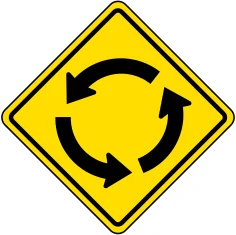
Traffic in a roundabout moves counterclockwise.

Handbook p. 43 ↗

Know the rule

Watch the signs as you approach to see which lane you need. Generally the left lane is for turning left, the right lane for the next right turn, and the middle lane for going straight.

Handbook p. 43 ↗

As you reach a roundabout

  • Slow down
  • Yield to pedestrians and bicycles
  • Yield to traffic on your left that is already in the roundabout
  • Yield to semitrucks
  • Enter when there's a safe gap in traffic
  • Keep your speed low and stay in your lane
  • As you reach your exit, turn on your right turn signal and exit
Handbook p. 43 ↗

Know the rule

If there's no traffic in the roundabout, you don't need to wait to enter.

Handbook p. 43 ↗

Know the rule

Do not switch lanes while you are in the roundabout.

Handbook p. 43 ↗

Know the rule

Yield to emergency vehicles with sirens on. If you haven't entered yet, pull over and let them pass. If you're already inside, exit at the next right, then pull over. Avoid stopping in the roundabout.

Handbook p. 43 ↗
Roundabout ahead
Roundabout Ahead warning sign

Put it into practice

You're halfway around a roundabout when you hear a siren behind you. Don't stop inside the circle. Keep going to the next exit on the right, leave the roundabout, then pull over and let the emergency vehicle pass.

Check your understanding

Read the question, decide on an answer, then open it to check the explanation. These are Roadwise study questions based on the source handbook.

Which direction does traffic move in a roundabout?
  1. Clockwise
  2. Clockwise in multi-lane roundabouts
  3. Toward the nearest exit
  4. Counterclockwise

Answer: Counterclockwise

Traffic moves counterclockwise in a roundabout.

Handbook p. 43 ↗
In a roundabout, who must you yield to before entering?
  1. No one, entering traffic always has the right-of-way
  2. Only vehicles signaling to exit
  3. Only oncoming traffic
  4. Traffic in it, pedestrians, bicycles and semitrucks

Answer: Traffic in it, pedestrians, bicycles and semitrucks

Yield to pedestrians, bicycles, traffic already in the roundabout, and semitrucks.

Handbook p. 43 ↗
What should you never do while inside a roundabout?
  1. Yield to pedestrians
  2. Signal your exit
  3. Switch lanes
  4. Keep your speed low

Answer: Switch lanes

Do not switch lanes while you are in the roundabout.

Handbook p. 43 ↗
If there is no traffic in the roundabout, what should you do before entering?
  1. Come to a full stop first
  2. You don't need to wait to enter
  3. Wait a full 5 seconds regardless
  4. Wait for a green signal

Answer: You don't need to wait to enter

If there's no traffic in the roundabout, you do not need to wait to enter.

Handbook p. 43 ↗
If an emergency vehicle approaches while you are already inside a roundabout, you should:
  1. Safely exit at the next right, then pull over
  2. Pull over to the inside of the roundabout
  3. Speed up to exit before it catches up
  4. Stop immediately inside the roundabout

Answer: Safely exit at the next right, then pull over

If already in the roundabout, exit at the next right, then pull over for the emergency vehicle.

Handbook p. 43 ↗
How should you signal as you approach your exit in a roundabout?
  1. No signal is needed
  2. Turn on your left turn signal
  3. Use your right turn signal
  4. Use your hazard lights

Answer: Use your right turn signal

Turn on your right turn signal as you reach your exit.

Handbook p. 43 ↗
Take the lesson checkpoint in the app

More in Driving Situations