A 3-minute lesson from the Wisconsin course. Read the rules and examples, follow the handbook page references, and check your understanding before you move on.
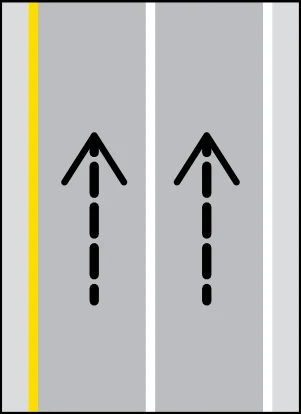
Lines on the road divide it into lanes and tell you when you may pass, change lanes or turn. Color is the first clue: white lines separate traffic going your way, yellow lines separate traffic going opposite ways.
Know the rule
Line markings and symbols divide the road into lanes, show when you can pass or change lanes, and which lanes you can use for turns. Line colors tell you if the road is one-way or two-way.
A place for pedestrians to cross safely, normally at intersections but sometimes mid-street or mid-block. Pedestrians may get signals telling them when to cross.
On a two-lane road with double solid yellow lines, you come up behind a car creeping at 20 mph in a 55 mph zone, under half the limit. You may pass if it's safe. If it were a tractor or other farm equipment, you could not.
Check your understanding
Read the question, decide on an answer, then open it to check the explanation. These are Roadwise study questions based on the source handbook.
What does a solid white line on the road indicate?
The right edge of the lane
The left edge of the traffic lane
A pedestrian crossing
A no-passing zone
Answer: The right edge of the lane
A solid white line indicates the right edge of the traffic lane.