Roadwise States West Virginia Driving lessons Sharing the road with trucks West Virginia driving lesson · Sharing the Road
Sharing the road with trucks A 3-minute lesson from the West Virginia course. Read the rules and examples, follow the handbook page references, and check your understanding before you move on.
Read time 3 minutes
Course unit Sharing the Road
Checkpoint questions 6
Source pages 62, 63 Heavy trucks typically weigh 80,000 pounds. They need far more room to stop and turn, and they have big blind spots called the No-Zone. Stay visible, don't linger beside them, and never cut in front.
3 times Stopping distance a loaded tractor-trailer at 55 mph needs compared to a car
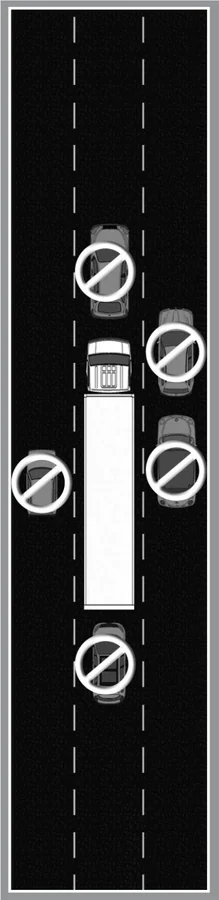
Handbook p. 62 ↗ How trucks differ from cars: They are harder to maneuver, longer and heavier They need much more room to turn They have larger blind spots Handbook p. 62 ↗ No-Zone A truck's blind spots, where the driver cannot see you. You can't avoid them completely, but don't stay in them longer than needed to pass.
Handbook p. 62 ↗ The No-Zone around a truck Know the rule
If you can't see the truck driver's reflection in the side mirror, you're in the driver's blind spot.
Handbook p. 62 ↗ Truck safety DOs: Give trucks plenty of room, and extra room for right turns Give extra space and time when a truck is backing up Avoid lingering in the No-Zone Call authorities if you see unsafe truck driving Handbook p. 63 ↗ Truck safety DON'Ts: Never linger in the No-Zone or underestimate a truck's size or speed Never slam on your brakes in front of a truck Never cut off a truck to reach your exit or turn Never tailgate a truck Never pass a truck on the right during a turn Handbook p. 63 ↗ Put it into practice
You've just passed a tractor-trailer on a dry interstate. Wait until two seconds have passed before merging back to the right, and don't slow down right in front of it: it needs about three times your stopping distance.
Check your understanding Read the question, decide on an answer, then open it to check the explanation. These are Roadwise study questions based on the source handbook.
A fully loaded tractor-trailer traveling at 55 mph needs how much more distance to stop compared to a car? Twice the distance Half again as much distance Three times the distance The same distance Answer: Three times the distance
A fully loaded tractor-trailer at 55 mph needs about three times the stopping distance of a car.
Handbook p. 62 ↗ What are a truck's blind spots commonly called? The Dead Zone The No-Zone The Blind Corridor The Shadow Zone Answer: The No-Zone
A truck's blind spots are called the No-Zone in the handbook.
Handbook p. 62 ↗ How can you tell if you are in a truck's blind spot? Your headlights flash automatically The truck's turn signal starts blinking You cannot see the truck driver's reflection in the side mirror You feel a slight vibration from the engine Answer: You cannot see the truck driver's reflection in the side mirror
If you can't see the truck driver's reflection in their side mirror, you're likely in their blind spot.
Handbook p. 62 ↗ In dry conditions, how many seconds should you wait after passing a truck before merging back in front of it? One second Two seconds Four seconds Six seconds Answer: Two seconds
In dry conditions, give two seconds after passing before merging right in front of a truck; wet conditions call for 4-6 seconds.
Handbook p. 63 ↗ In wet conditions, how many seconds of space should you give a truck before merging in front of it after passing? Four to six seconds Two seconds One to two seconds Ten seconds Answer: Four to six seconds
Wet conditions require giving trucks four to six seconds of space, more than the two seconds needed when dry.
Handbook p. 63 ↗ It is impossible to completely avoid a truck's blind spots. True False Answer: True
The handbook notes it's impossible to completely avoid a truck's No-Zone blind spots.
Handbook p. 62 ↗ Previous lesson Motorcycles and bicycles Next lesson Headlights and driving at night About the source Roadwise’s West Virginia course uses the driver handbook edition supplied with this study pack. This lesson cites source pages 62, 63. The linked PDF is a third-party mirror of the handbook, rather than a government-hosted page.
Open the handbook source PDF · View the source edition
For current application requirements, fees, appointments, and the format that applies to your age or license type, check West Virginia’s DMV. Roadwise provides study material and does not issue permits or licenses.