roadwise.Open study app

Washington driving lesson · Intersections and Turning

Turning, U-turns, and intersection types

A 3-minute lesson from the Washington course. Read the rules and examples, follow the handbook page references, and check your understanding before you move on.

Read time
3 minutes
Course unit
Intersections and Turning
Checkpoint questions
6
Source pages
123, 124, 125

A good turn is planned: signal early, pick the right lane, turn into the nearest lane, and check behind you for bicyclists. Washington also expects you to recognize common intersection shapes and who has the right-of-way at each.

Know the rule

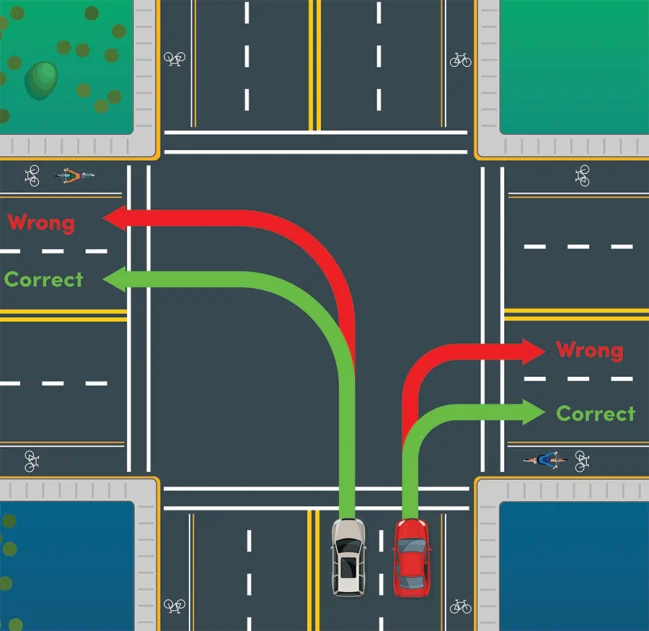
Whether turning left or right, state law requires you to turn into the lane closest to the direction you're coming from.

Handbook p. 123 ↗

Know the rule

With more than one turn lane, stay in your original lane as you turn so you don't veer into another lane.

Handbook p. 123 ↗

Know the rule

Once you complete your turn, you can change to another lane if you need to.

Handbook p. 123 ↗
Correct vs. wrong left-turn path
Correct and wrong turn paths
100 feet

Signal at least this far before turning left or right across oncoming traffic

Handbook p. 123 ↗

Know the rule

Look for a safe gap, and check the street you're turning onto for vehicles, pedestrians, or bicyclists in or approaching your path.

Handbook p. 123 ↗

Know the rule

Check behind you for bicyclists and yield to them before turning. They may be moving toward you faster than you realize.

Handbook p. 123 ↗

Know the rule

U-turns are generally allowed in Washington unless a sign prohibits them. You must have clear visibility in all directions, so never U-turn on a curve or when approaching the crest of a hill.

Handbook p. 124 ↗

Intersection types

Intersection types
TypeWhat it isRight-of-way
Cross intersectionFour-way junction, one or more lanes each wayApply normal right-of-way laws
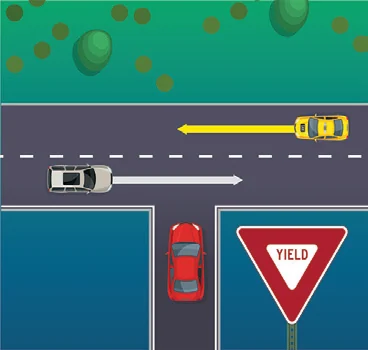
T-intersectionThree-way: a road ends at a through roadA yield or stop sign shows through traffic goes first
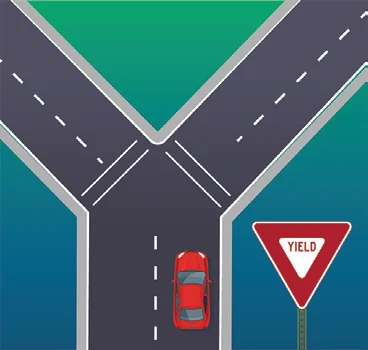
Y-intersectionA minor road connects with a major routeCars on the major road
Mid-block crossingA crosswalk in the middle of the blockPedestrians always, in a marked crosswalk
Handbook p. 124 ↗
T-intersection
T-intersection
Y-intersection
Y-intersection

Know the rule

Stop for pedestrians and bicyclists at a mid-block crossing whether or not it has a stop sign.

Handbook p. 125 ↗

Put it into practice

You're turning left from a one-way street onto a road with two lanes going your way. Turn into the lane closest to you (the left lane), then signal and change lanes after the turn if you need to.

Check your understanding

Read the question, decide on an answer, then open it to check the explanation. These are Roadwise study questions based on the source handbook.

How far before turning left or right across oncoming traffic must you signal?
  1. At least 100 feet
  2. At least 50 feet
  3. At least 300 feet
  4. At least 25 feet

Answer: At least 100 feet

Put on your turn signal at least 100 feet before turning left or right across oncoming traffic.
Handbook p. 123 ↗
When turning at an intersection, which lane must you turn into?
  1. Any open lane on the new road
  2. The far lane, to leave room for others
  3. Whichever lane has the least traffic
  4. The lane closest to the direction you're coming from

Answer: The lane closest to the direction you're coming from

State law requires you to turn into the lane closest to the direction you're coming from.

Handbook p. 123 ↗
Where should you avoid making a U-turn, even where they're generally allowed?
  1. On a one-way street with no traffic
  2. At a T-intersection
  3. On a curve or near a hilltop
  4. In a residential neighborhood

Answer: On a curve or near a hilltop

Don't make a U-turn on a curve or near the crest of a hill, since you need clear visibility in all directions.

Handbook p. 124 ↗
In Washington, when are U-turns generally allowed?
  1. Never, except with an officer's permission
  2. Anywhere, unless a sign prohibits them
  3. Only at intersections with a U-turn sign
  4. Only on one-way streets

Answer: Anywhere, unless a sign prohibits them

In Washington, U-turns are generally allowed unless a sign is posted saying they're not.

Handbook p. 124 ↗
At a Y-intersection where a minor road joins a major route, who usually has the right-of-way?
  1. Vehicles on the major road
  2. Vehicles on the minor road
  3. Whichever vehicle is on the right
  4. Whoever arrives first, regardless of road

Answer: Vehicles on the major road

At a Y-intersection, cars on the major road have the right-of-way over the minor connecting road.

Handbook p. 124 ↗
If there's more than one turn lane at an intersection, what should you do as you turn?
  1. Merge into the outer lane as you turn
  2. Pick whichever lane clears first
  3. Switch lanes halfway through the turn
  4. Stay in your lane through the turn

Answer: Stay in your lane through the turn

With more than one turn lane, stay in your original lane as you turn to avoid veering into another lane.

Handbook p. 123 ↗
Take the lesson checkpoint in the app

More in Intersections and Turning