roadwise.Open study app

Washington driving lesson · Intersections and Turning

Roundabouts and traffic calming circles

A 3-minute lesson from the Washington course. Read the rules and examples, follow the handbook page references, and check your understanding before you move on.

Read time
3 minutes
Course unit
Intersections and Turning
Checkpoint questions
6
Source pages
125, 126, 127

Roundabouts keep traffic moving slowly and in one direction, which cuts down on serious crashes. The key habits: slow down, pick your lane early, yield to everyone already circling, and give big trucks room to use both lanes.

Traffic calming circle

An intersection with a painted or raised center island that traffic flows counterclockwise around. Approaches may have stop or yield signs on all, some, or none.

Handbook p. 125 ↗

Know the rule

Use the same right-of-way rules at a calming circle as at any intersection. They're meant for passenger vehicles; fire trucks, buses, or delivery trucks may have to go clockwise, so give them space.

Handbook p. 125 ↗

Roundabout

A circular intersection where all approaching vehicles yield on entry and travel counterclockwise around a raised center island.

Handbook p. 126 ↗

Know the rule

Roundabouts are designed for cars, fire trucks, buses, delivery vehicles, freight trucks, bicyclists, and pedestrians.

Handbook p. 126 ↗
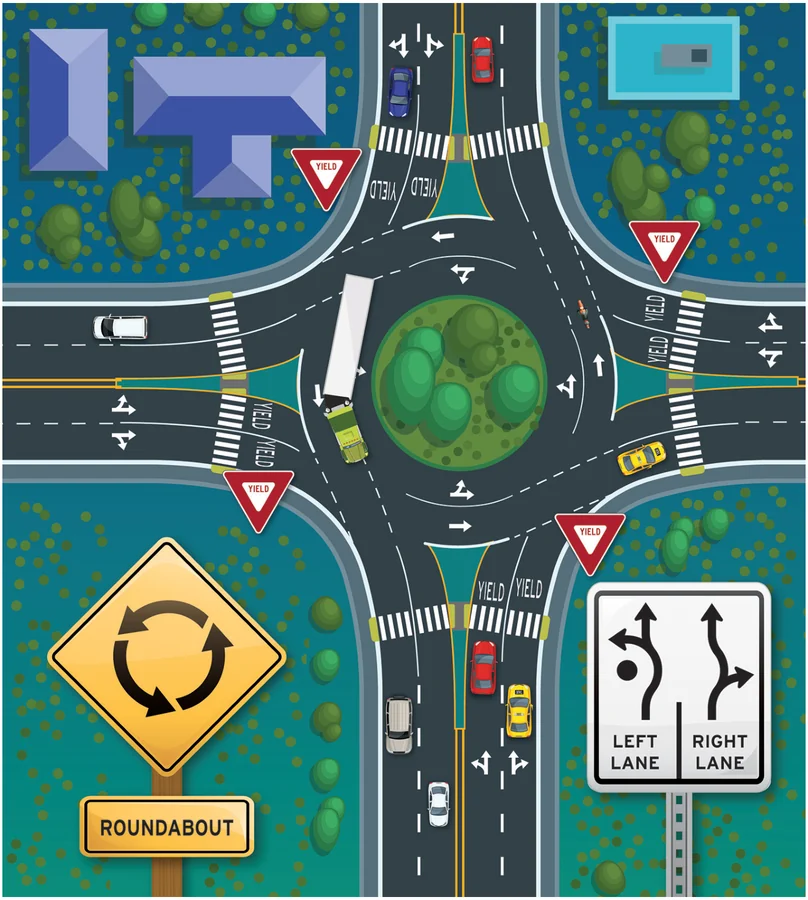
Roundabout intersection (multi-lane)
Two-lane roundabout with yield signs and lane choice sign

Know the rule

Some roundabouts have a truck apron around the central island. Large vehicles are allowed to cross the truck apron and both lanes, so give them plenty of space.

Handbook p. 127 ↗

Know the rule

Bicyclists may go through as a pedestrian or as a vehicle. As a vehicle, they should ride in the middle of the lane to be more visible.

Handbook p. 127 ↗
15 to 25 mph

Speeds roundabouts are designed for

Handbook p. 127 ↗

How to drive a roundabout:

  • 1. Slow down as you approach
  • 2. Pick a lane using the lane choice sign, and stay in it until you exit
  • 3. Stop for pedestrians and bicyclists in crosswalks when entering and exiting
  • 4. Look left and yield to all traffic already in the roundabout; keep back from trucks
  • 5. Enter to the right, traveling counterclockwise, staying in your lane
  • 6. Exit at the street you want
  • 7. If an emergency vehicle approaches, drive through and pull over, as at any intersection
Handbook p. 127 ↗

Put it into practice

You're in the left lane of a two-lane roundabout when an ambulance approaches with sirens. Don't stop in the circle. Continue to your exit, then pull over to let it pass.

Check your understanding

Read the question, decide on an answer, then open it to check the explanation. These are Roadwise study questions based on the source handbook.

What speed range are Washington roundabouts designed for?
  1. 5 to 10 mph
  2. 30 to 40 mph
  3. 25 to 35 mph
  4. 15 to 25 mph

Answer: 15 to 25 mph

Roundabouts are designed for speeds between 15 and 25 mph.
Handbook p. 127 ↗
Once you pick a lane approaching a roundabout, what should you do?
  1. Move to the outer lane only
  2. It doesn't matter which lane you use
  3. Stay in that lane until you exit
  4. Switch lanes freely inside the circle

Answer: Stay in that lane until you exit

Once you pick a lane at a roundabout, stay in it until you exit.

Handbook p. 127 ↗
Who has the right-of-way for traffic already circulating in a roundabout?
  1. Large vehicles always go first
  2. Traffic already in the roundabout
  3. Traffic entering the roundabout
  4. Whichever vehicle is on the right

Answer: Traffic already in the roundabout

Yield to all traffic already in the roundabout — they have the right-of-way.

Handbook p. 127 ↗
Traffic in a Washington roundabout travels clockwise around the center island.
  1. True
  2. False

Answer: False

In a roundabout, all approaching vehicles yield on entry and travel counterclockwise around a raised center island.

Handbook p. 126 ↗
Large vehicles in a roundabout are allowed to cross the truck apron and use both lanes as needed.
  1. True
  2. False

Answer: True

Truck aprons are designed for large vehicles, which may cross them and use both lanes through the roundabout.

Handbook p. 127 ↗
Why might a large vehicle need to travel clockwise through a traffic calming circle instead of counterclockwise?
  1. Clockwise travel is faster for all vehicles
  2. Only emergency vehicles may go clockwise
  3. The circle may not easily accommodate large vehicles going the usual direction
  4. It's always required by law for trucks

Answer: The circle may not easily accommodate large vehicles going the usual direction

Traffic calming circles are sized for passenger vehicles, so large vehicles might need to go clockwise to get through.

Handbook p. 125 ↗
Take the lesson checkpoint in the app

More in Intersections and Turning