roadwise.Open study app

Washington driving lesson · Sharing the Road

School buses and transit buses

A 3-minute lesson from the Washington course. Read the rules and examples, follow the handbook page references, and check your understanding before you move on.

Read time
3 minutes
Course unit
Sharing the Road
Checkpoint questions
6
Source pages
94, 95, 96, 97, 98

Children getting on and off a school bus aren't always predictable or aware of danger. School bus lights work like traffic signals, and the rules about who must stop depend on which side of the bus you're on and how the road is built.

Know the rule

School bus lights: red means stop; yellow means caution or slow down.

Handbook p. 94 ↗

Know the rule

Fines are doubled for anyone who passes a stopped school bus.

Handbook p. 95 ↗

Know the rule

It's unlawful to pass a school bus when its red lights flash. All drivers traveling the same direction must stop when the red lights flash and the stop sign is extended.

Handbook p. 95 ↗

Know the rule

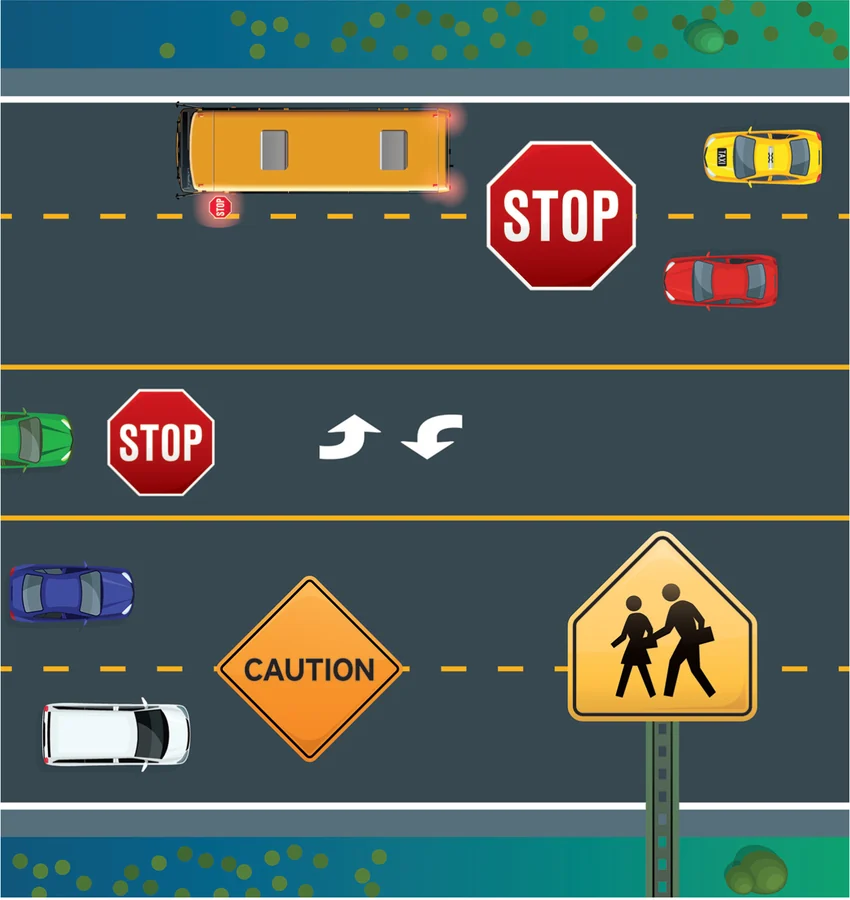
Don't use a center turn lane to pass a school bus. Drivers in all turn lanes must stop.

Handbook p. 95 ↗

You may go only after:

  • The red lights stop flashing
  • The stop sign is retracted
  • The metal arm returns to the front bumper of the bus
Handbook p. 95 ↗

Know the rule

Keep watching for children even after the red lights stop flashing.

Handbook p. 95 ↗

Red lights flashing: who stops?

Red lights flashing: who stops?
RoadBehind the busOncoming traffic
2-lane roadStopStop
Multilane roadStopStop, unless the exceptions below apply
Handbook p. 96 ↗

On a multilane road, oncoming drivers don't need to stop IF:

  • There are three or more lanes
  • Lanes are separated by a median or barrier
Handbook p. 97 ↗
School bus stop with crosswalk
School bus stopped on a multilane road

Know the rule

On a 2-lane road, oncoming traffic may resume when the lights stop flashing, the sign is retracted, and the metal arm returns to the bus's front bumper.

Handbook p. 96 ↗

Know the rule

Yield to any transit vehicle traveling in your direction that has signaled and is pulling back onto the roadway.

Handbook p. 98 ↗

Put it into practice

On a two-lane country road, a school bus coming toward you stops with red lights flashing and its stop sign out. You must stop too, and wait until the lights stop, the sign folds in, and the arm returns to the front bumper.

Check your understanding

Read the question, decide on an answer, then open it to check the explanation. These are Roadwise study questions based on the source handbook.

On a school bus, what do the yellow lights mean?
  1. The bus is broken down
  2. Caution, slow down
  3. Stop immediately
  4. Prepare to pass the bus

Answer: Caution, slow down

School bus lights work like traffic signals: yellow means caution or slow down.
Handbook p. 94 ↗
You're behind a school bus in a center turn lane when its red lights start flashing. What must you do?
  1. Stop, even in a turn lane
  2. Use the turn lane to pass
  3. Only slow down, not stop
  4. Proceed if no children are visible

Answer: Stop, even in a turn lane

Drivers in all turn lanes, including a center turn lane, must stop for a bus's flashing red lights.

Handbook p. 95 ↗
How do fines for passing a stopped school bus compare to typical fines?
  1. They're the same
  2. They're reduced for first offenders
  3. They're capped at $50
  4. They're doubled

Answer: They're doubled

Fines are doubled for anyone who passes a stopped school bus.

Handbook p. 95 ↗
You're driving on a 2-lane road toward a stopped school bus with its red lights flashing. What must you do?
  1. Stop only if children are visible
  2. Pass carefully on the shoulder
  3. Stop, like traffic behind the bus
  4. Continue at reduced speed

Answer: Stop, like traffic behind the bus

On a 2-lane road, all vehicles, including those approaching from the opposite direction, must stop.

Handbook p. 96 ↗
You're approaching a stopped school bus from the opposite direction on a multilane road with 3 lanes separated by a raised median. Must you stop?
  1. Only during school hours
  2. No, oncoming traffic doesn't have to stop under these conditions
  3. Yes, always stop regardless of lanes
  4. Only if you're within 50 feet

Answer: No, oncoming traffic doesn't have to stop under these conditions

On a multilane road with 3+ lanes separated by a median or barrier, oncoming traffic doesn't need to stop.

Handbook p. 97 ↗
You should yield to a transit bus that has signaled and is pulling back onto the roadway from a stop.
  1. True
  2. False

Answer: True

You must yield to any transit vehicle traveling in your direction that has signaled and is pulling back into traffic.

Handbook p. 98 ↗
Take the lesson checkpoint in the app

More in Sharing the Road