roadwise.Open study app

Washington driving lesson · Sharing the Road

Large vehicles, snowplows, and farm vehicles

A 3-minute lesson from the Washington course. Read the rules and examples, follow the handbook page references, and check your understanding before you move on.

Read time
3 minutes
Course unit
Sharing the Road
Checkpoint questions
6
Source pages
98, 99, 100, 106

Trucks and buses need more time to stop, more room to turn, and have big blind zones. Farm vehicles move slowly. You need more time and space around all of them, and cutting them off is dangerous for everyone.

Know the rule

Visibility: when following a large vehicle, adjust your following distance so you have a wide view of the road ahead.

Handbook p. 98 ↗

Know the rule

Blind zones: large vehicles have blind zones on each side. If you can't see the driver's mirrors, the driver can't see you. Avoid driving alongside them for too long.

Handbook p. 98 ↗
450 feet

Distance a loaded truck with properly adjusted brakes needs to stop from 55 mph

Handbook p. 98 ↗

Know the rule

Merging: before pulling in front of a large vehicle, wait until you can clearly see both of its headlights in your rearview mirror. Then keep up with traffic.

Handbook p. 99 ↗

Know the rule

Turning: large vehicles may need more than one lane to turn, and 2 lanes in a roundabout. Don't pass one while it's turning; that's a frequent cause of collisions with large vehicles.

Handbook p. 99 ↗

Know the rule

Hazardous materials: avoid driving near vehicles with signs showing they carry hazardous materials when possible.

Handbook p. 99 ↗

Know the rule

Long, steep grades: large vehicles travel slowly up and down them. Expect slow vehicles in the right lane.

Handbook p. 99 ↗

Know the rule

Snowplows can throw snow up and off the road, creating blizzard-like conditions for drivers following too closely.

Handbook p. 100 ↗
25 mph or less

Farm vehicles designed for this speed carry a triangle emblem on the back

Handbook p. 106 ↗
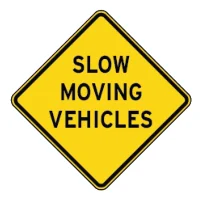
Slow-moving vehicles
Slow moving vehicles warning sign

Around a slow-moving farm vehicle:

  • Be patient and slow down
  • Give plenty of space and use caution when passing
  • Two lanes your direction: move over one full lane to pass
  • One lane each way: look for oncoming traffic and proceed carefully
  • Leave at least 3 feet between your vehicle's widest part and the farm vehicle
Handbook p. 106 ↗

Put it into practice

You're merging back into the right lane after passing a semi. Glance in your rearview mirror: once you see both of the truck's headlights, there's enough room to move in front of it.

Check your understanding

Read the question, decide on an answer, then open it to check the explanation. These are Roadwise study questions based on the source handbook.

About how far does it take a loaded truck traveling 55 mph to come to a complete stop?
  1. 450 feet
  2. 150 feet
  3. 800 feet
  4. 250 feet

Answer: 450 feet

A loaded truck with properly adjusted brakes traveling 55 mph needs about 450 feet to stop.
Handbook p. 98 ↗
How many lanes of space might a large vehicle need to complete a turn?
  1. Only its own lane
  2. Its own lane plus the shoulder
  3. Exactly three lanes
  4. More than one lane

Answer: More than one lane

Large vehicles might require more than one lane to complete a turn without hitting something.

Handbook p. 99 ↗
Why shouldn't you pass a large vehicle while it's turning?
  1. The truck may need to stop suddenly
  2. It blocks the truck's view of signals
  3. It's a frequent cause of collisions involving large vehicles
  4. It's only a courtesy issue

Answer: It's a frequent cause of collisions involving large vehicles

Passing a large vehicle while it's turning is a frequent cause of collisions.

Handbook p. 99 ↗
Large vehicles need only one lane of space to get through a roundabout, the same as cars.
  1. True
  2. False

Answer: False

Large vehicles need 2 lanes of space in a roundabout.

Handbook p. 99 ↗
You need to pass an agricultural vehicle and there's only one lane in each direction. What should you do?
  1. Wait for a two-lane road
  2. Look for oncoming traffic and proceed carefully with 3 feet of clearance
  3. Pass regardless of oncoming traffic
  4. Never pass under any circumstances

Answer: Look for oncoming traffic and proceed carefully with 3 feet of clearance

With only one lane each way, check for oncoming traffic and pass carefully, leaving at least 3 feet.

Handbook p. 106 ↗
What marking identifies a slow-moving agricultural vehicle designed to go 25 mph or less?
  1. A rear triangle emblem
  2. A flashing red light
  3. An orange stripe on the roof
  4. A green reflective circle

Answer: A rear triangle emblem

Slow farm vehicles going 25 mph or less display a triangle sign or emblem on the back.

Handbook p. 106 ↗
Take the lesson checkpoint in the app

More in Sharing the Road