roadwise.Open study app

Washington driving lesson · Parking and Transporting

Parking techniques: angled, perpendicular, and parallel

A 3-minute lesson from the Washington course. Read the rules and examples, follow the handbook page references, and check your understanding before you move on.

Read time
3 minutes
Course unit
Parking and Transporting
Checkpoint questions
4
Source pages
146, 147, 148

Parking maneuvers are slow, step-by-step jobs. The skills exam checks them, and the written test may ask the order of steps. Signal your intentions, move slowly, keep checking traffic, and finish centered and close to the curb.

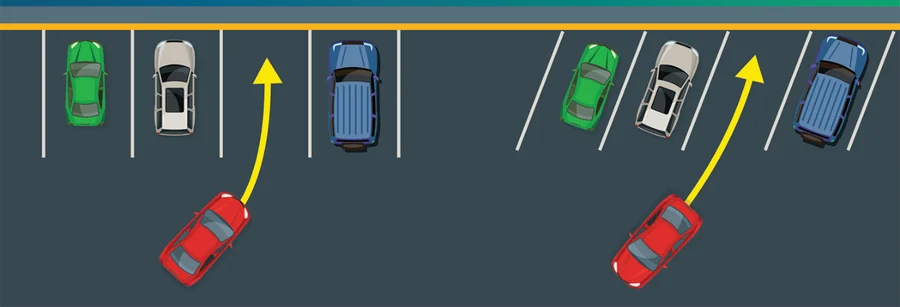
Entering a perpendicular or angled space:

  • 1. Identify the space and check traffic
  • 2. Signal your intention to turn
  • 3. Move forward slowly, turning the wheel, until the vehicle reaches the middle of the space
  • 4. Center the vehicle between the painted lines
  • 5. Move to the front of the space, stop, and secure the vehicle
Handbook p. 146 ↗

Exiting a perpendicular or angled space:

  • 1. Check for traffic in all directions
  • 2. Keep checking and move straight back until your bumper clears the vehicle beside you
  • 3. Turn the wheel sharply in the direction you want to go
  • 4. Clear the space and stop, then move forward, straightening the wheels
Handbook p. 146 ↗
Perpendicular and angled parking
Entering and leaving angled spaces

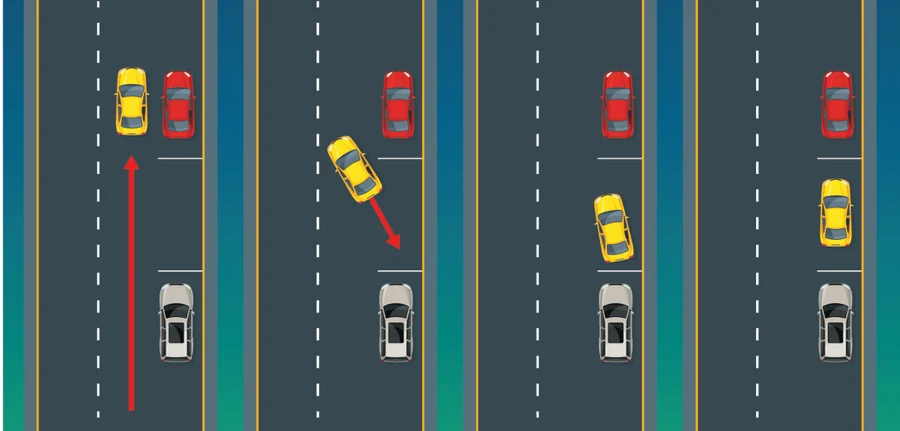
Entering a parallel space:

  • 1. Identify the space, check traffic, and signal
  • 2. Reverse, looking in the direction the vehicle will move
  • 3. Back slowly until your front bumper lines up with the rear bumper of the car you're parking behind
  • 4. Turn the wheel sharply and back slowly into the space
  • 5. Turn the wheel rapidly to center the vehicle in the space
  • 6. Stop before touching the bumper of the vehicle behind you
  • 7. Move forward to adjust, no more than 12 inches from the curb
Handbook p. 147 ↗
Parallel parking
Parallel parking steps

Exiting a parallel space:

  • 1. Check traffic, brake, shift to reverse, and back up as far as possible toward the car behind
  • 2. Check for traffic and signal
  • 3. Move forward slowly, steering into the lane
  • 4. If your front bumper won't clear the car ahead, reverse and adjust the wheel
  • 5. Move into the closest lane when your front door clears the rear bumper of the car ahead
Handbook p. 147 ↗
12 inches

Maximum distance from the curb after parallel parking

Handbook p. 147 ↗

Put it into practice

Leaving a parallel spot, you pull forward and see your bumper won't clear the car ahead. Don't force it: reverse, adjust the steering wheel, and try again. Merge into the closest lane once your front door passes the other car's rear bumper.

Check your understanding

Read the question, decide on an answer, then open it to check the explanation. These are Roadwise study questions based on the source handbook.

How far from the curb can your vehicle be parked, at most?
  1. 12 inches
  2. 6 inches
  3. 18 inches
  4. 24 inches

Answer: 12 inches

Your vehicle should be no more than 12 inches from the curb when parked.
Handbook p. 147 ↗
What's the first step when entering a perpendicular or angled parking space?
  1. Reverse into the space first
  2. Signal only after you've stopped
  3. Pick the space and check traffic
  4. Turn the wheel sharply immediately

Answer: Pick the space and check traffic

The first step is identifying the space you want and checking traffic before signaling and moving in.

Handbook p. 146 ↗
Entering a parallel space, you back slowly until your front bumper lines up with what, before turning the wheel sharply?
  1. The front bumper of the car ahead
  2. The rear door of the car ahead
  3. The rear bumper of the car ahead
  4. The painted end line of the space

Answer: The rear bumper of the car ahead

Back slowly until your front bumper is in line with the rear bumper of the vehicle you're parking behind, then turn sharply.

Handbook p. 147 ↗
Backing out of a perpendicular space, when do you turn the steering wheel sharply?
  1. When your bumper clears the car beside you
  2. As soon as you shift into reverse
  3. When your front door passes the curb
  4. After you back fully into the lane

Answer: When your bumper clears the car beside you

Move straight back until your bumper clears the vehicle beside you, then turn the wheel sharply the way you want to go.

Handbook p. 146 ↗
Take the lesson checkpoint in the app

More in Parking and Transporting