roadwise.Open study app

Washington driving lesson · Vehicle Equipment

Lights, turn signals, and hand signals

A 3-minute lesson from the Washington course. Read the rules and examples, follow the handbook page references, and check your understanding before you move on.

Read time
3 minutes
Course unit
Vehicle Equipment
Checkpoint questions
6
Source pages
49, 50, 51

Lights let you see, but just as importantly they let others see you and know what you're about to do. Washington sets exact times for headlights, distances for dimming high beams, and a backup set of hand signals if your lights fail.

½ hour

Headlights required from a half hour after sunset to a half hour before sunrise

Handbook p. 49 ↗

It's easier to just keep headlights on:

  • All the time
  • When it's dark
  • When it's rainy, snowy, foggy, or smoky
Handbook p. 49 ↗

Know the rule

Daytime running lights aren't as bright as headlights and don't turn on your taillights.

Handbook p. 49 ↗

Know the rule

Keep all lights clean, bright, aimed correctly, and working. A "lamp out" symbol on the dashboard means it's time to replace the bulbs.

Handbook p. 49 ↗

Know the rule

You may use high beams on open roads without streetlights.

Handbook p. 50 ↗

Switch from high beams to regular headlights

Switch from high beams to regular headlights
SituationDistance
Oncoming vehicle ahead of you500 feet
You're behind another vehicle300 feet
Handbook p. 50 ↗
100 feet

Distance your red brake lights must be clearly visible from

Handbook p. 50 ↗
100 feet

Signal this far before you make your move

Handbook p. 50 ↗

Know the rule

Signal every time you change direction, even when no one seems to be around, and make sure the signal stops blinking after the turn.

Handbook p. 50 ↗
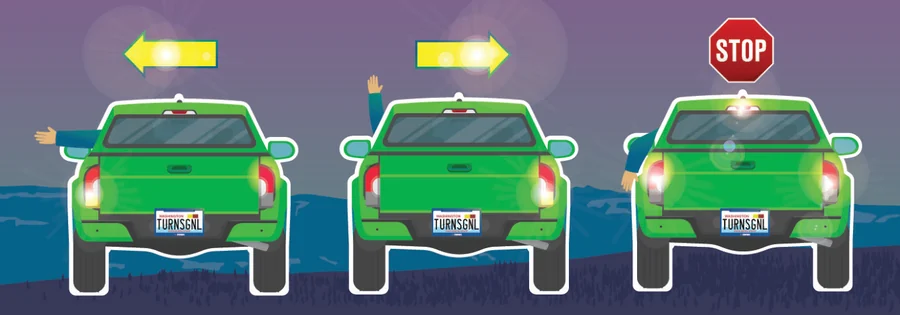
Turn signal sequence before a turn
Turn signals and brake lights

Hand signals (left arm out the driver's window)

Hand signals (left arm out the driver's window)
SignalArm position
Stop or slow downArm out, fingers pointing to the ground
Left turnArm straight out to the left
Right turnArm bent up, fingers pointing to the sky
Handbook p. 51 ↗

Know the rule

Use hand signals if your brake lights or one or both turn signals aren't working.

Handbook p. 51 ↗

Know the rule

Turn on your flashing hazard lights if your car malfunctions or you must make an emergency stop, so others can safely go around you.

Handbook p. 51 ↗

Put it into practice

You're on a dark country road with high beams on when headlights appear over a rise. Switch to regular headlights before the car is within 500 feet. Later, catching up to a car ahead, dim once you're within 300 feet.

Check your understanding

Read the question, decide on an answer, then open it to check the explanation. These are Roadwise study questions based on the source handbook.

During what hours must your headlights be on in Washington?
  1. 30 min after sunset to 30 min before sunrise
  2. Sunset to sunrise exactly
  3. 6 p.m. to 6 a.m.
  4. An hour after sunset to an hour before sunrise

Answer: 30 min after sunset to 30 min before sunrise

Washington law requires headlights on from a half hour after sunset to a half hour before sunrise.
Handbook p. 49 ↗
How far in front of an oncoming vehicle must you dim your high beams?
  1. 300 feet
  2. 200 feet
  3. 1,000 feet
  4. 500 feet

Answer: 500 feet

You must switch to regular headlights when 500 feet in front of an oncoming vehicle.

Handbook p. 50 ↗
How far behind another vehicle must you dim your high beams?
  1. 100 feet
  2. 150 feet
  3. 300 feet
  4. 500 feet

Answer: 300 feet

When you're 300 feet behind a vehicle, you must switch back to regular headlights.

Handbook p. 50 ↗
From how far away must your brake lights be clearly visible?
  1. 300 feet
  2. 100 feet
  3. 500 feet
  4. 50 feet

Answer: 100 feet

Brake lights are red and must be clearly visible from 100 feet away.

Handbook p. 50 ↗
Your turn signals stop working. Which hand signal tells the driver behind you to slow down and stop?
  1. Left arm out the window, fingers pointed up
  2. Left arm out the window, straight out
  3. Left arm out the window, waving up and down
  4. Left arm out the window, fingers down

Answer: Left arm out the window, fingers down

Pointing your fingers to the ground with your left arm out the window signals slowing down and stopping.

Handbook p. 51 ↗
Using hand signals because your turn signals are broken, how do you signal a right turn?
  1. Right arm out, pointed down
  2. Left arm out, fingers pointed down
  3. Left arm out, bent, fingers pointed up
  4. Left arm out, straight out to the left

Answer: Left arm out, bent, fingers pointed up

A right turn is signaled with your left arm out the window, bent so your fingers point upward.

Handbook p. 51 ↗
Take the lesson checkpoint in the app

More in Vehicle Equipment