Roadwise States Washington Driving lessons Blind zones, mirror checks, and before you go Washington driving lesson · Handling Your Vehicle
Blind zones, mirror checks, and before you go A 3-minute lesson from the Washington course. Read the rules and examples, follow the handbook page references, and check your understanding before you move on.
Read time 3 minutes
Course unit Handling Your Vehicle
Checkpoint questions 6
Source pages 63, 64, 65, 66 Every vehicle has areas the driver can't see, and they can hide a whole car, motorcycle, or bicycle. Mirrors shrink those areas, but only turning your head clears them. Big vehicles have even bigger blind zones, so don't linger in them.
Blind zones Areas around a vehicle you can't see from the driver's seat. They can completely hide another vehicle, motorcyclist, or bicyclist.
Handbook p. 63 ↗ Reduce your blind zones: Set the rearview mirror so you can see out the back window without stretching Set side mirrors with the traditional or enhanced method Still do a full visual search: move your head, neck, and body so both eyes see the zone Use blind zone alerts as help, but make a habit of checking with your own eyes Handbook p. 63 ↗ Know the rule
When you turn your head to look, keep the steering wheel straight.
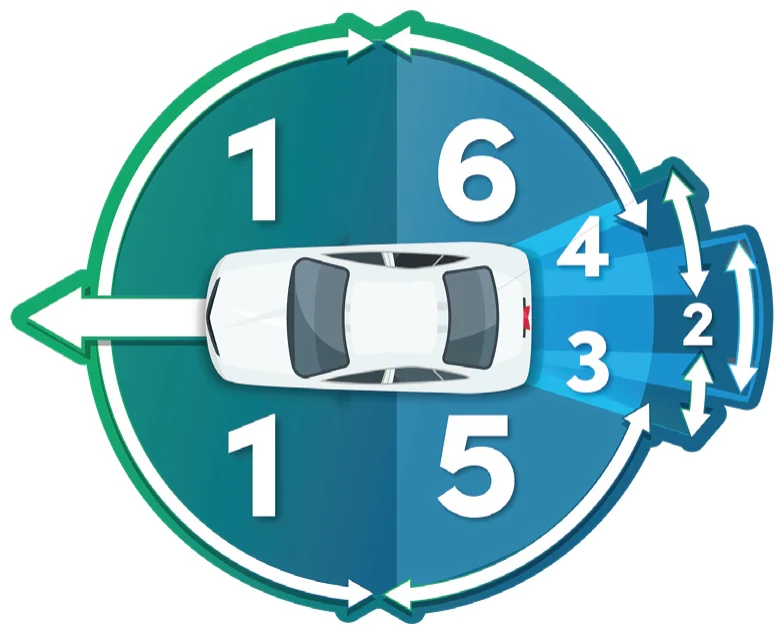
Handbook p. 63 ↗ To stay aware, regularly check: 1. The area in front of you 2. Your rearview mirror 3 and 4. Your side mirrors 5 and 6. Over your shoulders Handbook p. 64 ↗ The six-point check around your vehicle Know the rule
Stay out of other vehicles' blind zones. Speed up or slow down so the driver can clearly see you.
Handbook p. 64 ↗ No zones The large blind zones of buses, motor homes, and commercial vehicles, so named because no vehicle should be traveling in them.
Handbook p. 64 ↗ Know the rule
Around large vehicles: if you can't see their mirrors, the driver can't see you.
Handbook p. 64 ↗ Know the rule
Recheck your mirrors every time you get behind the wheel, and check them constantly while driving.
Handbook p. 65 ↗ A good routine before you drive: Check outside: objects in tires, broken glass, fluid leaks, children, pets, obstructions Check inside: dashboard warnings, clear windows, loose items secured Check adjustments: mirrors, seat, steering wheel, seat belt, phone silenced and put away Check yourself: healthy, clearheaded, emotions under control, ready to focus Handbook p. 66 ↗ Put it into practice
You're about to change lanes on the freeway. Mirrors look clear, but a motorcycle could be hiding beside your rear door. Signal, then turn your head for a shoulder check while keeping the wheel straight, and move only when the zone is clear.
Check your understanding Read the question, decide on an answer, then open it to check the explanation. These are Roadwise study questions based on the source handbook.
What are the areas around a vehicle that the driver can't see from the seat called? No-go zones Dead angles Shadow lanes Blind zones Answer: Blind zones
Blind zones are the areas around a vehicle a driver can't see from the driver's seat.
Handbook p. 63 ↗ If you can't see a large truck's side mirrors, what does that tell you? You must be directly behind the truck The truck is about to turn The truck driver can't see you either The truck is signaling a lane change Answer: The truck driver can't see you either
If you can't see a large vehicle's mirrors, the driver can't see you, so avoid lingering in that zone.
Handbook p. 64 ↗ What term does the handbook use for large vehicles' extra-large blind zones? Shadow zones No zones Dead zones Ghost zones Answer: No zones
Large vehicles have bigger blind zones, sometimes called 'no zones,' because no vehicle should travel there.
Handbook p. 64 ↗ Before driving, you should check outside the vehicle for hazards and inside for warning lights as part of your routine. True False Answer: True
The pre-drive routine includes checking outside the vehicle, inside the vehicle, adjustments, and checking in with yourself.
Handbook p. 66 ↗ When turning your head to check a blind zone, you should also turn the steering wheel in the same direction. True False Answer: False
Keep the steering wheel straight while you turn your head to check your blind zones.
Handbook p. 63 ↗ What is one way to reduce your blind zones before you start driving? Raise your seat to its highest setting Sit farther back from the wheel Adjust your mirrors Turn on your daytime running lights Answer: Adjust your mirrors
Adjusting your mirrors is one way to reduce the size of your blind zones.
Handbook p. 63 ↗ Previous lesson Balanced weight and reference points Next lesson Health, vision, and hearing More in Handling Your Vehicle About the source Roadwise’s Washington course uses the driver handbook edition supplied with this study pack. This lesson cites source pages 63, 64, 65, 66. The linked PDF is a third-party mirror of the handbook, rather than a government-hosted page.
Open the handbook source PDF · View the source edition
For current application requirements, fees, appointments, and the format that applies to your age or license type, check Washington’s DOL. Roadwise provides study material and does not issue permits or licenses.