roadwise.Open study app

Utah driving lesson · Distractions & Driving Challenges

Skids, floods, and water

A 3-minute lesson from the Utah course. Read the rules and examples, follow the handbook page references, and check your understanding before you move on.

Read time
3 minutes
Course unit
Distractions & Driving Challenges
Checkpoint questions
5
Source pages
67, 68, 71, 72

Water is one of the most underestimated hazards. Wet roads can make you hydroplane, black ice looks like a wet spot, and a few inches of moving water can float a car. Learn how to recover from a skid and how to escape a sinking vehicle.

35 mph

Speed above which your car may start to hydroplane (front tires riding on water instead of the road)

Handbook p. 71 ↗

Know the rule

Black ice is a particular problem in Utah. It is hard to see and looks more like a wet spot than ice. Many crashes each year come from skids on black ice.

Handbook p. 71 ↗

Preventing and handling a skid:

  • Slow to a speed at which you can control the car
  • If you skid, slowly take your foot off the gas pedal
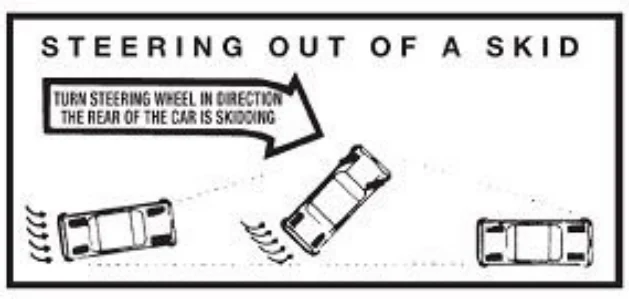
  • Rear wheels skid right: turn your front wheels right
  • Rear wheels skid left: turn your front wheels left
  • Don't steer too far, or you'll skid the other way
  • Don't slam on the brakes
  • Once you regain traction, straighten your wheels
Handbook p. 71 ↗
Steering out of a skid
Steering out of a skid: turn the wheel the direction the rear is skidding

Know the rule

Flash floods can come within minutes or hours of heavy rain. Floodwaters can be on roads, bridges, and low areas.

Handbook p. 67 ↗
6 inches

Water that reaches the bottom of most passenger cars, causing loss of control or stalling

Handbook p. 67 ↗
2 feet

Moving water that can carry away most vehicles, including SUVs and pickups

Handbook p. 67 ↗

Flooded roads:

  • If you see a flooded road ahead, turn around and find another route
  • Be extra cautious at night, when visibility is limited
  • Don't cross even if it looks shallow; water hides dips and washed-out road
  • If there's no other route, go to higher ground and wait for the water to go down
Handbook p. 67 ↗
30–60 seconds

How long a vehicle floats after entering water

Handbook p. 71 ↗

If your vehicle goes into water:

  • Stay calm and get out right away: remove your safety belt first
  • Lower the window and climb onto the roof; check the current before swimming
  • If you can't open a door or window, wait for the pressure to equalize
  • Shed heavy clothing but keep your shoes on to kick out a window
  • Use the air pocket near the highest part; take a breath, kick out the window, and escape
Handbook p. 71 ↗

Put it into practice

Your rear wheels slide to the left on a snowy curve. You ease off the gas, turn your front wheels gently to the left, avoid the brakes, and straighten the wheels as soon as the tires grip again.

Check your understanding

Read the question, decide on an answer, then open it to check the explanation. These are Roadwise study questions based on the source handbook.

At what speed can hydroplaning typically begin?
  1. Over 35 mph
  2. Over 55 mph
  3. Over 20 mph
  4. Over 45 mph

Answer: Over 35 mph

A car may start to hydroplane at speeds over 35 mph.
Handbook p. 71 ↗
If your rear wheels skid to the right, which way should you turn your front wheels?
  1. To the left
  2. To the right
  3. Keep them straight
  4. Hard left, then hard right

Answer: To the right

If your rear wheels skid to the right, turn your front wheels to the right to correct the skid.

Handbook p. 71 ↗
How much water can reach the bottom of most passenger cars and cause loss of control?
  1. One inch
  2. One foot
  3. Six inches
  4. About two feet

Answer: Six inches

Six inches of water will reach the bottom of most passenger cars, causing loss of control or stalling.

Handbook p. 67 ↗
How much moving water can carry away most vehicles, including SUVs and pickups?
  1. Six inches
  2. One foot
  3. Four feet
  4. Two feet

Answer: Two feet

Two feet of moving water can carry away most vehicles, including SUVs and pickup trucks.

Handbook p. 67 ↗
A vehicle that plunges into water usually floats for several minutes, so there is no need to hurry out.
  1. True
  2. False

Answer: False

A vehicle in water floats only 30 to 60 seconds, so try to get out immediately.

Handbook p. 71 ↗
Take the lesson checkpoint in the app

More in Distractions & Driving Challenges