roadwise.Open study app

Utah driving lesson · Distractions & Driving Challenges

Fatigue and night driving

A 3-minute lesson from the Utah course. Read the rules and examples, follow the handbook page references, and check your understanding before you move on.

Read time
3 minutes
Course unit
Distractions & Driving Challenges
Checkpoint questions
6
Source pages
66, 67, 69, 70

Fatigue slows your mind and body and makes you see less clearly, so you may not stop in time. At night you can see only as far as your headlights reach. Both call for rest, more space, and exact rules for using your lights.

Before a long trip:

  • Get enough sleep; most people need 7 to 9 hours to stay awake during the day
  • Plan to stop every two hours
  • Bring another person to watch your driving
  • Check medicine labels; some make you sleepy
  • Don't drink alcohol or take other drugs and drive
Handbook p. 66 ↗

Know the rule

If you start to feel tired, stop driving: pull off at an exit or rest area for a 20-minute power nap, or find a place to sleep for the night. Don't drive late at night.

Handbook p. 67 ↗

Warning signs of drowsiness:

  • Can't remember the last few miles
  • Hitting a rumble strip or drifting from your lane, and pulling back into it
  • Wandering, disconnected thoughts
  • Yawning repeatedly
  • Trouble focusing or keeping your eyes open and head up
  • Tailgating or missing traffic signs
  • Narrowly missing a crash
Handbook p. 67 ↗

Night driving numbers

Night driving numbers
RuleDistance
Headlights on from sunset to sunrise, or when you can't see1,000 feet ahead
Dim high beams for an oncoming carWithin 500 feet
Dim high beams when following a carWithin 300 feet
Extra following distance at nightAt least 2 more seconds
Handbook p. 70 ↗

Know the rule

If an oncoming driver doesn't dim, look at the right side of the road so you aren't blinded. Avoid looking directly into headlights.

Handbook p. 70 ↗

Know the rule

Keep your eyes searching ahead for dark shapes on the roadway, and glance right and left for the pavement edge and roadside hazards.

Handbook p. 70 ↗

Know the rule

Don't wear sunglasses or colored lenses at night; tinted lenses reduce the light you need to see.

Handbook p. 70 ↗

Know the rule

The law requires a reasonable and prudent speed. At night, even the posted limit may be too fast.

Handbook p. 70 ↗
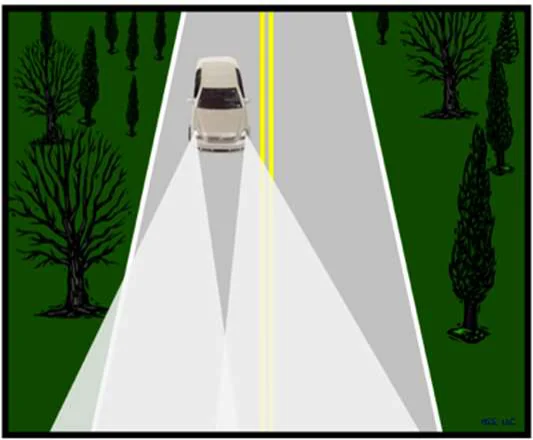
Night driving visibility
Your headlights only light a limited distance ahead

Put it into practice

On a dark two-lane highway your high beams are on. When an oncoming car's lights appear, you dim before it is within 500 feet. Later, catching up to a car ahead, you dim once you're within 300 feet.

Check your understanding

Read the question, decide on an answer, then open it to check the explanation. These are Roadwise study questions based on the source handbook.

How many feet ahead must you be able to see clearly, or you must use your headlights?
  1. 500 feet
  2. 1,000 feet
  3. 300 feet
  4. 1,500 feet

Answer: 1,000 feet

Headlights are required whenever you cannot see 1,000 feet ahead clearly.
Handbook p. 70 ↗
When must you dim your high beams for an oncoming vehicle?
  1. Within 300 feet
  2. Within 1,000 feet
  3. Within 500 feet
  4. Within 200 feet

Answer: Within 500 feet

Dim your lights before you get within 500 feet of an oncoming car.

Handbook p. 70 ↗
When must you dim your lights if following another vehicle?
  1. Within 500 feet
  2. Within 1,000 feet
  3. Within 100 feet
  4. Within 300 feet

Answer: Within 300 feet

Dim your lights when you are within 300 feet of the vehicle ahead of you.

Handbook p. 70 ↗
By how much should you increase your following distance at night, compared to daytime?
  1. At least two more seconds
  2. At least one more second
  3. No change is needed
  4. At least five more seconds

Answer: At least two more seconds

Increase your following distance at night by at least two seconds.

Handbook p. 70 ↗
How many hours of sleep does the handbook recommend before driving to stay awake during the day?
  1. 4 to 6 hours
  2. 7 to 9 hours
  3. 10 to 12 hours
  4. 5 to 7 hours

Answer: 7 to 9 hours

Most people need 7 to 9 hours of sleep to stay awake during the day.

Handbook p. 66 ↗
How often should you plan to stop during a long trip to take a break?
  1. Every hour
  2. Every four hours
  3. Every two hours
  4. Only when you feel tired

Answer: Every two hours

Plan to stop every two hours during long trips to take a break from driving.

Handbook p. 67 ↗
Take the lesson checkpoint in the app

More in Distractions & Driving Challenges