roadwise.Open study app

Utah driving lesson · Rules of the Road

Pavement markings and special lanes

A 3-minute lesson from the Utah course. Read the rules and examples, follow the handbook page references, and check your understanding before you move on.

Read time
3 minutes
Course unit
Rules of the Road
Checkpoint questions
4
Source pages
49, 53, 54, 84, 113

Lines painted on the road tell you which way traffic flows, where you may pass, and where to stop. Yellow lines separate traffic moving in opposite directions; white lines separate lanes moving the same way.

Know the rule

Pavement markings divide lanes, show where you may pass or change lanes, mark turn lanes and crosswalks, and show where to stop for signs or signals.

Handbook p. 53 ↗

Know the rule

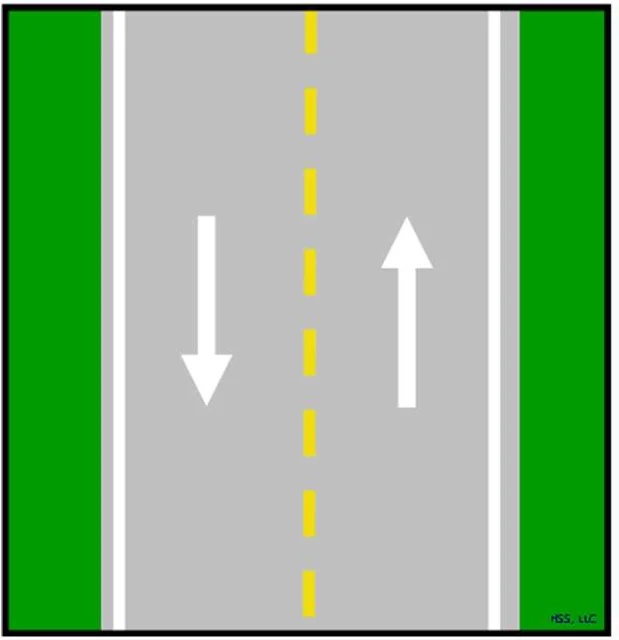
White line markings mean traffic travels in one direction; yellow line markings mean traffic travels in two directions.

Handbook p. 113 ↗

Line meanings

Line meanings
MarkingMeaning
Broken yellow center lineTwo-way road; passing permitted
Solid yellow beside broken yellowPass only when the broken line is on your side
Double solid yellowNo passing in either direction
Broken white linesOne-way traffic; passing permitted
Solid white by express/carpool laneSeparates it from general lanes; no crossing
Handbook p. 53 ↗
Broken yellow center line
Passing allowed only for the side with the broken line
Broken yellow center line
Double solid yellow: no passing either way

Know the rule

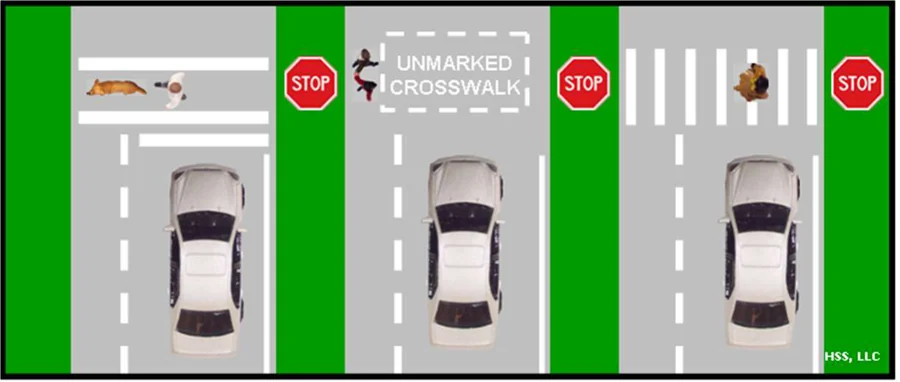
Crosswalks show where pedestrians may cross. At a stop sign or signal, stop behind the stop line or crosswalk. If none is marked, stop before the intersection or stop sign.

Handbook p. 53 ↗
Stopping position at crosswalks
Stop lines and marked and unmarked crosswalks

Know the rule

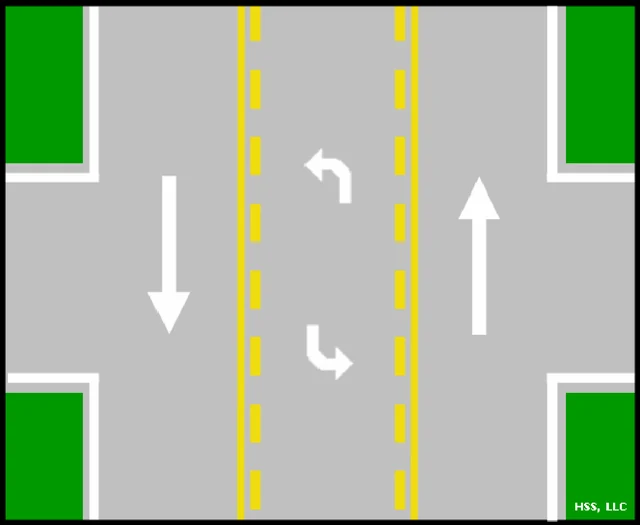
Using a shared center left turn lane: check mirrors, signal left, check your left blind spot, steer smoothly in, and turn when traffic is clear.

Handbook p. 54 ↗
500 feet

The farthest before your turn you may enter a shared center left turn lane (unless the last car is more than 500 feet from the intersection)

Handbook p. 54 ↗
Two-way left turn lane markings
Shared center left turn lane

Flex lane

A lane that may carry traffic one way at some times and the opposite way at others, often at rush hour. It may have double-dashed yellow lines on either side and signals overhead.

Handbook p. 49 ↗

Know the rule

Before entering a flex lane, check the overhead signals: a green arrow means you can use the lane; a red X means you cannot.

Handbook p. 49 ↗

Know the rule

Dedicated bicycle lanes are marked with solid white lines.

Handbook p. 84 ↗

Put it into practice

You need to turn left into a store about a block away. You wait until you're within 500 feet, check your mirror and left blind spot, signal, and move into the center turn lane, then turn when oncoming traffic clears.

Check your understanding

Read the question, decide on an answer, then open it to check the explanation. These are Roadwise study questions based on the source handbook.

On a two-way road with a solid yellow line and a dashed yellow line side by side, when may you pass?
  1. When the dashed line is on your side
  2. When the solid line is on your side
  3. Never, in either direction
  4. Only to pass a bicyclist

Answer: When the dashed line is on your side

With a solid and a dashed yellow line, passing is permitted only for traffic on the side of the dashed line.
Handbook p. 53 ↗
Before making a left turn from a shared center left-turn lane, how far before the turn may you enter it?
  1. Not more than 100 feet before the turn
  2. Not more than 500 feet before the turn
  3. Not more than 1,000 feet before the turn
  4. At any distance before the turn

Answer: Not more than 500 feet before the turn

You may not enter the shared left-turn lane more than 500 feet before making the turn.

Handbook p. 54 ↗
White lane markings separate lanes of traffic moving in opposite directions.
  1. True
  2. False

Answer: False

White lane markings mean traffic travels in one direction; yellow markings separate traffic moving in two directions.

Handbook p. 53 ↗
Above a flex lane you see a red X. What does it mean?
  1. The lane is for left turns only
  2. You may not use that lane
  3. Enter the lane with caution
  4. The lane is closed to trucks

Answer: You may not use that lane

Signals above flex lanes show which lanes are open: a green arrow means you can use the lane, a red X means you cannot.

Handbook p. 49 ↗
Take the lesson checkpoint in the app

More in Rules of the Road