roadwise.Open study app

Utah driving lesson · Rules of the Road

Warning and work zone signs

A 3-minute lesson from the Utah course. Read the rules and examples, follow the handbook page references, and check your understanding before you move on.

Read time
3 minutes
Course unit
Rules of the Road
Checkpoint questions
4
Source pages
57, 58

Warning signs tell you a hazard is ahead so you can slow down before you reach it. Most are yellow diamonds. Orange signs mean a work zone, where people are working near traffic and fines for speeding double.

Know the rule

Warning signs are usually diamond-shaped and yellow with black letters or symbols. They warn of possible danger ahead.

Handbook p. 57 ↗
Various warning sign icons
Lane ends, merging traffic, added lane, curves, and divided highway

Common warning signs:

  • Lane Ends, Merging Traffic, and Added Lane
  • Curvy Road Ahead, Right Curve, and Sharp Curve Ahead
  • Divided Highway begins or ends
  • Intersection, Side Road, or T-Intersection Ahead
  • Stop Sign Ahead and Traffic Signal Ahead
  • Advisory Speed Around Curve
  • School Crossing and Pedestrian Crossing
  • Share the Road with Bicycles, Bicycle Crossing, and Slippery when Wet
  • No Passing Zone
Handbook p. 58 ↗
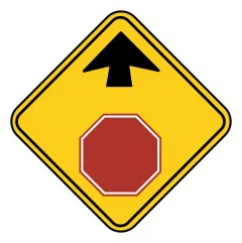
Stop ahead
Stop Sign Ahead
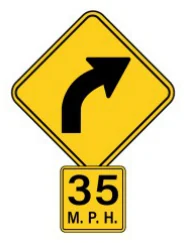
Curve right
Advisory speed around a curve
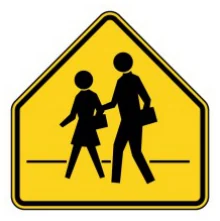
School crossing
School Crossing

Know the rule

Work zone signs are diamond or rectangular and orange with black letters or symbols. They warn of workers ahead, reduced speed, detours, slow-moving road machinery, or surface changes.

Handbook p. 58 ↗
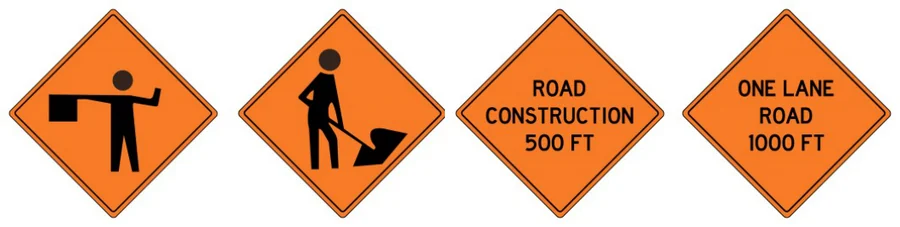
Various work zone sign icons
Work zone signs: flagger, workers, road construction, one lane road ahead

Know the rule

Barriers keep you out of closed roads and other dangerous areas. At a short-term work zone signal, stop at the white line if there is one.

Handbook p. 58 ↗

Know the rule

Slow down in work zones, be ready to stop quickly, and don't tailgate. Fines for speeding in a work zone are doubled.

Handbook p. 58 ↗

Know the rule

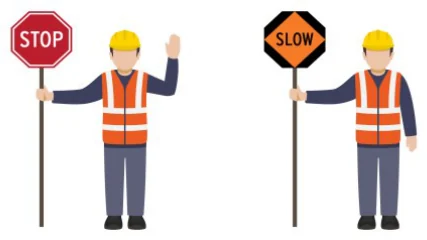
A flagger may direct traffic in a work zone. You must do as the flagger directs.

Handbook p. 58 ↗
Flagger stop/slow paddles
Flaggers use STOP and SLOW paddles

Put it into practice

You pass an orange 'Flagger Ahead' diamond, then see a worker holding a STOP paddle, even though the light at the next intersection is green. You stop and wait until the flagger turns the paddle to SLOW.

Check your understanding

Read the question, decide on an answer, then open it to check the explanation. These are Roadwise study questions based on the source handbook.

What shape and color are most warning signs, such as curve or merge warnings?
  1. Round, red with white letters
  2. Square or rectangular, blue with white letters
  3. Diamond, yellow with black symbols
  4. Octagon, red with white letters

Answer: Diamond, yellow with black symbols

Warning signs are usually diamond shaped and yellow with black lettering or symbols.

Handbook p. 57 ↗
What color are highway work zone signs?
  1. Yellow with black letters
  2. Red with white letters
  3. Orange with black letters or symbols
  4. Green with white letters

Answer: Orange with black letters or symbols

Work zone signs are diamond or rectangular and orange with black letters or symbols.

Handbook p. 58 ↗
Who must you obey when directing traffic in a work zone?
  1. Any construction worker
  2. Only a police officer, never a flagger
  3. A flagger
  4. No one; follow posted signs only

Answer: A flagger

A flagger may direct traffic in a work zone, and you must do as the flagger directs.

Handbook p. 58 ↗
A work zone uses a short-term traffic signal and it turns red. Where should you stop?
  1. Next to the flagger
  2. At the white line, if there is one
  3. Beside the first orange cone
  4. Just past the signal

Answer: At the white line, if there is one

In a work zone with a short-term signal, stop at the white line if there is one, and be ready to stop quickly.

Handbook p. 58 ↗
Take the lesson checkpoint in the app

More in Rules of the Road