roadwise.Open study app

Tennessee driving lesson · Vehicle Control & Defensive Driving

Avoiding collisions & animals

A 4-minute lesson from the Tennessee course. Read the rules and examples, follow the handbook page references, and check your understanding before you move on.

Read time
4 minutes
Course unit
Vehicle Control & Defensive Driving
Checkpoint questions
6
Source pages
110, 111, 112

Most crashes happen in clear weather. When one is about to happen, many drivers freeze. There's almost always something you can do — and you have three options: stop, turn, or speed up.

Know the rule

With ABS, stop quickly by pressing the brake as hard as you can and keeping it there. The pedal may push back — don't let up; ABS only works with the pedal held down firmly.

Handbook p. 110 ↗

Know the rule

Without ABS, brake as hard as you can without locking the wheels. If they lock and you start to skid, quickly let up, then press again as soon as the skid stops. Repeat until stopped.

Handbook p. 110 ↗
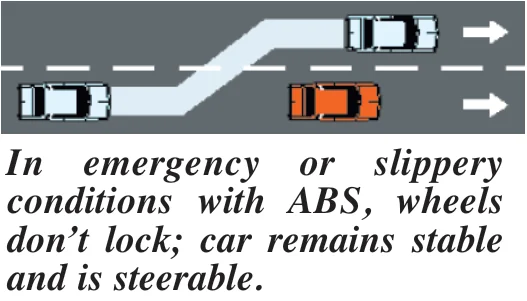
ABS braking and steering (with ABS)
With ABS: wheels don't lock and the car can be steered

Know the rule

You can usually turn faster than you can stop. Keep both hands at about 9 and 3 o'clock, steer where you want the car to go, and be ready to control it after the swerve.

Handbook p. 110 ↗

Know the rule

Without ABS, let up on the brake before you turn; braking first puts weight on the front tires for a quicker turn, but don't keep braking if the front wheels lock. It's generally better to run off the road than crash head-on.

Handbook p. 111 ↗

Know the rule

Speed up when another vehicle is about to hit you from the side or behind and there's room ahead — then slow down once the danger passes.

Handbook p. 111 ↗

ABS do's and don'ts

  • DO stomp and hold the pedal down — pulsing and noise are normal
  • DON'T pump the brakes
  • DO steer around the obstacle
  • DON'T freeze or jerk the wheel
  • DO practice: from about 20 mph in an empty lot, brake hard and steer
  • DON'T drive more aggressively just because you have ABS
Handbook p. 111 ↗

Know the rule

Fall is peak season for deer crashes (mating and hunting season). Be most alert at dusk and dawn, near woods and water — where there's one deer, there are often more.

Handbook p. 111 ↗

Avoiding animals

  • Watch for deer crossing signs and scan far down the road
  • Use high beams at night when possible to light the road's edges
  • Look for headlights reflecting in deer's eyes
  • If you have time: slow down, tap your brakes to warn others, sound your horn
  • Flashing your lights may freeze a deer in place
  • If no one is close behind, brake hard without locking the wheels
  • If a hit is unavoidable, don't swerve — stay in control on the road
  • Report hitting a deer or farm animal to police
Handbook p. 111 ↗
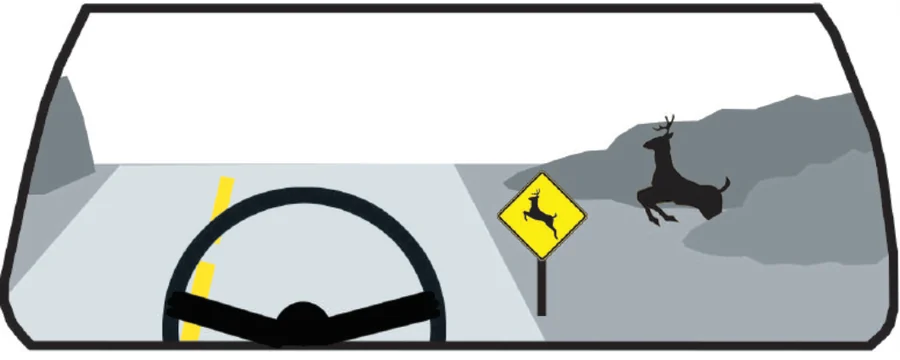
Watching for deer while driving
Watch for deer at dusk and dawn

Leading factors in crashes

  • Excessive speed
  • Lack of concentration
  • Improper evasive action
Handbook p. 112 ↗

Know the rule

The highway system has three parts — the driver, the vehicle and the road — and neglecting any of them contributes to most crashes. Human error is the single most common cause.

Handbook p. 112 ↗

Put it into practice

On a two-lane road at night, a deer steps out 100 feet ahead with an oncoming car in the other lane. Brake hard and hold the wheel straight. Swerving into the other lane or a ditch could hurt you far worse than hitting the deer.

Check your understanding

Read the question, decide on an answer, then open it to check the explanation. These are Roadwise study questions based on the source handbook.

When avoiding a collision, drivers generally have which three options?
  1. Stop, honk, or flash lights
  2. Stop, turn, or reverse
  3. Swerve, reverse, or wait
  4. Stop, turn, or speed up

Answer: Stop, turn, or speed up

The three general options for avoiding a collision are to stop, turn, or speed up.
Handbook p. 110 ↗
The handbook suggests practicing ABS stops in an empty lot. About how fast should you drive before braking hard?
  1. 10 m.p.h.
  2. 20 m.p.h.
  3. 35 m.p.h.
  4. 45 m.p.h.

Answer: 20 m.p.h.

Start driving about 20 m.p.h. in a big empty lot, slam on the brakes and steer, until steering while stomping becomes a habit.

Handbook p. 112 ↗
Without ABS, if your brakes lock up during a hard stop, you should:
  1. Hold the pedal down until the car stops
  2. Ease off the brake, then reapply
  3. Steer sharply while holding the brake
  4. Shift into neutral and coast

Answer: Ease off the brake, then reapply

Without ABS, if the brakes lock up and the vehicle skids, quickly release and then reapply the brake pedal.

Handbook p. 110 ↗
For quick evasive steering, it is recommended you keep your hands at approximately:
  1. The 12 o'clock and 6 o'clock positions
  2. The 10 o'clock and 2 o'clock positions
  3. The 3 o'clock and 9 o'clock positions
  4. The 11 o'clock and 5 o'clock positions

Answer: The 3 o'clock and 9 o'clock positions

Keeping hands at about 3 and 9 o'clock allows for effective, controlled evasive steering.

Handbook p. 110 ↗
You should never use evasive steering to avoid a collision; braking is always the safer option.
  1. True
  2. False

Answer: False

In many cases you can turn the vehicle quicker than you can stop it, so evasive steering is a valid option to avoid a collision.

Handbook p. 110 ↗
A deer jumps into your lane and a collision seems unavoidable. What does the handbook advise?
  1. Keep control and don't swerve
  2. Swerve hard onto the shoulder
  3. Swerve into the oncoming lane
  4. Flash your high beams to scare it

Answer: Keep control and don't swerve

If a collision seems inevitable, don't swerve — your injury risk may be greater. Keep the vehicle under control and on the roadway.

Handbook p. 111 ↗
Take the lesson checkpoint in the app

More in Vehicle Control & Defensive Driving