Roadwise States South Carolina Driving lessons Inspecting your tires South Carolina driving lesson · Before You Drive
Inspecting your tires A 2-minute lesson from the South Carolina course. Read the rules and examples, follow the handbook page references, and check your understanding before you move on.
Read time 2 minutes
Course unit Before You Drive
Checkpoint questions 6
Source pages 44, 45, 46 You can't control other drivers or road conditions, but you can control how well your vehicle and tires are maintained. Tire-related collisions are preventable with a few simple monthly checks.
Know the rule
Driving on under-inflated or over-inflated tires, or tires with low tread, can lead to safety problems on the road.
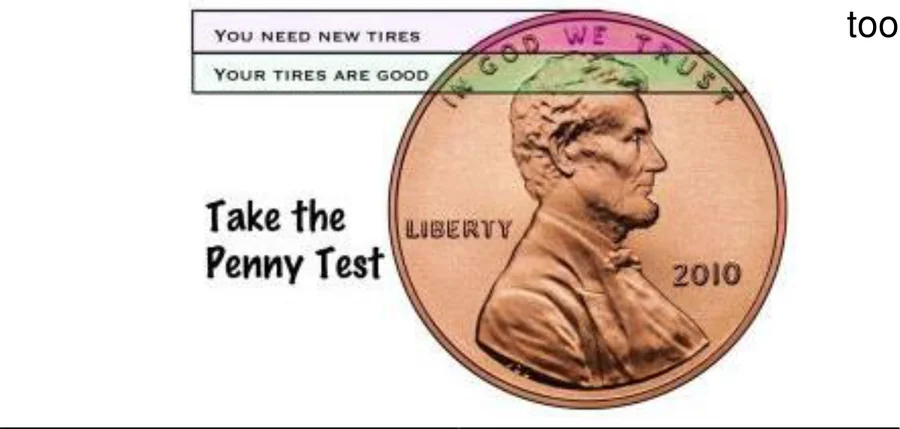
Handbook p. 44 ↗ Monthly tire pressure check: Get a tire pressure gauge if you don't have one Open the door and note the PSI number on the sticker inside the doorframe Remove the valve cap and press the gauge evenly onto the valve stem Check when the tires are cold Gauge higher than the sticker? Let air out Gauge lower than the sticker? Inflate until the numbers match Handbook p. 45 ↗ The penny test for tread depth Penny test for tread depth: Hold a penny with Lincoln's body between your thumb and forefinger Put the penny into the deepest-looking groove, Lincoln's head first Can you see all of his head? Your tires are too worn Handbook p. 45 ↗ Know the rule
If you can see all of Lincoln's head, don't drive on those tires. Get them replaced.
Handbook p. 46 ↗ Put it into practice
Your door sticker says 35 PSI. On a cold morning your gauge reads 29 PSI on one tire. It's lower than the sticker, so inflate that tire until the gauge reads 35.
A useful reminder Check tire pressure cold. For the penny test, if you can see all of Lincoln's head, the tires are worn out.
Check your understanding Read the question, decide on an answer, then open it to check the explanation. These are Roadwise study questions based on the source handbook.
What does PSI stand for in relation to tire pressure? Pressure per Square Inch Pounds per Square Inch Pounds per Safety Inch Pressure Safety Index Answer: Pounds per Square Inch
PSI means Pounds per Square Inch, the measurement used for tire pressure.
Handbook p. 45 ↗ Where should you look to find the correct tire pressure for your vehicle? The tire sidewall The tire pressure warning light The inside doorframe sticker The air pump at the gas station Answer: The inside doorframe sticker
Open your vehicle door and check the sticker on the inside doorframe for the correct PSI number.
Handbook p. 44 ↗ When should you check your tire pressure for an accurate reading? Immediately after a long drive Only when a tire looks flat Only when the warning light is on When the tires are cold Answer: When the tires are cold
Press the gauge onto the valve stem to get an accurate reading, making sure to check when the tires are cold.
Handbook p. 45 ↗ Using the penny test, if you can see all of Lincoln's head when the penny is placed in the tread, this means: Your tires are worn out Your tires have excellent tread Your tire pressure is too low Your tires only need rotating Answer: Your tires are worn out
If you can see all of Lincoln's head, your tires are too worn and should not be driven on.
Handbook p. 45 ↗ If the number on your tire pressure gauge is higher than the number on the doorframe sticker, you should: Add more air to your tires Let air out of your tires Replace the tires immediately Rotate the tires front to back Answer: Let air out of your tires
If your gauge reading is higher than the doorframe sticker number, let air out of your tires until the numbers match.
Handbook p. 45 ↗ You should check tire tread depth using a penny placed with Lincoln's head going in last. True False Answer: False
The penny should be placed with Lincoln's head going first into the deepest-looking groove.
Handbook p. 45 ↗ Previous lesson Implied consent & other drugs Next lesson Adjusting your seat & mirrors About the source Roadwise’s South Carolina course uses the driver handbook edition supplied with this study pack. This lesson cites source pages 44, 45, 46. The linked PDF is a third-party mirror of the handbook, rather than a government-hosted page.
Open the handbook source PDF · View the source edition
For current application requirements, fees, appointments, and the format that applies to your age or license type, check South Carolina’s DMV. Roadwise provides study material and does not issue permits or licenses.