roadwise.Open study app

South Carolina driving lesson · Before You Drive

Adjusting your seat & mirrors

A 3-minute lesson from the South Carolina course. Read the rules and examples, follow the handbook page references, and check your understanding before you move on.

Read time
3 minutes
Course unit
Before You Drive
Checkpoint questions
6
Source pages
46, 47, 48

Set your seat and mirrors before you start driving. A good position lets you see clearly, reach the pedals and wheel with full control, and leaves room for the air bag to deploy.

Know the rule

Sit upright with your back against the seat and feet on the floor. Slouching reduces how well the restraint system works.

Handbook p. 46 ↗

Seat checklist:

  • Your foot pivots smoothly from brake to accelerator with your heel on the floor
  • The top of the steering wheel is no higher than the top of your shoulders
  • At least 10 inches between your chest and the steering wheel
  • Not so far forward that you can't steer easily, and never reclined
  • Head restraint touches the back of your head, not below ear level
Handbook p. 46 ↗
10 inches

Minimum space between your chest and the steering wheel

Handbook p. 46 ↗

Head restraint

Designed to prevent whiplash. Adjust it to contact the back of your head, not below the level of your ears.

Handbook p. 46 ↗

Know the rule

The rearview mirror is your primary view to the rear. Adjust it to frame the rear window, and set a day/night mirror for the time of day.

Handbook p. 47 ↗

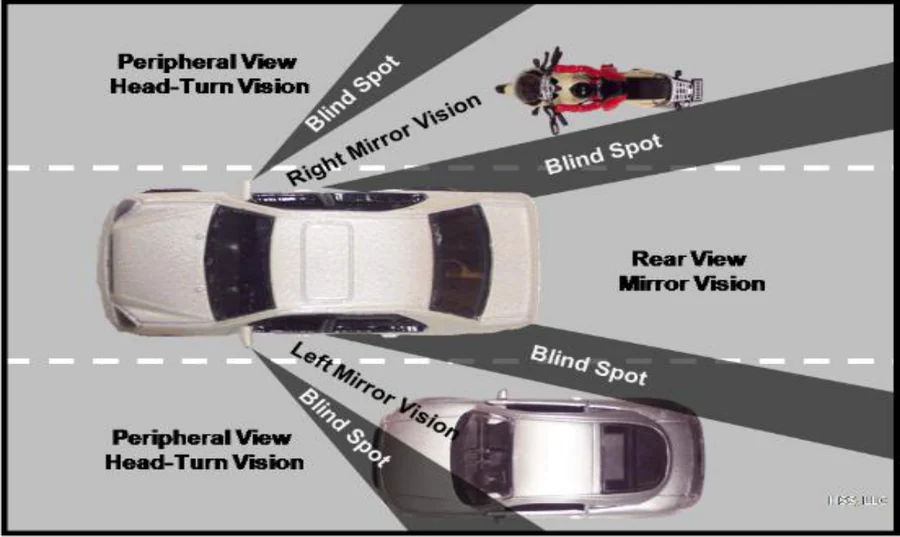
Blind spot

An area around your vehicle where your view is obstructed. Adjust outside mirrors to reduce them.

Handbook p. 47 ↗
Enhanced mirror settings (blind spot reduction)
Mirror views and blind spots

Enhanced mirror settings:

  • Left: rest your head on the closed left window; set the mirror so the car's rear edge barely shows
  • Right: lean so your head is below the rearview mirror/above the console; the car's side barely shows
Handbook p. 48 ↗
12 to 16 degrees

Extra viewing area per side from enhanced mirror settings

Handbook p. 48 ↗

Know the rule

With enhanced settings you won't see your own car's sides when you glance in the outside mirrors.

Handbook p. 48 ↗

Put it into practice

You borrow a taller friend's car. Before pulling out, move the seat so your heel rests on the floor and pivots between pedals, keep 10 inches from the wheel, lower the head restraint to the back of your head, then reset all three mirrors.

Check your understanding

Read the question, decide on an answer, then open it to check the explanation. These are Roadwise study questions based on the source handbook.

The top of the steering wheel should be no higher than:
  1. Your chin
  2. Eye level
  3. Your forehead
  4. The top of your shoulders

Answer: The top of your shoulders

The top of the steering wheel should be no higher than the top of your shoulders.

Handbook p. 46 ↗
How much space should there be between your chest and the steering wheel?
  1. At least 10 inches
  2. At least 2 inches
  3. At least 20 inches
  4. At least 5 inches

Answer: At least 10 inches

There should be at least 10 inches between your chest and the steering wheel.

Handbook p. 46 ↗
Head restraints are designed to:
  1. Improve rear visibility
  2. Prevent whiplash
  3. Support your lower back
  4. Reduce airbag deployment force

Answer: Prevent whiplash

Head restraints are designed to prevent whiplash and should contact the back of your head.

Handbook p. 46 ↗
The primary mirror to view traffic behind your vehicle is the:
  1. Left outside mirror
  2. Right outside mirror
  3. Rearview mirror
  4. Backup camera

Answer: Rearview mirror

The rearview mirror on the windshield is the primary mirror used to view traffic to the rear.

Handbook p. 46 ↗
Using the enhanced mirror-setting method, outside mirrors add how many degrees of additional viewing area to each side?
  1. 2 to 5 degrees
  2. 20 to 25 degrees
  3. 30 to 40 degrees
  4. 12 to 16 degrees

Answer: 12 to 16 degrees

This adjustment adds 12 to 16 degrees of additional viewing area to each side of the vehicle.

Handbook p. 48 ↗
Adjusting outside mirrors using the enhanced method eliminates the need to check blind spots by turning your head.
  1. True
  2. False

Answer: False

Even with enhanced mirror settings, the driver will not see the sides of the vehicle by glancing in the mirrors, so checking blind spots is still needed.
Handbook p. 48 ↗
Take the lesson checkpoint in the app

More in Before You Drive