A 3-minute lesson from the Oregon course. Read the rules and examples, follow the handbook page references, and check your understanding before you move on.
Recreational vehicles, trailers, trucks and commercial buses need more time to speed up and more room to maneuver, and their drivers have big blind spots. Most crashes with them happen when a car lingers where the driver can't see it or cuts in too close.
About 3×
Distance large vehicles need to stop compared with smaller vehicles at the same speed
Side blind spots: large vehicles have bigger blind spots on both sides. If you can't see the driver in the vehicle's side mirror, the driver can't see you.
Rear blind spot: there's a deep blind spot directly behind. Following too closely also blinds you. Don't pull up close behind a stopped large vehicle — it may roll back slightly when starting.
Passing: it takes longer to pass a large vehicle. Pass as quickly as possible and don't stay alongside. Before pulling in front, see the entire front of the vehicle in your rearview mirror.
Large vehicles can't hold speed climbing hills and must go slowly downhill. Smoking wheels or a high speed can signal brake loss — leave more space and don't pass.
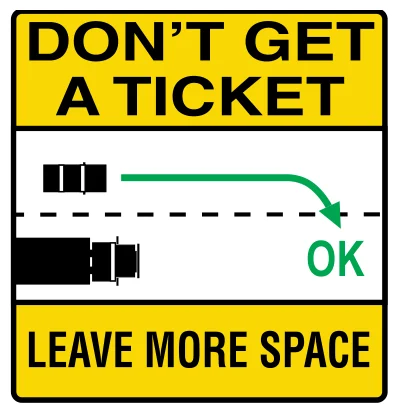
A truck ahead signals a right turn but swings left first. You're also turning right. Don't slip into the gap between the truck and the curb. Wait behind it until it finishes the turn, then make yours.
Check your understanding
Read the question, decide on an answer, then open it to check the explanation. These are Roadwise study questions based on the source handbook.
If you can't see the driver of a large vehicle in their side mirror, this means:
You are following too closely, but the driver can still see you
The driver can't see you either
It has no effect on visibility between vehicles
The driver sees you in the other mirror
Answer: The driver can't see you either
If you can't see their mirror, they can't see you.